Showing posts with label Portugal. Show all posts

Thursday, 25 August 2022

The Six Nations waste potential to power rugby's growth

[This is a follow up post to a previous one about how the RWC has been the main driver of global growth over the past 20 years]

One may look at Italy and their results over the past 9 years and ask "How has being in the Six Nations helped them? They constantly lose". It is not often you see this point made, but in actual fact Italy has benefited MASSIVELY by being added to the Six Nations.

To understand this properly you need to think of the counterfactual where Italy were ignored by the Six Nations and remained a "Tier 2" side in the REC. In this hypothetical world all the following things would have most likely been different:

  • They would not have the annual budget of all the top five REC sides Georgia, Romania, Spain, Portugal, & Netherlands combined.
  • As a result not had the money for professional teams in the URC.
  • More often played at far smaller stadiums with far smaller crowds.
  • Not had the money to invest so much in improving what was a weak youth system.
  • Nor the regular international competition for that youth to test themselves.
  • Nor would they have the full 3 votes on the World Rugby Council.
  • Selection would have less consistency and involve more negotiation with clubs.
  • Nor would have they been able to select anywhere near the level of foreign imports and heritage players they have managed to get available over the years (over the 2003-2013 period this was a high percentage of their most significant players).
  • And may have very likely got caught fielding ineligible players and like Spain got booted out of a RWC by Russian sleuths if they played in REC too.

It is true Italy's wooden spoon collection has hardly made them the ideal example of how entry to the Six Nations can grow the sport. But that is only if you ignore what the Six Nations prevented them most becoming: a mid-table REC side probably 5 or 6 places lower in the rankings than they are today and without the ability to invest so much in improving youth.

The more you think about this. The more totally obvious it becomes. Of course Italian rugby is much better and richer than it would be otherwise outside the Six Nations. It is for this reason any suggestion they voluntarily put their place at risk in a relegation playoff is a non-starter.

Despite many losses Italy's participation in the Six
Nations has still boosted their level immensely.
Sadly for the sport though few appear to have properly understood this and been able to follow the logical implications of how spreading some of those same benefits of the Six Nations to others would grow the game on the rest of the continent. Instead after every bad result over the last 8 years we have more often heard useless talk of kicking Italy out of the Six Nations (a truly terrible idea that would risk setting them back years).

People now just assume if Georgia or Portugal were added to the Six Nations they would just be another Italy. However much like when the RFU wanted to exclude both those nations from the 2007 World Cup. This is a hopelessly short termist growth killing viewpoint.

Instead what they should be thinking is: "Georgia and Portugal are pushing Italy hard to close and exciting competitive games despite having only a fraction of their budget. Imagine how much more they could grow if the Six Nations opened its doors and they were able to get considerably more funding and experience".

Also: "Spain got a crowd of 40,000 for an exhibition game. There is huge growth potential there. Imagine how much stronger they could be with the budget to maintain a more consistent selection and retain homegrown players like Lucas Paulos and Samu Ezeala. Plus add heritage players the level of Joris Segonds or Rémy Baget like Italy has always been able to do with the likes of Parisse and Castrogiovanni, or in more recently Polledri and Capuozzo".

Lamentably though it is doubtful any thoughts along those lines crossed the mind of a single one of the Six Nations blazers this summer. And that is why the sport struggles to grow.

Georgia and other REC nations compete with a
fraction of the budget of Italy and other "Tier 1". 

Instead of encouraging and inviting growth. The vague alternative idea seems to be that "Tier 1" plays "Tier 2" occasionally in friendlies. And for a team like Georgia to ever join the Six Nations they must follow the same model as Italy and work their way into the tournament through a few wins in those friendlies until they can no longer be ignored (it is sort of the libertarian "pull yourself up by your bootstraps" line of thinking).

This idea basically means Georgia (or any other REC side) is asked to beat Six Nations sides despite having a fraction of the budget, a fraction of the professional player pool, a fraction of the top level experience, and those occasional matches when they happen most often being played away from home.

Unfortunately some clueless people think this is the best and most efficient way to grow the sport. Instead of expanding the Six Nations and enabling them to build a better budget, player pool, and experience to be able to compete. They are asked to perform a miracle only possible with a one off "golden generation" (which would then be wasted as they'd have spent entire careers playing those friendlies and be retired by the time they ever got into the tournament).

When discussing Georgia and the Six Nations. You will commonly hear something along the lines of "yeah, they should get chance of some more "Tier 1" games, but not the Six Nations". Whilst on the surface this may sound supportive, in reality it maintains the vastly uneven playing field and is basically just fobbing them off. Anyone who repeats that line with no plan of Six Nations expansion attached is not genuinely serious about growing the sport.

Expecting teams to repeat Italy's early professional
era wins over Five Nations sides is unrealistic and
ignorant of how international rugby has changed.
(Note: The comparison to Italy c.1997-98 is utterly flawed for another reason. In those barely just turned pro years of the sport. Scotland (at home) could lose 68-10, France (at home) could lose 52-10, and Wales could lose 96-13 versus South Africa. Ireland (at home) could lose 63-15, England could lose 64-22, and Argentina could lose 93-8 versus New Zealand. Never in the history of the sport was the gap between 5N and SANZAR bigger. Nowadays the international landscape is totally different. It is simply not a fair comparison for example to compare Georgia playing Ireland in 2022 to Italy playing Ireland in 1997).

Expansion can be in the interests of "Tier 1" too

Obviously expansion to the Six Nations should be in the interests of every REC nation and anyone who genuinely cares about growing the sport (a lot of fans may say they do but when it comes to applying the necessary changes needed very clearly don't).

But there is another reason why expansion and involvement of "Tier 2" in big events ought to be in the interests of "Tier 1" instead of just playing "Tier 2" in friendlies.

Anyone who has followed rugby long enough should know vaguely supportive promises of "more games for Tier 2 between World Cups" are far from reliable. In 2017 World Rugby pledged to increase "Tier 1 vs Tier 2" matches by 39% over 2020-32. However pretty much the status quo remains (four SANZAAR sides play four of the Six Nations sides on a July/November weekend with the two left over Six Nations playing a "Tier 2" nation).

Reason for little change is obvious. Those friendlies are on some level fundraisers. The biggest draws are the biggest brands (ie All Blacks). When it comes down to it, no "Tier 1" side is volunteering to play two rather one "Tier 2" side in November. For matches involving less established teams to attain high commercial value it requires attachment to a big brand event.

A perfect example of this is the last three matches between Fiji and Uruguay. Despite being one of the lower profile games shifted to midweek, in 2015 and 2019 the fixture sold out stadiums in both Milton Keynes and Kamaishi which were broadcast to global audiences on TV. By contrast in 2018 they played a November friendly at Hartpury College and the crowd was in three figures and only streamed on YouTube. Many of those fans did not come for Fiji vs Uruguay specifically. They came to see the RWC.

Ireland vs Romania sold out Wembley to set
the record crowd of 89,267 for a RWC match.
Similarly in 2015 when we saw Ireland vs Romania sell out Wembley to set the RWC attendance record of 89,267. It was not Romania that were a huge draw per se. Again it was the RWC as an event that sold.

The Six Nations as an event has a similar effect in selling the matches involving a somewhat lower profile team in Italy. We can see this by comparing the fixtures involving Italy in the Six Nations and the exact same fixtures when played as friendlies in RWC warm ups.

2003 RWC warm ups:
25,000 vs Scotland in Edinburgh (20,000 fewer than previous fixture in the Six Nations)
14,000 vs Ireland in Limerick (35,000 fewer than previous fixture in the Six Nations)

2007 RWC warm ups:
14,000 vs Ireland in Belfast (35,000 fewer than previous fixture in the Six Nations)

2011 RWC warm ups:
20,000 vs Scotland in Edinburgh (22,000 fewer than previous fixture in the Six Nations)

2015 RWC warm ups:
10,000 vs Scotland in Torino (56,000 fewer than previous fixture in the Six Nations)
43,000 vs Scotland in Edinburgh (19,000 fewer than previous fixture in the Six Nations)
52,000 vs Wales in Cardiff (14,000 fewer than previous fixture in the Six Nations)

2019 RWC warm ups:
30,000 vs Ireland in Dublin (21,000 fewer than previous fixture in the Six Nations)  
25,000 vs France in Paris (25,000 fewer than previous fixture in the Six Nations)
50,000 vs England in Newcastle (32,000 fewer than previous fixture in the Six Nations)

Some of those crowds are good (50,000 in Newcastle or Cardiff). But still on average across those 10 friendlies Italy games sold 28,000 fewer tickets per match at presumably lower prices and lower TV rights than they did in the corresponding Six Nations fixture. The largest effect is seen in Italy itself, who attract far better numbers for the Six Nations than friendlies.

To be fair "Tier 1" Six Nations sides (besides Italy) get quite healthy crowds these days hosting their annual "Tier 2" fixture in November, but those matches are still obviously of much higher commercial value as part of big events than friendlies.

If the Six Nations would be willing to think long term there is also the larger potential future pay off in creating more competitive teams with bigger fanbases, and having a tournament with more matches to sell, which allows for more possible exposure for sponsors and larger TV deals. The modern day RWC has grown more lucrative as an event for these reasons and Six Nations could too. "Tier 2" growth should not have to come at expense of "Tier 1".

Conclusion: Six Nations has huge potential power to grow the sport in Europe that it is wasting. As seen at the RWC, most growth comes from expanding major tournaments, not from friendlies.

"Tier 1" blazers take the view that the big mid-RWC events must ultra exclusive to themselves, and they will "grow the game" with the odd friendly. This gets it totally back to front. It is the big events that make the biggest impact in growing the sport and should aim to be inclusive. Then you can leave sides to organise friendlies and three match test series mostly as they please.

For rugby to grow, and one day fully shed its "Tier" tags, it is crucial that its administrators open their minds to the idea of expansion of the major mid-RWC event. There are huge potential gains to be made throughout the continent from an expanded European Championship event (maybe once every four years similar to football). Especially for all those labelled "Tier 2" of course, but long term also "Tier 1" as well.

It is incredibly frustrating the Six Nations with their total lack of vision and desire for growth fail to see this. European expansion should be seen as a great opportunity for the sport, where unlike the USA there is a more open niche available for full contact team sport, but it gets ignored and wasted as "Tier 2" sides remain asked to compete at enormous financial and competitive disadvantages in perpetuity. Rugby has to look at where successful examples of growth have come at RWCs and apply those lessons to their other major events.

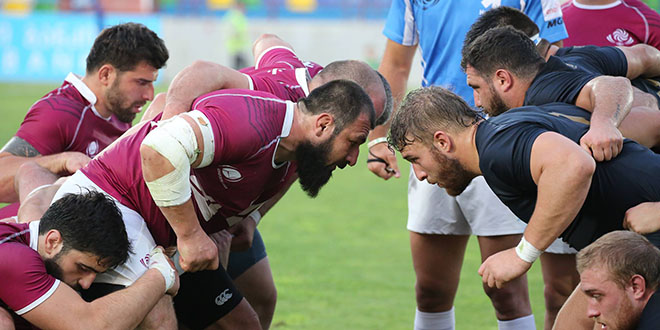
Video: Everything Georgia captain Merab Sharikadze says here is spot on. "Rugby must be more open".

Wednesday, 24 August 2022

Six examples of how RWC has powered rugby's global growth

Major changes to the hierarchy of international rugby generally occur at a glacial speed. However it is worth looking at some of the biggest success stories of where increases in growth and popularity have happened outside the "foundation Unions" (made up of the old Five Nations and Tri Nations) from over the past 20 or so years.

A common theme in each of these examples is that every single one illustrates the pivotal role the World Cup has had in driving of the sport's growth and expansion in new areas.   

Argentina (1999 & 2007)

Argentina, just like most of the Five Nations, suffered their record heaviest defeat in the early professional era period (where SANZAR professionalised earlier) when in 1997 an amateur side got thrashed 93-8 by New Zealand. It was obvious mostly amateur players would no longer compete with these teams.

Fortunately though a special generation of Argentines born 1973-77 would all emerge at roughly the same time and form the core of the team for the next three World Cups. (Agustín Pichot, Mario Ledesma, Felipe Contepomi, Rodrigo Roncero, Martín Scelzo, Ignacio Fernández Lobbe, Gonzalo Longo, Diego Albanese, Ignacio Corleto, Manuel Contepomi).

Prior to 1999, Los Pumas had disappointingly only won 1 out 9 of their previous RWC games (vs Italy in 1987). This generation changed that. Upsetting Ireland to reach the quarter finals for the first time and firmly putting Argentine rugby on the world map. In the 18 months or so afterwards, the squad was transformed from only having two or three professional players to nearly an entire team playing at a high level in France or England.

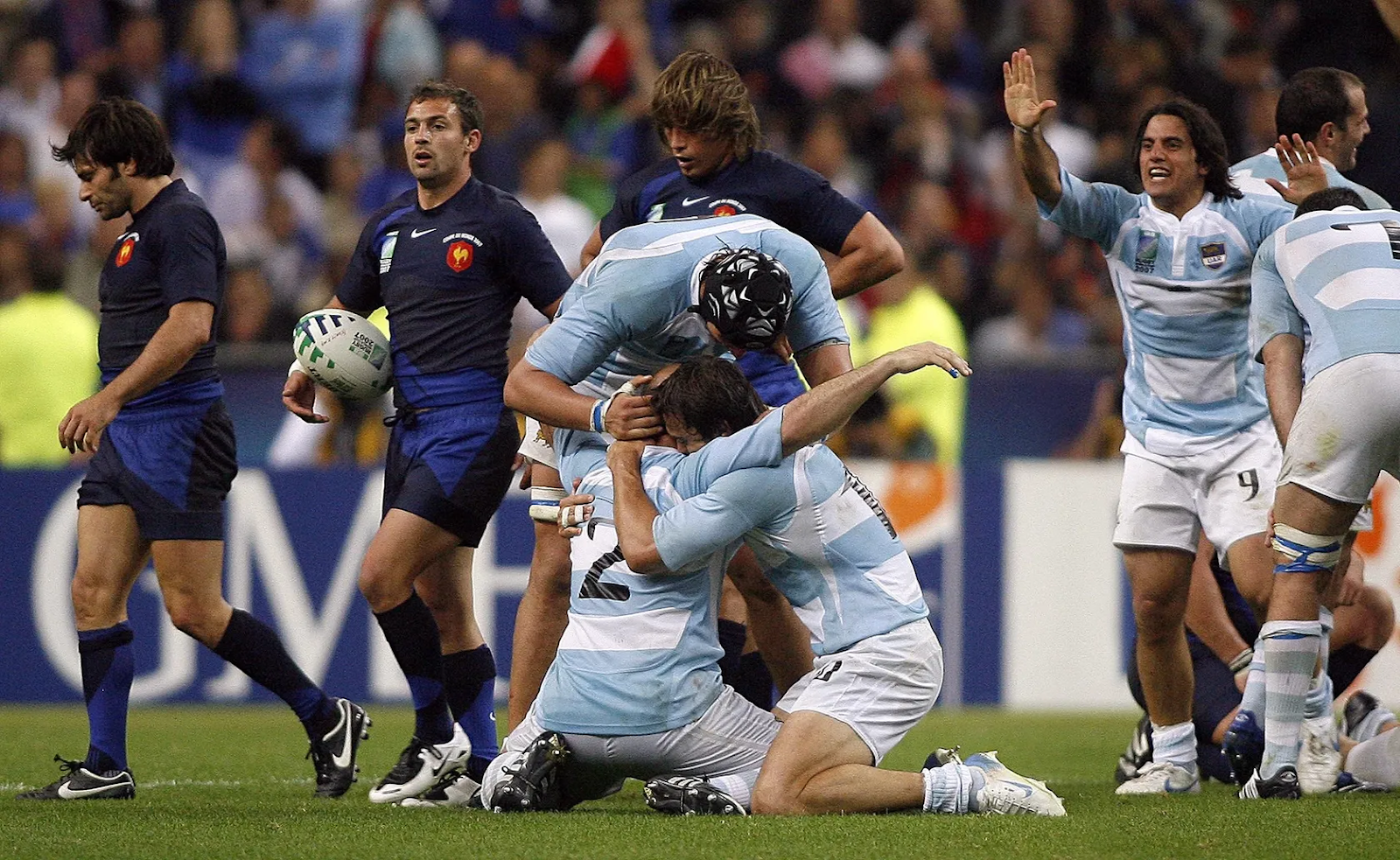
Argentina shock France in the opening game of RWC 2007
That first stage of growth led to the second stage when a more experienced team showed up at RWC 2007 and did even better. In a "pool of death" with #1 and #2 of that year's Six Nations, Los Pumas shocked France in the opening game of their home World Cup, then swept aside Ireland to top the pool, and went onto reach the semi finals and win the bronze medal.

Argentina had achieved some big results before (they had beaten all the Six Nations over that four cycle including an away win at Twickenham). However it was this World Cup that captured the public imagination of the country like never before. It was in this tournament this generation confirmed a legacy for future growth.

This is shown today by how the sport has spread across the country. In 2007, 26 of the 30 man squad were from Buenos Aires. Now 13 of the 23 that beat the All Blacks, and all 7 try scorers in their recent record win over the Wallabies, were from other parts of the country. Both those matches were in the Rugby Championship, where the overdue Argentine inclusion was another legacy from that generation's achievement.

Georgia (2007)

To understand how much Georgian rugby has evolved. It always worth going back to this description from The Guardian of their team at the 2003 World Cup.

There was a buzz of excitement in the Georgia camp last week as they rounded off their final training runs at La Grande Motte on the shores of the Mediterranean in southern France.

At last, the 30 members of Georgia's World Cup squad were to receive their first official piece of equipment: tracksuits, paid for by their coach, the Frenchman Claude Saurel, and the other team officials, who had all chipped in to ensure that the players would have at least one piece of equipment in common before they arrived in Australia.

The former Béziers coach and Languedoc winegrower has also forked out for a video camera, computer and tape machine in an attempt to replicate the sophisticated analysis systems now used by major international teams.

"We are light years behind teams like England or France but we realise there is nothing much we can do about it," confided Gregoire Yachvili, the Georgian flanker whose brother, Dimitri, is the scrum-half for France.

"There is no point in our getting obsessed by the logistical and financial difficulties; we just have to get on and do our best. We might not have any tackle-bags, we have no body armour and we have to borrow a scrum machine, but we've got a ball, we've got a pitch to play on, and two teams of players... What else do you need to train for a game of rugby?"

Even more disastrous for the Georgians has been the ad hoc nature of their build-up. A training camp in the mountains of Georgia and a two-match tour of Canada were reluctantly cancelled in July for financial reasons.

At this point Georgian rugby had almost nothing but got by just from natural talent and predisposition for the rough and tumble of the sport along with the helpful generosity of coach Claude Saurel (who used his contacts to first open the doors for Georgian players to play in France - initially in lower leagues but gradually more in higher teams).

Georgia powering to their first RWC win in 2007
Still going in to RWC 2007 there were reports of only eight pitches in the country. But this tournament was a turning point where they most famously came ever so close beating Ireland (indeed they really should won that match). They were also only 6-3 behind vs Argentina at 45 minutes, and resoundingly recorded their first RWC win 30-0 vs Namibia.

It was after this the Georgian government and politicians took notice and started to support the side. In particular from 2008 the Cartu Foundation started investing heavily in improving infrastructure. This enabled the new generation of young kids inspired by Gorgodze to play the sport to enjoy facilities a world apart from what the earlier players in the 2000s had.

The result is Georgia is now one of the leading producers of young talent outside "Tier 1", and have established themselves as the top side of the REC, with a far stronger, more skilled, and professional group of players many of which now star in Top 14 or Pro D2.

Portugal (2007)

Heading into their first World Cup back in 2007. Portugal were supposed to be the exemplar of a team World Rugby wanted to boot out as they planned to cut the tournament back to 16 teams for 2011.

BBC Sport's tournament preview listed their weaknesses as "pretty much everything" and that "hopefully the mismatches they face will not end in serious injury". In The Guardian veteran BBC radio commentator Iain Robertson argued passionately against their presence at the event stating "there is a serious risk to the physical welfare of the Portuguese players" and "it will be an embarrassment for rugby". This was a commonly repeated sentiment at the time among journalists.

Portugal's passionate anthem singing at RWC 2007
In the end whilst they did suffer the largest defeat of that tournament (108-13 against a ruthless all time great All Blacks team), the team won over many spectators with the passion and heart they showed despite their limitations, and their fans in the stands never stopped cheering for them throughout the match. Every single Portuguese player and staff still reflects back on the match as an amazing experience.

Also despite being given least rest time of any team in the tournament they competed above expectation in other matches. They were only 16-5 down to Italy after 65 minutes before fading and conceding two late tries, and led Romania for 71 minutes before losing 14-10 to another late try.

They defied those predictions of how their matches could be "an embarrassment for rugby" and many fans enjoyed watching them play and now argued in favour of keeping sides like them in the tournament. More importantly, their efforts also led to an immediate surge of interest in the sport at home, with large numbers of more kids turning up to play.

Although in the following years they dropped down the rankings, reaching a low in 2016 with relegation from the REC, the legacy of that 2007 World Cup team lived on. As around 10 years later many of those kids who were inspired to take up the sport around that time became part of the growth of Portuguese youth rugby which started performing well above its senior ranking and nearly reaching promotion to the U20 Championship.

A number of those U20 players from 2017-19 were quickly promoted to the senior team, and along with some added French experience, now form the basis of one of the most exciting young teams on the "Tier 2" scene, and who in the past year have nearly upset Japan, Georgia, Italy, and were within 10 seconds of qualifying directly for the RWC ("nearly" is a word they will be so desperate not to hear again this November in the Repechage). 

Japan (2015)

The interest in Japanese rugby had long dwindled in the modern era. When in 2009 they were awarded hosting rights to the 2019 World Cup, there was some concern about whether they could fill the grounds for all the smaller matches. Unless a "Tier 1" team came to visit (which was rare - Japan did not host them a single "Tier 1" test between 2005 and 2013), crowds were usually very modest for their usual Pacific Nations Cup matches.

The moment that changed Japanese rugby forever
Then everything changed in September 2015 when Japan shocked the world with the biggest upset in World Cup history against the Springboks. After many years of humiliation against the leading teams on the big stage, Japanese rugby became an overnight sensation and interest instantly boomed with the Brave Blossoms matches attracting some huge TV viewing figures.

A hypothetical win over South Africa in a friendly outside the World Cup would have been equally shocking, but the magnitude of the enormous effect it had on the Japanese public was so much more for the result coming at the sport's showpiece event when the entire world's attention on that match.

If you ever play the match of your life and stage a monumental upset. It is always best to do it on the world stage with every rugby fan watching. One huge match at a World Cup can change everything and leave a legacy.

Not everything has necessarily been perfect in capitalising on that success. but regardless the level of interest remains miles above what it was before 2015 and that momentous match in Brighton, and in the end nobody needed to have worried about the World Cup as the Japanese crowd enthusiastically packed every stadium for every match.

The impact of this match (followed by the repeated heroics at their home RWC four years later) could still be felt more further down the road if the increase in young kids inspired to start rugby as a result of it later brings its benefits to senior level.   

Uruguay (2015)

Uruguay's win over Russia in 2014 has ended up
being significant for all of South American rugby
Uruguay reached the World Cup in 1999 and 2003, but it was their return to the tournament after defeating Russia in 2014 that led to major growth and change to the sport in the country. Indeed that match in Montevideo may be one of the most significantly important matches in South American rugby history.

Heading into RWC 2015 they proudly talking of their amateur status. Afterwards, with the unlocked funding and ambition they gained from the tournament, they launched a new era under coach Esteban Meneses.

This involved leading players signing up to a more professional High Performance system and better schedule of matches. Although it was not all plain sailing (they had miserable November tours in 2016 and 2018), they arrived at the 2019 World Cup a far better prepared outfit having qualified without needing to go through the Repechage and beaten all the four national teams in the now defunct Americas Rugby Championship that year.

Los Teros played three of the same opponents (Wales, Australia, Fiji) in 2019 as they did in 2015. In every match they were more competitive than they had been four years earlier. Improving from an 166-27 aggregate score against them to an 107-53 aggregate score. This of course included their all time best ever result with the upset vs Fiji.

That improved level Uruguay showed in 2019 would never have been possible if they hadn't qualified beating Russia in 2014 first. Their success then added to the entire South American rugby ecosystem and with that came another bonus bit of growth as well.

If Uruguay didn't reach RWC 2015 it is far less likely the new South American domestic league SLAR would have launched in 2020, and if that league had not launched it is likely Chile would never have been able to obtain a more professional High Performance system of their own, and without that their defeat of the USA to become the biggest surprise qualifier in recent World Cup history would not have likely been possible. 

USA (1999-2019)

This case is a bit different to all the others mentioned here. USA Rugby is far from at its highest point, and cannot be said to have made the level of progress some may have hoped. There is a good chance they may even not qualify for the World Cup next year.

Would USA's historic win over Scotland have
happened if they had missed RWCs for over 20 years?
However they are still a success story of the World Cup in that it has prevented decline as much as helped growth. To understand this you need to ask yourself a counterfactual. What would the state of USA Rugby look like today if the tournament had never expanded and remained at 16 teams and Canada kept the Eagles out of the event for over 20 years? (2019 was the first time USA beat Canada to take the Americas qualifying spot).

My guess is that they would probably be about several years behind where they are now. The Major League Rugby project would be not yet be in existence. Nor would have they got that historic win over Scotland in 2018. And probably can forget about the plan for them to host the World Cup in 2031. Rugby League may have even seen an opportunity to attempt targeting them as a region where Union was weaker.

(Similarly when looking at Italy in the Six Nations. They may not have been great, but in the counterfactual world where they were ignored by the Five Nations like Romania in the 1980s, they would have likely fallen to the level of a mid-table REC side and had none of the money to invest in improving their youth which now so looks to promising for a brighter future).

Some have hypothesised World Rugby expanded to 20 teams in 1999 to keep the USA involved after were left out for the first time in 1995. There are no direct quotes saying this was the reason, and there were plans in the 2000s to reduce the format to leave them out again, but if it was the reason it was a sensible one. Now there is a speculation among fans if them missing out again in 2023 will lead WR to hurry up and increase to 24 teams for 2027 not 2031.

Conclusion: RWC is the key driver of the sport's growth and must be understood as investment for the FUTURE not the just the present


Nothing else over the past 20 years has been as consistently proven to significantly grow the sport outside the old Five Nations and Tri Nations sides as the World Cup.

The most important lesson to learn though is the Rugby World Cup is about the future as much as the present. This is relevant to today's discussions over potential expansion to a 24 team tournament.

For much of the 2000s there were frequent discussions over mismatches at the tournament. In 2002 the RFU bid for the 2007 World Cup with a plan to cut it down to 16 teams. That failed as France won the bid and kept the 20 team format, but World Rugby again initially planned to reduce the tournament to 16 for 2011.

Portugal vs Georgia this year would have likely been
of a much lower standard if the short termist RFU had
gotten their way and cut them both out of RWC 2007
We can now see just how disastrously short termist those plans were. If the RFU had won that bid and enacted their plan neither Georgia or Portugal would have been at the 2007 World Cup. The investment since 2008 in Georgian rugby simply would not have happened. Some of those kids who took up rugby in Portugal and now are playing such good rugby for the national team may have never picked up the sport.

RWCs also serve as a good arena for talent to get noticed. For example USA vs South Africa match in 2007 launched two successful pro careers. Chris Wyles, who was unattached and on the verge of quitting rugby, got noticed by Eddie Jones and signed by Saracens. Whilst Takudzwa Ngwenya famously scorched Bryan Habana for one of the best tries in RWC history which led to a move to Biarritz. Both players went on to strengthen the Eagles across three World Cups. If RFU had their way none of that would have happened.


Similarly if they reduced to 16 teams Uruguay would have never qualified in 2015. Much of their progress over the next four year cycle would not have been possible, nor the improvements that spilled over to Chile over this four year cycle.

Even some of the sides that did still reach World Cups may have been negatively effected as the entire "Tier 2" global rugby ecosystem would have been weakened. A side like Japan would have still qualified, but their preparation for each tournament would have suffered from several of their opponents having made less progress.

Thankfully improved performances from "Tier 2" in 2007 changed minds on this issue. Not many talk of reducing to 16 teams any more, but now World Rugby remain wary of increasing to 24 teams for same reasons they were constantly thinking of cutting back to 16 in the 2000s.

It is true that total wipeouts are not desirable and you don't want to see too many. But fans and administrators also need to understand short term pain for long term gain. Georgia needed to first play 2003 to be the side that recently thrashed Scotland at U20 level. Portugal needed to play 2007 to be the exciting team they are today. Uruguay needed to first play 2015 to be more competitive in 2019 and Chile needed that to qualify for 2023.

Stories of growth like these are why World Rugby should stop being overly cautious about increasing to 24 teams for the 2027 World Cup. The tournament is the vehicle that has produced most of the sport's growth over the professional era and they have to think about expanding for the potential pay off in the future and not solely focus on the present.

Tuesday, 28 January 2020

REC 2020 preview

Image result for Georgia Russia 2019 rugby

A short preview looking at the state of play ahead the REC in 2020.


The dominant force of the tournament Georgia have seen coach Milton Haig depart after 8 years in charge, but their squad does not have a new era feel to it. Still yet to appoint a new head coach, they are being led on a caretaker basis by the former defence coach under Haig, Levan Maisashvili.

Image result for davit kacharava
Veterans like Kacharava are continuing post-RWC
Only in charge for five matches, he has deemed this too little time to consider any longer term plans, and opted to keep almost all the veterans who you may have expected to retire after the RWC. So for the Lelos this tournament's main objective will be simply to maintain their dominance on the competition and possibly give players like 35 year old Davit Kacharava or Shalva Sutiashvili fitting farewells in front of home fans.

---

Likely the trickiest obstacle for a third consecutive Grand Slam is an away trip to Spain, where on their last visit in 2017 Georgia trailed at half time, and for the past two years looked unconvincing in having to rely on scrummaging dominance to secure ugly home wins against opponents not at full strength.

In 2019 Spain found a habit of being on the right side of some tight results winning four REC matches for the first time and going on an unbeaten tour of Tier 2 South America. Now they approach tougher challenges travelling to Russia and Romania, and a home game vs Georgia fully believing they can win.
Image result for espana hong kong rugby
Spain won 8 out of 9 tests in 2019

Injury and unavailability is the norm with Spanish selection and they are not full strength without Charly Malie, Marco Pinto, Asier Usarraga, Mickael de Marco, Alvar Gimeno, Facundo Munilla (although they do have some interesting new additions on residency or heritage or from their U20s). Another successful REC campaign in spite of that would be a great achievement for Santiago Santos' team.

---

Looking to stop Spain's winning run are Russia, who were the oldest squad at the recent RWC, but like Georgia most of their veteran players have not retired and been retained by Lyn Jones.

The Bears have been consistently mid-table finishing either 3rd or 4th every single year since 2010. This year playing both Spain and Romania at home, they have as good an opportunity as ever to change that, although it must be said they are a team that was old before and not getting much younger.
Image result for kaliningrad stadium rugby
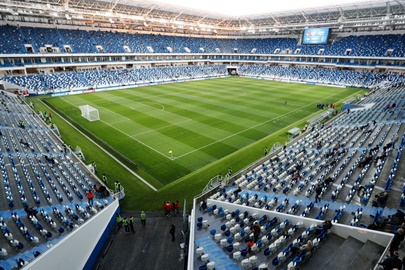
Kaliningrad is to host their first REC match

One of the most interesting aspects of Russia's REC campaign this year will be them playing their first match in Kaliningrad against Portugal. The city superbly hosted last year's Rugby Europe U18 Championship and if successful could be a superior winter base for them with far better support than one man and a dog in Sochi (which is now hosting a game at the 47,659 Fisht Olympic Stadium).

---

Under new leadership this year are Romania with Andy Robinson. He has a mixed head coaching record and comes into this job after three years out of the game following dismal failure at Bristol. However he has a reputation as a good technical coach (but poor selector or recruiter), and one of the best successes of his career was repairing a bare bones Edinburgh squad in 2007 to 2009. If committed it is possible he could be a good fit for this Romania job where "upskilling" players is more the challenge than selection.

Several of the 1986 generation is still going (and Andrei Radoi comes out of international retirement), but the Oaks seem to have abandoned betting on residency players, and selected more young players than they have for some time (although now they are coming out of Romania's worst ever U20s).
Image result for Andy Robinson romania rugby
New Romania coach Andy Robinson

For years the great rival for the REC with Georgia, their hopes of winning the Antim Cup away in their opening game in Tbilisi have never been slimmer, instead the focus for Romania this year is on redeveloping a squad and finding new players ready to play key roles in their RWC qualifying campaign starting next year.

---

Below the top four are Belgium who come into this tournament on poor form. Their away form has been a total joke for a while, but even at home they have failed to match some of their past success. Losing badly at home to Romania last year, and more recently to a very average Hong Kong team.

Their strategy will as last year be to focus mainly on just one game against their most likely relegation rival Portugal. This will be first up, and unfortunately for Belgium also away from home, so to stay up they will have to do something they've never done before and win an REC game outside Brussels.

---

Rejoining the REC for the first time in four years are the 2003 Grand Slam winners Portugal who after winning the RET with ease finally beat Germany in the playoff.

Os Lobos have played few higher ranked opponents over the past couple of years so this will be an interesting challenge for a team that almost resembles a University side in its youth (although has now added experienced Top 14 players Samuel Marques and Geoffrey Moise after long absences).

Beating Belgium to avoid bottom place is the priority, and although somewhat unlikely to finish in the top half, they do have some talent and carry an unknown quantity element that could surprise and give a hard test to at least one of the more experienced and higher ranked sides.

---

Below the REC the RET also continues but the winner at this point seems very likely to be the Netherlands having already resoundingly beaten a very weak Germany team 37-7. The Dutch, barring a giant choke, will face probably the loser of Portugal vs Belgium in a summer playoff where they could return to the REC for the first time since they were relegated way back in 2002.

---

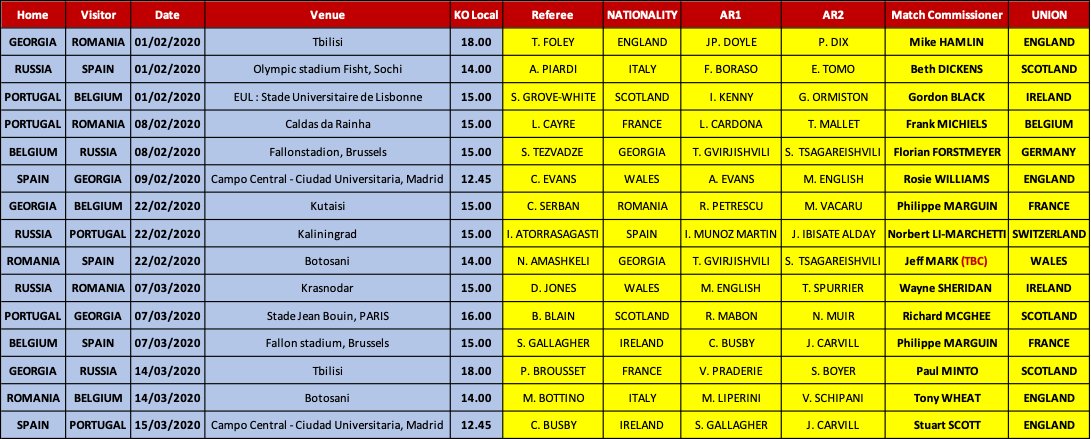
Rugby Europe Championship schedule 2020:


Image

Sunday, 7 April 2019

The big difference between Spanish and Portuguese rugby

If you were to name the top few prospects coming from Spain you would get names from almost every major region coming from several different clubs. Madrid (Lucas Paulos, Gonzalo López), Catalonia (Samu Ezeala), Valencia (Alvar Gimeno), Valladolid (Martín Alonso, Juan Martínez), Basque Country (Kerman Aurrekoetxea), or Andalusia (Josh Peters, Tomás Munilla).

Indeed looking at the recent 26 man U20 squad it featured players from 16 different clubs spread in various parts in the country. If you were to add the U18s, the extended squad, along with the clubs abroad who have signed players to offer possible opportunity to further develop in professional rugby to the list of clubs contributing players for Spain grows even longer.

This puts Spain notably in direct contrast to some other Tier 2 nations more focused around certain areas including their big rival at age grade level Portugal. Whilst Spain's age grade sides have featured players from many clubs including those in lower divisions, Portugal's team was nearly entirely from (24 out of 26 players with RC Montemor the exception) just those from the main domestic league.

Portugal U20 this year have just one player from the country's second biggest city Porto with the vast majority of the team all based in or near Lisbon. The starting XV they fielded for the Rugby Europe U20 Trophy qualifying final was all within an hour's drive of each other (according to Google).


Map illustrating the location of clubs providing players to Portugal & Spain's U20 teams this year

Another nation which has even an more narrowly based talent pool is Uruguay. Every year their squad is provided for by the same few clubs all less than an hour drive of each other. If you look at their U20 squad from last year, 16 of their 26 man squad were provided by just two clubs. The sole exception in being some distance away from Montevideo was Dolores Rugby Club in Soriano (a club whose success has been in producing the props of this year's Los Teritos group Ezequiel Ramos and Reinaldo Piussi).


Map illustrating the location of clubs providing to Uruguay's U20 squad in 2018

There are obvious advantages in terms of feasibility of regular training camps and preparation in countries like Portugal and Uruguay with such a close playing base and very few players moving abroad. That has very likely been a factor of them overachieving especially at junior level in picking up some notable scalps you would probably not expect their senior team to be able to do.

After disappointment of another loss this weekend in Rugby Europe U20 Trophy qualifying to Portugal (who could not have wished for more ideal slippery conditions to play perfectly in their favour), some in Spain may complain of the lack of preparation they can afford relative to their Iberian rival.

However longer term moving forward to senior level their position looks to be the stronger and with a higher ceiling for potential progress than those more tightknit closely prepared squads. To get to the highest level requires identifying best talent from as wide a range as possible, plus some having the ambition to move abroad, even if it comes with a trade off with less training time as a squad.

Tuesday, 29 January 2019

Is there a worthwhile future for the REC clubs in the Challenge Cup?

Prior to 2014 the Challenge Cup featured six clubs outside the three main European leagues. This was a point of frustration for many as there was a feeling they were selected poorly. They included four Italian clubs along with two others, the Bucharest Wolves, along with often a mid table Spanish side as the top side didn't have the money or desire to compete, or for one season a Portuguese selection.

For selection sides like Bucharest Wolves assembling with little preparation for two week blocks to take on much more cohesive club sides was not ideal. The Spanish side wasn't even the best in Spain. Whilst Georgian and Russian representation was being omitted despite usually beating Iberian opponents internationally and the latter clearly having some stronger clubs than those that were competing.

Meanwhile the Italian clubs were remarkably poor. Calvisano were the Italian league champions in 2013/14, yet still lost home and away to the Bucharest Wolves. Even Bizkaia Gernika in 2012/13, despite qualifying on the back of a sixth place domestic league finish still beat Rovigo home and away.
Image result for Енисей-СТМ
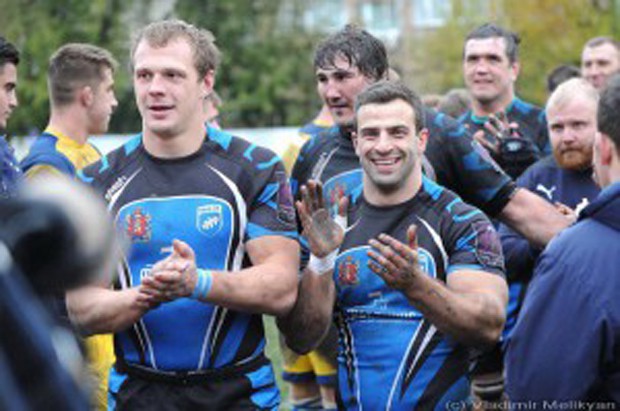
Enisey-STM players celebrate their
win 19-12 over Worcester in 2016

The change in 2014 which introduced the Continental Shield and opened up the Challenge Cup to a meritocratic qualifying basis was much welcomed. However it hasn't quite turned out as has hoped.

Initially the Russian clubs which were full of internationals and strengthened by experienced players from across Eastern Europe backed up what many had thought. In their first European campaign in 2015/16 Enisey-STM took two scalps from major leagues in Brive (10-7) and Newcastle (24-7). Away trips were trickier, their worst loss was 55-7 in Newcastle, but in light of this season you would take that as a worst result.

The following season they also beat Worcester (19-12) and the Dragons (38-18), whilst only had one loss over 40 pts in their last match away to Worcester (57-14). Their average scoreline over the first two seasons was 14-32. They were winning more often than they conceding over 50+ points.

This was in the context of being new and inexperienced in the competition and with the disadvantage of playing matches in what is their off season and some of the "home" matches being played miles away in Sochi. It was hoped this could be a platform to potentially continue to achieve more credibility and experience on the European stage over the following years.

That has not happened though and their fortunes in the 2018/19 season took a dramatic nosedive. Instead of conceding 50+ pts just once a season, they conceded over that in every match bar one, with even Zebre thrashing them. Whilst they took some scalps in the matches hosted in Russia initially, this season they lost 82-21 to La Rochelle and 65-9 to Bristol. Finally their campaign finished atrociously conceding 17 tries in a 107-19 slaughter in Bristol after an early red card.
Image result for timisoara rovigo rugby
Timisoara beat Italian clubs with ease
to qualify for the Challenge Cup in 2016
but their time actually in the competition
has ended up being utterly forgettable

Meanwhile Timisoara who also at the time had several experienced internationals looked in the qualifying competition like they could possibly perform similarly to Enisey-STM. They were beating Italian clubs in the Continental Shield by clearer margins than the Bucharest Wolves did. Rovigo and Calvisano were the top two teams in the Italian league in 2015/16 and the Romanians beat the former 45-13, and the latter twice home and away over two legs 64-40.

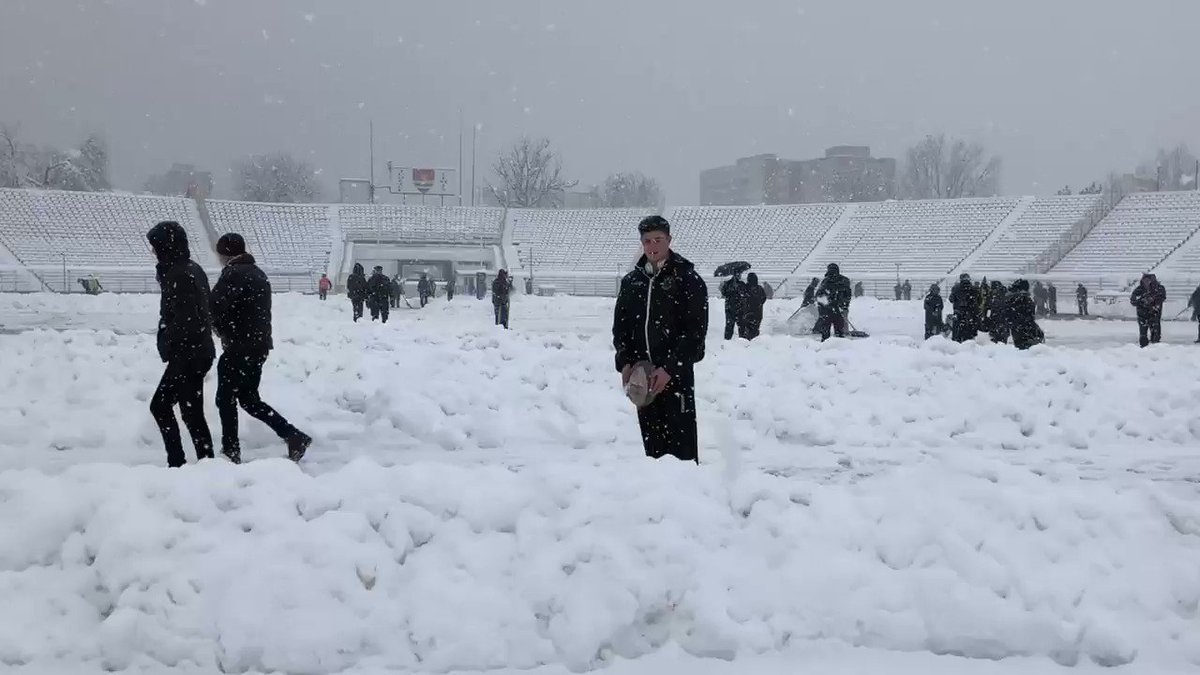
Unfortunately once they reached the Challenge Cup in 2016/17 Timisoara did not at all fare well. Not only were results bad, but they ended up with a sizeable fine for a cancelled match due to snow. There has only been bad news for the club ever since then, with talk of unpaid players and low morale, their main backer reducing investment, and players have been leaving.
Image result for timisoara snow rugby
The snowy pitch that cost Timisoara
yet another €30,000 fine from EPCR

They couldn't qualify for the 2018/19 Challenge Cup on merit getting knocked out by Heidelberger RK, but got through after the Germans were kicked out for ownership conflicts. It was widely expected that they would struggle badly, but in getting hit by yet another fine for a snowy pitch, and then taking 59-3 and 111-3 humiliating hammerings against the Dragons and Bristol it still managed to be a total horror campaign even despite the incredibly low expectations.

The Italians incidentally in the Continental Shield have also done much to alter the view of how having four of them in the old format was certainly not selecting the best possible teams. In the 2016/17 tournament Enisey-STM beat Mogliano 97-7 over two legs, whilst Krasny Yar beat Mogliano 48-24, and Rovigo 42-11. Even German champions Heidelberger RK could beat the Italians and in the 2017/18 season scored wins over the both the top two clubs (Petrarca Padova and Calvisano).

Whilst the Continental Shield also initially seemed a good concept, it has been underwhelming. If you look at the EPCR site you could be forgiven for not realising it existed given the little attention it gets. It has been cut down in size with clubs from Spain, Portugal and Germany all withdrawing due to (likely) financial reasons and possible lack of desire to really compete at Challenge Cup level.

This year there were only two competitors outside of Italy in the Continental Shield, and one of those (a selection side from Belgium the "Belgian Barbarians XV") was hardly prepared at all and was a bit of joke getting annihilated 68-12 and 89-7 home and away to Rovigo.
Image result for enisey stm bristol
The reported crowd at Enisey-STM
vs Bristol at Sochi was a mere 100

These recent results call into question whether there is worthwhile future for the Continental Shield and teams outside the main three European leagues competing in the Challenge Cup right now.

If there was more money to be made either from TV, sponsorship, and a growing fanbase from competing then this would be a non-question. However there does not appear to be much evidence this is the case given the amount of teams who have withdrawn from the Continental Shield. Enisey-STM playing in Sochi drew an attendance reported as small as 100 and was not televised. The probability that Challenge Cup participation right now is a loss maker for these clubs is pretty high.

Image result for Timisoara Northampton
Timisoara's 111-3 annihilation against
Northampton may be the last we see of
them competing in the Challenge Cup
For now it is hard to see any real point from the Romanian perspective at least to continue putting resources towards a series of thumpings and fines for snowy pitches. This is particularly relevant for a club like Timisoara who have reportedly been struggling to pay players and seem in little position to either produce or recruit the amount of talent to compete.

Some have suggested a return to the selection squads like Bucharest Wolves. They were not great (average scoreline in their 2014/15 campaign was 44-13), but at least did not suffer to the degree Timisoara have and get fines for snowy pitches. But again given the state they are in frankly Challenge Cup should not be the priority for Romanian rugby right now. There is also a reasonably strong chance such a side would be much worse in 2020 than they may have been 5 years ago.

As for the Russian clubs their downfall has been slightly more puzzling given a lot of their team getting thumped this season are the same players who were a lot more competitive only a couple years back. However one possibility is fact they are mostly the same team could be part of the problem.

They are not lacking experience, but the core of their squad looks very old and could just be over the hill now at this level. They went into each match this season with a starting XV with an average age of 30 or 31. Half of the XV against Zebre is aged over 32 with a handful veterans over 35.
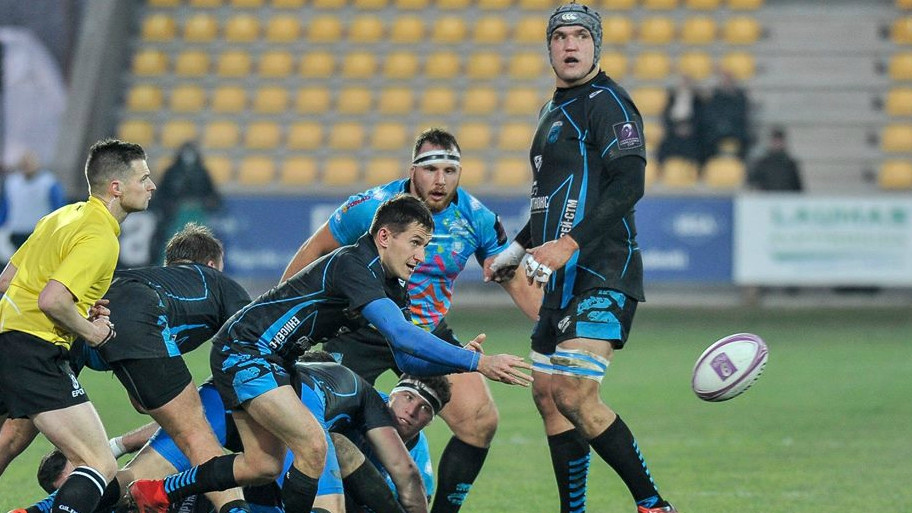
Image result for enisey stm zebre
Enisey-STM have an ageing squad with
an average of 31 that has barely changed
from their debut Challenge Cup season

At that age a couple years difference can be noticeable and several of those players are probably nearing retirement. This is a side 3 or 4 years older than the average professional team, the rotational Bristol team that pasted them had an average age over 5 years younger.

This brings us onto a similar theme. It has escaped so much attention as Romania as it has not to the same degree or been as badly exposed, but Russia too over the past few years have also had a relatively poor time of late at junior level and been struggling to find the quantity of new young talent from those sides to come through and been relying on a core of older players.

Hence why at national team level they were giving a debut to a 34 year old scrum half (who was the 17th member of their U21 side of 2004 of which remarkably 8 players were still active in 2018). Also possibly hence why we see Enisey-STM enter the Challenge Cup this year with what is an ageing squad that has still barely changed since they first entered the competition back in 2015.

Again to reiterate the situation for Russia is not as dismal as it is for Romania but the general theme remains the same. They have neither been able to produce the level of talent to feed into their domestic teams, nor have they been able to recruit it from overseas either.

So what about the teams that have been considerably more successful in producing talent?

Georgia are notably the clear standouts in this regard, but it's also clear their domestic setup is not producing teams to the level to be competitive at the Challenge Cup. The Didi 10 champions from last season Lokomotivi Tbilsi have recently been playing in the Continental Shield against Italian opposition. Three of four matches those were close contests. If they were going to be competitive at the higher level that opposition would pose no problems.

Obviously the Georgian the domestic level is likely to be weakened with a considerable number of their players abroad, but that doesn't tell the whole story though due to the large percentage of those being props. There still actually remains some decent young talent which is feeding into the Didi 10. We saw this with the U20s and in the upset from the young fully Georgian based Georgia XV team vs Argentina XV in the summer (which didn't even include many domestic based international squad members).
roarse
Unlike some other leagues, there has not
been a really dominant team in Georgia
with the top talent spread across clubs and
5 different regular season winners in 5 years

But there has not been a really strong club side in Georgia owing to how dispersed across the Didi 10 that talent is. There are no one or two teams who stockpile the best talent and dominate unlike some other leagues. In November there were 8 domestic based players in the squad across 6 of the teams. Over the past five seasons five different teams have topped the regular season table.

That is in complete contrast to Romania and Russia in recent times. The SuperLiga final has been Timisoara vs Baia Mara in five of the past six seasons. In Russia it has been Enisey-STM vs Krasny Yar for eight consecutive seasons. Also been similar in Japan, up until this year Panasonic and Suntory shared all the past 8 Top League titles between them. That has made their league much more boring, but also meant a side like Enisey (previously at least), or Panasonic and Suntory (on paper clearly the strongest clubs from a Tier 2 nation) can be able to compete with low end clubs in elite leagues.
Image result for Georgia XV rugby
Georgia XV showed there is some talent
in the Didi 10 with their upset win over
Argentina XV in the Tbilisi Cup last year

Also of course need to remember the Georgians have only been having top tier level youth teams for four years. It will take time for that to feed into the depth of the league which has virtually zero overseas recruitment to boost it. Although clearly the fact they continue to produce a good level of talent, puts them in a better position to potentially field a reasonable side in the competition in future if not yet.

The other REC teams to consider are the Iberians, who both remain largely amateur, and in some cases lack ambition, and have been reluctant to compete in Continental Shield with the costs involved.

A bit of talk has happened in Spain about forming a more professional league. However for now mentions of professionalism is just talk, and they are still miles away from being talked about as possible competitors at Challenge Cup level and the impression you get is don't even want to be either.

So unfortunately being realistic it is hard to see really anybody representative from the REC nations be competitive in the Challenge Cup in the immediate term. The window where the Russian clubs could pick up wins appears to have passed, the Romanians too will unlikely get any better and those have been countries where the strongest REC clubs have come from in recent years. The Georgians maybe have potential upside, but not yet, especially with no club hording all the top players.

Hopefully there will still be a future for REC clubs to be more competitive in the Challenge Cup at some point. It's just right now that seems even more of a long term goal. In the meantime it may be of better use to focus more resources elsewhere with a possible view of coming back when in a stronger position. This season with Timisoara getting fined for snow and embarrassed by Northampton, or Enisey-STM in their off season travelling over 5,000km to Sochi to get thrashed by Bristol in front of 100 people. It simply seems now there is little value in the Challenge Cup for these clubs in just repeating that.

Thursday, 3 January 2019

When will Portugal become a serious REC competitor again?


The beginning of Portugal's fall to REC relegation candidates first started following the disappointing RWC 2015 qualifying campaign of 2013/14. That was the last attempt at reaching the big stage for most of the generation that took them there in 2007 (apart from Gonçalo Uva who was the last of that team to retire this year), but it didn't go quite as hoped and coach Errol Brain got sacked half way through it.

His assistant Frederico Sousa took over as coach for the next year, but Portugal could not recover their RWC campaign. In fact they were even less competitive and he got sacked after 8 tests. However short that time in charge was though Sousa still managed more matches than all of his next three successors.

João Luís Pinto only lasted 7 tests in 2014/15 with his last being an away defeat to Kenya. After him came Frenchman Olivier Baragnon, but his time in charge ended up similar to that of Romania's recent appointment as he quickly fell out with the FPR and got sacked after just 3 tests. So by the time of the REC campaign in 2016 where Portugal were on their fifth coach within four years in Scotsman Ian Smith.


This was a team who previously had the same coach Tomaz Morais for over 70 tests and the best part of a decade from 2001 to 2010. Now results were diminishing and they were burning through a number of coaches. Following the 2016 REC under Ian Smith where Portugal were relegated for the first ever time and a period of instability and worsening results a change of approach seems to have come about with the appointment in September 2016 of ex GD Direito coach Martim Aguiar.
Image result for Luís Cassiano Neves e Martim Aguiar
Martim Aguiar unveiled as the new
Portugal coach in September 2016

Notable about Aguiar's appointment was in the opening press conference is the comments of FPR president Luís Cassiano Neves. He talked of no "immediate pressure" of results for Aguiar but the main focus and goal being qualifying for the RWC in 2023.

So suddenly Portugal went from quite a change of appointing a coach virtually every year to talking of no pressure on the coach and of focusing on a project to reach a tournament 7 years away.

In practice what this idea of "building a project" for 2023 basically seems to be be though is throwing so many young players into the team that recent selections have not far off resembled a University team and almost accepting remaining in the RET for the time being.

Over the past two years under Aguiar Portugal have fielded a greater quantity of young players than any other international team and have done by a comfortable margin too. That is of course in spite of being a team that plays relatively fewer tests than most top 20 sides over that period as well.

According to ESPN Scrum statistics Portugal under Aguiar's 17 tests in charge have used 22 players aged 20 or under (by comparison next highest is Georgia who have fielded 13 over that period, and all 10 Tier 1 sides combined have fielded 25). On average 9 of his starting XV has been aged 24 or under.
Image may contain: 4 people, outdoor
Portugal U20 2017

If you look at the average age of their matchday squad that played Romania in November the average was just 23. That's over two years younger than any of the top 22 international teams fielded that month, and four years younger than the general average age of 27 for an international team.

It's only 15 months since Portugal reached the final of the World Rugby U20 Trophy in 2017 for their best ever finish in the tournament and they have wasted no time bringing those players through to the senior team. Already 16 of that squad are now fully capped internationals which has flown past the previous record of 12 for most players from a single U20 squad reaching the full national team within a year.

Portugal have been awarding full international caps to their successful 2017 U20 team at a record pace

However when you look closer that is not the first time Portugal have been doing this. Their U20 Trophy squad of 2013 is in fact the joint record holder for most players to have become full internationals with 18, whilst the squad from 2015 has produced 17 full internationals.

So a large quantity of young players have come into international rugby, but a number of those are just coming in for a handful of caps and then make way for the next batch coming in. As of yet it is hard to see what project Portugal are building whilst the team keeps changing.

Aguiar's team went into a REC promotion/relegation playoff against Romania selecting a 23 man squad with an average age of 23, and an average 7 caps with 17 of 23 not yet on 10 caps. Romania had a 23 with precisely 700 more caps in total. Florin Vliacu had more than Portugal's starting XV between them.
Image result for Samuel Marques portugal rugby
Samuel Marques is one of a handful
of French-Portuguese players who would
offer valuable experience and quality but
have not played for them for years now

Meanwhile experience in the form of players in professional leagues has largely been missing. With the exception of Francisco Fernándes and Jean Sousa who were called up only for the Germany RWC qualifying match, all the other heritage players like Julien Bardy, Mike Tadjer, Samuel Marques, Aurélien Beco have not been seen for years now. Even the two homegrown Portuguese players José Lima and Pedro Bettencourt who play professionally in France and England have not been seen throughout the past year.

The question is how long will this RET phase of Portugal's inconsistent inexperienced selections continue for until they start to compete more seriously?

It's a shame for Portugal as on paper they have the personnel to certainly be a capable REC level team at the very least. But if you look at that selection against Romania, or even the one that got a surprise opportunity to reach the RWC Repechage against Germany this year, those were not ones that were genuinely making the best attempt Portugal could possibly manage at achieving their best results. Neither was the team they selected which very nearly lost to Poland last March.

When we the reach qualifying period for RWC 2023 in three or four years time, will Aguiar have got back into the REC having built an established core to his team through his talented upcoming generation of Portugal most successful ever U20s along with added experience from professional players in France? Or will there still be this revolving door of young players who come in for 5 caps and Portugal still be known as the nation with by far the worst senior side in relation to their juniors?

They have the well trained youth talent, but it is the high performance programs and professionalism that appear to be lacking. There has been talk recently of adding professionalism to the setup and possibly contracting players following possibly similar to how Uruguay have done (good news), and increasing focus on 7s (not such good news and from a 15s standpoint simply a waste of resources).

Wednesday, 17 February 2016

Portugal's strangely scattergun selection policy


Portugal are the only side other than Georgia and Romania to have topped the ENC, but over the past 4 years have languished nearer the basement of the top division. As the older 2007 RWC generation of players has faded out, here's a look at the seemingly random and bizarre selection policy they have taken in their rebuild.

Monday, 24 November 2014

Roundup: November Internationals Week 3

image

A roundup of the international results from the final week of the test window, which again was a disappointing one for many sides, particularly for the Pacific Islanders.

Friday, 21 November 2014

Team News: November Internationals Week 3

image

Team lists for the final week of the November international window, which includes big games for Samoa and Tonga whilst the ENC sides attempt to salvage something from a poor month.

Tuesday, 24 June 2014

Details on European Rugby Challenge Cup qualifying emerge

logos

Finally some details on what the "Qualifying Tournament" for the European Rugby Challenge Cup will likely be appears to have emerged following FIRA-AER AGM meetings in Croatia.

Thursday, 10 April 2014

Good riddance to the ERC

temp

European Rugby Cup Ltd hasn't just made a mess with it's dealings with the 6 Nations. Here is explained why the soon to be defunct governing body also was shambolic in their dealings with the Tier 2 nations in the ENC as well.

Sunday, 23 March 2014

Wednesday, 19 March 2014