Showing posts with label Rugby Europe Championship. Show all posts

Friday, 26 August 2022

Can "Tier 1" ever be persuaded to expand the Six Nations?

Can the Six Nations be persuaded to
open their doors to expansion?
Over the past several years after a poor result for Italy in the Six Nations there has been discussion around promotion and relegation. Whilst this does shed some light on the obvious unfairness of the system for those shut out by the status quo. It is not either a sensible or realistic idea and it is time it gets forgotten.

The risk (albeit for most Unions it would be tiny) would pose to any Six Nations side would be huge. A large percentage of each Unions budgets is based on the income generated by the tournament. Relegation would be potentially ruinous. It is a total non-starter and if you suggest it they just will slam they door in your face.

Whilst it is true this also makes the Six Nations blazers utterly hypocritical, as they know how much worse off they would be in the REC, yet talk down to those in Europe with ambitions to join for not being at their level. It nevertheless is not a good idea from the perspective of the overall growth and competitiveness of the sport. The potential gains of the side being promoted would be cancelled out by the consequences for the one being relegated.

Instead those who want to the sport grow must focus on making the argument for expansion. The problem here is of course there is unfortunately there is not much sign the Six Nations blazers want to spend a second contemplating this idea either.

However if the chance they accept relegation rounds down to something like 0%. The chance of expansion, although also small, is surely a tiny bit better. Also even if something is unlikely, doesn't mean there is never any value of making the argument for it, and the discussion always needs to start somewhere. Meekly accepting the status quo will doom "Tier 2" forever.

The Pacific Islands have vocally campaigned in the media for various things that were not supposed to happen (All Blacks in Samoa, looser eligibility laws) and managed to win. They should be a model for European "Tier 2" to fight for their interests.

The actual problem is the Six Nations run the European game like the continent's governing body but without the responsibility to help anyone but themselves. So pointing out that it would obviously help the sport grow enormously isn't enough. You need to make the case it will benefit "Tier 1" too and try address their biggest problems. So this a first draft attempt to think of ways of giving it some appeal to them and open the door maybe just a little.

The format

If the initial expansion is to 8 teams. The format would be two pools of 4 teams. It would be necessary to ditch the round robin league format with expansion as there is no room in the calendar to expand in that way.

The two pools could look something like this:

Pool 1: France, England, Italy, Georgia
Pool 2: Ireland, Scotland, Wales, Spain

This would be followed by a round of semi finals, bronze final, and grand final. To keep all teams maintaining revenue from five matches it would also require ranking matches from 5-8.

To avoid scaring the Six Nations. The proposal would be for this expanded format to take place only once every four years in between RWCs (like football's European Championship).

The first monster hurdle to overcome

Will attachment to the traditional
Six Nations clashes forever block
any hope of rugby's growth?
Immediately this plan will be met with a monster hurdle. A year without a "traditional" annual fixture like the England vs Scotland Calcutta Cup clash will seem utterly unthinkable to many in the Six Nations.

It is hard, but unfortunately this is something that the sport has overcome. If you follow through the line of thinking that an England vs Scotland or England vs Wales match has to happen every year as part of the tournament and that is non-negotiable. Then it will be simply impossible for the tournament and the sport to ever grow. Only a round-robin can guarantee these fixtures and that format cannot move beyond six teams. If the sport can't get beyond this point then we may as well give up any hope of rugby ever becoming significantly stronger on the continent.

Already suspect many in Six Nations tempted to slam the door shut again. But would note a couple of things. The added England vs Georgia match to the tournament would be of far more commercial value as part of a big event than in a friendly (remember Ireland vs Romania set the RWC record attendance in 2015). Whereas the "traditional" fixtures like England vs Scotland could always be replaced and sell equally well as standalone friendlies. So they could still have all their "traditional" rivalries and make just as much money from them, but also gain more than they would otherwise from the "Tier 2" fixture.

Also remember. In football there was an annual England vs Scotland fixture for 117 years up to 1989. The sport did not crumble going a year without it. There are other interesting matches and rivalries to make if more teams were allowed to grow.

The losing 5th/6th nation

Whilst it might not be so bad for the top four sides who reach the semi finals, for the 5th or 6th placed of the Six Nations, it would see a reduction in their level of fixtures with them playing two "Tier 2" sides. Admittedly this may be a hard sell (even though to repeat they can still organise the historic matches which would still sell well as friendlies).

But at least it is not nearly as hard a sell as the idea of promotion and relegation where a Six Nations side would in theory be exposed to risk of dropping out of the tournament completely.

Also we need not forget to think not just of the present but the future. A side like Spain coming up could bring big crowds and grow significantly with the benefits of inclusion. The atmosphere and vibe around the games as part of a big event should make the "Tier 2" games a lot more exciting for "Tier 1" an standard friendly.

Many "Tier 1" fans do not respect the REC (as seen by various predictions prior to Italy vs Portugal or Georgia this summer) but these sides have worked hard to improve and with increased resources available could be more competitive quicker than some think. It is not as if we are asking to consider sides who would frequently ship 60 points.

Rugby World Cup seeding bonus

Another concern is the tournament could fail to carry the big event if it seen as pointless. If held once every four years, with ordinary Six Nations still being held in other years, it would risk carrying little prestige when it is clearly harder to win the round robin format.

RWC seeding could add increased
importance to the tournament
One possible good remedy for this is attaching RWC seeding. Instead of the silly current method of basing the seeding on a snapshot of the rankings 3 years out. If this European tournament saw sides competing for seeding then all sides would be at 100% for it and the matches would increase with importance and intensity as a result. This would help it keep the vibe of a big event, and justify it as worth having once every four years as something slightly distinct and special than an ordinary Six Nations.

Obviously this would require both Six Nations and World Rugby to agree to this. But there has long been a missed opportunity to add more intrigue and tension to some mid-RWC matches if WR put RWC seeding directly at stake.

More revenue from "Tier 2" matches in tournaments than friendlies

As mentioned in detail in a previous article. If "Tier 1" played their "Tier 2" matches in a tournament context would have much higher commercial value than in friendlies.

Ireland vs Romania set the RWC attendance record at Wembley at far from cheap ticket prices. If the tournament managed was promoted and marketed in a way that created the same big event feel around as in RWCs. There would be little to fear in terms of revenue loss from those matches.

More matches to sell to TV broadcasters

Another point mentioned in the previous article. The tournament would also see an increase from 15 to 20 matches (whilst not adding more weekends). This would create more content to sell to TV broadcasters and more possible exposure for sponsors in more markets.

The potential pay offs from long term growth

In spite of the Six Nations undoubted success. It still has recently struggled to attract a title sponsor at the asking price. Opening the door to new markets could increase its visibility.

Finally it is important to repeat of thinking of the long term not just the present. Including sides like Georgia and Spain would allow them substantially more extra room to professionalise and improve. Both could also surely fill football stadiums if given a chance in an expanded Six Nations and bring excellent atmosphere and added colour to the tournament.

In addition opening the door to expansion (presuming qualifiers for the two new places) in the much longer term could also attract more sponsorship and investment in other less rugby oriented places like Germany if they saw the door was held open.

Talking about long term payoff may seem unpersuasive as it is vague and nobody can see in the future to guarantee it. But we have seen over the last 20 years the biggest success the sport has had in growth come from the RWC. The examples seen there show the best evidence that more inclusion is the most important factor in growing the sport.

South Africa

South Africa at the U20 Summer Series opened up
a place for Georgia to compete at the tournament
This is not something ideal as it removes a place for an REC team and also means the tournament is no longer European. But if the Six Nations were to add South Africa though like they are adding them to everything else their presence would remove any issue around reduced standard in the immediate term if that is the biggest problem. This move would at least open one place to an REC side (as seen at the recent U20 Summer Series) and one place is better than none.

First steps

Whilst accept it is a long shot to ever persuade the Six Nations to open up. Hopefully more articles like this can be the first baby steps to at least getting expansion some sort of hearing and start to create momentum for some change. It would be good to hear journalists start pressing the Six Nations blazers about the positive case of a rising tide lifting all the boats up with expansion and not the more negative case to bring Italy down with promotion and relegation.

Even if the idea of expansion sounds unappealing or not quite ready right now. Hopefully some will start thinking about it as a concrete goal to be achieved in the not too far future.

Even if the big goal remains a way off. Hopefully the idea of expansion being more widely discussed can at least perhaps lead to some smaller concessions from the Six Nations which would help the sport grow. For example one being the inclusion of Georgia and Portugal/Spain to the U20 Six Nations.

If you have any other good ideas of how the Six Nations can possibly be persuaded to consider expansion in the rest of Europe. Leave them in the comments below.

Thursday, 25 August 2022

The Six Nations waste potential to power rugby's growth

[This is a follow up post to a previous one about how the RWC has been the main driver of global growth over the past 20 years]

One may look at Italy and their results over the past 9 years and ask "How has being in the Six Nations helped them? They constantly lose". It is not often you see this point made, but in actual fact Italy has benefited MASSIVELY by being added to the Six Nations.

To understand this properly you need to think of the counterfactual where Italy were ignored by the Six Nations and remained a "Tier 2" side in the REC. In this hypothetical world all the following things would have most likely been different:

  • They would not have the annual budget of all the top five REC sides Georgia, Romania, Spain, Portugal, & Netherlands combined.
  • As a result not had the money for professional teams in the URC.
  • More often played at far smaller stadiums with far smaller crowds.
  • Not had the money to invest so much in improving what was a weak youth system.
  • Nor the regular international competition for that youth to test themselves.
  • Nor would they have the full 3 votes on the World Rugby Council.
  • Selection would have less consistency and involve more negotiation with clubs.
  • Nor would have they been able to select anywhere near the level of foreign imports and heritage players they have managed to get available over the years (over the 2003-2013 period this was a high percentage of their most significant players).
  • And may have very likely got caught fielding ineligible players and like Spain got booted out of a RWC by Russian sleuths if they played in REC too.

It is true Italy's wooden spoon collection has hardly made them the ideal example of how entry to the Six Nations can grow the sport. But that is only if you ignore what the Six Nations prevented them most becoming: a mid-table REC side probably 5 or 6 places lower in the rankings than they are today and without the ability to invest so much in improving youth.

The more you think about this. The more totally obvious it becomes. Of course Italian rugby is much better and richer than it would be otherwise outside the Six Nations. It is for this reason any suggestion they voluntarily put their place at risk in a relegation playoff is a non-starter.

Despite many losses Italy's participation in the Six
Nations has still boosted their level immensely.
Sadly for the sport though few appear to have properly understood this and been able to follow the logical implications of how spreading some of those same benefits of the Six Nations to others would grow the game on the rest of the continent. Instead after every bad result over the last 8 years we have more often heard useless talk of kicking Italy out of the Six Nations (a truly terrible idea that would risk setting them back years).

People now just assume if Georgia or Portugal were added to the Six Nations they would just be another Italy. However much like when the RFU wanted to exclude both those nations from the 2007 World Cup. This is a hopelessly short termist growth killing viewpoint.

Instead what they should be thinking is: "Georgia and Portugal are pushing Italy hard to close and exciting competitive games despite having only a fraction of their budget. Imagine how much more they could grow if the Six Nations opened its doors and they were able to get considerably more funding and experience".

Also: "Spain got a crowd of 40,000 for an exhibition game. There is huge growth potential there. Imagine how much stronger they could be with the budget to maintain a more consistent selection and retain homegrown players like Lucas Paulos and Samu Ezeala. Plus add heritage players the level of Joris Segonds or Rémy Baget like Italy has always been able to do with the likes of Parisse and Castrogiovanni, or in more recently Polledri and Capuozzo".

Lamentably though it is doubtful any thoughts along those lines crossed the mind of a single one of the Six Nations blazers this summer. And that is why the sport struggles to grow.

Georgia and other REC nations compete with a
fraction of the budget of Italy and other "Tier 1". 

Instead of encouraging and inviting growth. The vague alternative idea seems to be that "Tier 1" plays "Tier 2" occasionally in friendlies. And for a team like Georgia to ever join the Six Nations they must follow the same model as Italy and work their way into the tournament through a few wins in those friendlies until they can no longer be ignored (it is sort of the libertarian "pull yourself up by your bootstraps" line of thinking).

This idea basically means Georgia (or any other REC side) is asked to beat Six Nations sides despite having a fraction of the budget, a fraction of the professional player pool, a fraction of the top level experience, and those occasional matches when they happen most often being played away from home.

Unfortunately some clueless people think this is the best and most efficient way to grow the sport. Instead of expanding the Six Nations and enabling them to build a better budget, player pool, and experience to be able to compete. They are asked to perform a miracle only possible with a one off "golden generation" (which would then be wasted as they'd have spent entire careers playing those friendlies and be retired by the time they ever got into the tournament).

When discussing Georgia and the Six Nations. You will commonly hear something along the lines of "yeah, they should get chance of some more "Tier 1" games, but not the Six Nations". Whilst on the surface this may sound supportive, in reality it maintains the vastly uneven playing field and is basically just fobbing them off. Anyone who repeats that line with no plan of Six Nations expansion attached is not genuinely serious about growing the sport.

Expecting teams to repeat Italy's early professional
era wins over Five Nations sides is unrealistic and
ignorant of how international rugby has changed.
(Note: The comparison to Italy c.1997-98 is utterly flawed for another reason. In those barely just turned pro years of the sport. Scotland (at home) could lose 68-10, France (at home) could lose 52-10, and Wales could lose 96-13 versus South Africa. Ireland (at home) could lose 63-15, England could lose 64-22, and Argentina could lose 93-8 versus New Zealand. Never in the history of the sport was the gap between 5N and SANZAR bigger. Nowadays the international landscape is totally different. It is simply not a fair comparison for example to compare Georgia playing Ireland in 2022 to Italy playing Ireland in 1997).

Expansion can be in the interests of "Tier 1" too

Obviously expansion to the Six Nations should be in the interests of every REC nation and anyone who genuinely cares about growing the sport (a lot of fans may say they do but when it comes to applying the necessary changes needed very clearly don't).

But there is another reason why expansion and involvement of "Tier 2" in big events ought to be in the interests of "Tier 1" instead of just playing "Tier 2" in friendlies.

Anyone who has followed rugby long enough should know vaguely supportive promises of "more games for Tier 2 between World Cups" are far from reliable. In 2017 World Rugby pledged to increase "Tier 1 vs Tier 2" matches by 39% over 2020-32. However pretty much the status quo remains (four SANZAAR sides play four of the Six Nations sides on a July/November weekend with the two left over Six Nations playing a "Tier 2" nation).

Reason for little change is obvious. Those friendlies are on some level fundraisers. The biggest draws are the biggest brands (ie All Blacks). When it comes down to it, no "Tier 1" side is volunteering to play two rather one "Tier 2" side in November. For matches involving less established teams to attain high commercial value it requires attachment to a big brand event.

A perfect example of this is the last three matches between Fiji and Uruguay. Despite being one of the lower profile games shifted to midweek, in 2015 and 2019 the fixture sold out stadiums in both Milton Keynes and Kamaishi which were broadcast to global audiences on TV. By contrast in 2018 they played a November friendly at Hartpury College and the crowd was in three figures and only streamed on YouTube. Many of those fans did not come for Fiji vs Uruguay specifically. They came to see the RWC.

Ireland vs Romania sold out Wembley to set
the record crowd of 89,267 for a RWC match.
Similarly in 2015 when we saw Ireland vs Romania sell out Wembley to set the RWC attendance record of 89,267. It was not Romania that were a huge draw per se. Again it was the RWC as an event that sold.

The Six Nations as an event has a similar effect in selling the matches involving a somewhat lower profile team in Italy. We can see this by comparing the fixtures involving Italy in the Six Nations and the exact same fixtures when played as friendlies in RWC warm ups.

2003 RWC warm ups:
25,000 vs Scotland in Edinburgh (20,000 fewer than previous fixture in the Six Nations)
14,000 vs Ireland in Limerick (35,000 fewer than previous fixture in the Six Nations)

2007 RWC warm ups:
14,000 vs Ireland in Belfast (35,000 fewer than previous fixture in the Six Nations)

2011 RWC warm ups:
20,000 vs Scotland in Edinburgh (22,000 fewer than previous fixture in the Six Nations)

2015 RWC warm ups:
10,000 vs Scotland in Torino (56,000 fewer than previous fixture in the Six Nations)
43,000 vs Scotland in Edinburgh (19,000 fewer than previous fixture in the Six Nations)
52,000 vs Wales in Cardiff (14,000 fewer than previous fixture in the Six Nations)

2019 RWC warm ups:
30,000 vs Ireland in Dublin (21,000 fewer than previous fixture in the Six Nations)  
25,000 vs France in Paris (25,000 fewer than previous fixture in the Six Nations)
50,000 vs England in Newcastle (32,000 fewer than previous fixture in the Six Nations)

Some of those crowds are good (50,000 in Newcastle or Cardiff). But still on average across those 10 friendlies Italy games sold 28,000 fewer tickets per match at presumably lower prices and lower TV rights than they did in the corresponding Six Nations fixture. The largest effect is seen in Italy itself, who attract far better numbers for the Six Nations than friendlies.

To be fair "Tier 1" Six Nations sides (besides Italy) get quite healthy crowds these days hosting their annual "Tier 2" fixture in November, but those matches are still obviously of much higher commercial value as part of big events than friendlies.

If the Six Nations would be willing to think long term there is also the larger potential future pay off in creating more competitive teams with bigger fanbases, and having a tournament with more matches to sell, which allows for more possible exposure for sponsors and larger TV deals. The modern day RWC has grown more lucrative as an event for these reasons and Six Nations could too. "Tier 2" growth should not have to come at expense of "Tier 1".

Conclusion: Six Nations has huge potential power to grow the sport in Europe that it is wasting. As seen at the RWC, most growth comes from expanding major tournaments, not from friendlies.

"Tier 1" blazers take the view that the big mid-RWC events must ultra exclusive to themselves, and they will "grow the game" with the odd friendly. This gets it totally back to front. It is the big events that make the biggest impact in growing the sport and should aim to be inclusive. Then you can leave sides to organise friendlies and three match test series mostly as they please.

For rugby to grow, and one day fully shed its "Tier" tags, it is crucial that its administrators open their minds to the idea of expansion of the major mid-RWC event. There are huge potential gains to be made throughout the continent from an expanded European Championship event (maybe once every four years similar to football). Especially for all those labelled "Tier 2" of course, but long term also "Tier 1" as well.

It is incredibly frustrating the Six Nations with their total lack of vision and desire for growth fail to see this. European expansion should be seen as a great opportunity for the sport, where unlike the USA there is a more open niche available for full contact team sport, but it gets ignored and wasted as "Tier 2" sides remain asked to compete at enormous financial and competitive disadvantages in perpetuity. Rugby has to look at where successful examples of growth have come at RWCs and apply those lessons to their other major events.

Video: Everything Georgia captain Merab Sharikadze says here is spot on. "Rugby must be more open".

Tuesday, 28 January 2020

REC 2020 preview

Image result for Georgia Russia 2019 rugby

A short preview looking at the state of play ahead the REC in 2020.


The dominant force of the tournament Georgia have seen coach Milton Haig depart after 8 years in charge, but their squad does not have a new era feel to it. Still yet to appoint a new head coach, they are being led on a caretaker basis by the former defence coach under Haig, Levan Maisashvili.

Image result for davit kacharava
Veterans like Kacharava are continuing post-RWC
Only in charge for five matches, he has deemed this too little time to consider any longer term plans, and opted to keep almost all the veterans who you may have expected to retire after the RWC. So for the Lelos this tournament's main objective will be simply to maintain their dominance on the competition and possibly give players like 35 year old Davit Kacharava or Shalva Sutiashvili fitting farewells in front of home fans.

---

Likely the trickiest obstacle for a third consecutive Grand Slam is an away trip to Spain, where on their last visit in 2017 Georgia trailed at half time, and for the past two years looked unconvincing in having to rely on scrummaging dominance to secure ugly home wins against opponents not at full strength.

In 2019 Spain found a habit of being on the right side of some tight results winning four REC matches for the first time and going on an unbeaten tour of Tier 2 South America. Now they approach tougher challenges travelling to Russia and Romania, and a home game vs Georgia fully believing they can win.
Image result for espana hong kong rugby
Spain won 8 out of 9 tests in 2019

Injury and unavailability is the norm with Spanish selection and they are not full strength without Charly Malie, Marco Pinto, Asier Usarraga, Mickael de Marco, Alvar Gimeno, Facundo Munilla (although they do have some interesting new additions on residency or heritage or from their U20s). Another successful REC campaign in spite of that would be a great achievement for Santiago Santos' team.

---

Looking to stop Spain's winning run are Russia, who were the oldest squad at the recent RWC, but like Georgia most of their veteran players have not retired and been retained by Lyn Jones.

The Bears have been consistently mid-table finishing either 3rd or 4th every single year since 2010. This year playing both Spain and Romania at home, they have as good an opportunity as ever to change that, although it must be said they are a team that was old before and not getting much younger.
Image result for kaliningrad stadium rugby
Kaliningrad is to host their first REC match

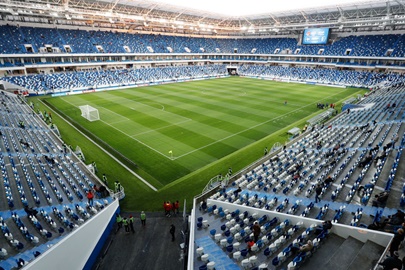
One of the most interesting aspects of Russia's REC campaign this year will be them playing their first match in Kaliningrad against Portugal. The city superbly hosted last year's Rugby Europe U18 Championship and if successful could be a superior winter base for them with far better support than one man and a dog in Sochi (which is now hosting a game at the 47,659 Fisht Olympic Stadium).

---

Under new leadership this year are Romania with Andy Robinson. He has a mixed head coaching record and comes into this job after three years out of the game following dismal failure at Bristol. However he has a reputation as a good technical coach (but poor selector or recruiter), and one of the best successes of his career was repairing a bare bones Edinburgh squad in 2007 to 2009. If committed it is possible he could be a good fit for this Romania job where "upskilling" players is more the challenge than selection.

Several of the 1986 generation is still going (and Andrei Radoi comes out of international retirement), but the Oaks seem to have abandoned betting on residency players, and selected more young players than they have for some time (although now they are coming out of Romania's worst ever U20s).
Image result for Andy Robinson romania rugby
New Romania coach Andy Robinson

For years the great rival for the REC with Georgia, their hopes of winning the Antim Cup away in their opening game in Tbilisi have never been slimmer, instead the focus for Romania this year is on redeveloping a squad and finding new players ready to play key roles in their RWC qualifying campaign starting next year.

---

Below the top four are Belgium who come into this tournament on poor form. Their away form has been a total joke for a while, but even at home they have failed to match some of their past success. Losing badly at home to Romania last year, and more recently to a very average Hong Kong team.

Their strategy will as last year be to focus mainly on just one game against their most likely relegation rival Portugal. This will be first up, and unfortunately for Belgium also away from home, so to stay up they will have to do something they've never done before and win an REC game outside Brussels.

---

Rejoining the REC for the first time in four years are the 2003 Grand Slam winners Portugal who after winning the RET with ease finally beat Germany in the playoff.

Os Lobos have played few higher ranked opponents over the past couple of years so this will be an interesting challenge for a team that almost resembles a University side in its youth (although has now added experienced Top 14 players Samuel Marques and Geoffrey Moise after long absences).

Beating Belgium to avoid bottom place is the priority, and although somewhat unlikely to finish in the top half, they do have some talent and carry an unknown quantity element that could surprise and give a hard test to at least one of the more experienced and higher ranked sides.

---

Below the REC the RET also continues but the winner at this point seems very likely to be the Netherlands having already resoundingly beaten a very weak Germany team 37-7. The Dutch, barring a giant choke, will face probably the loser of Portugal vs Belgium in a summer playoff where they could return to the REC for the first time since they were relegated way back in 2002.

---

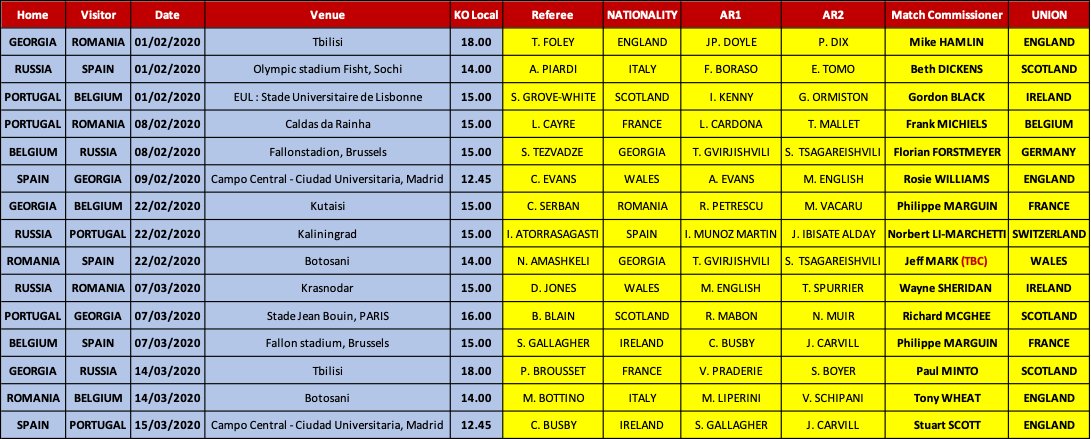
Rugby Europe Championship schedule 2020:


Image

Thursday, 10 January 2019

Rugby in Eastern Europe in a terrible state

The emergence and continued rise of Georgian rugby has been one of the best stories in the sport over the past 15 years. However not only are they somewhat of an anomaly as a nation who went from absolutely nowhere to quickly reach RWC level, but they also buck another unfortunate trend as rugby in Eastern Europe currently seems to be otherwise in poor health right now.

Romania's severe struggles at junior level for the past several years and horrible 2018 have been well documented on this site. But the Oaks may be the most high profile team but are far from alone as several other lower ranked nearby nations have been going through tough times themselves.

Around 5 years ago Moldova looked to be a team on the up with some of the characteristics of a very early Georgia. They started the European Nations Cup in 2000 in the very lowest division playing the likes of Israel and Bulgaria, and rose up the levels and got very near promotion to the REC ahead of Germany in 2013/14, and did so with a big pack which notably included their first two players Vadim Cobilas and Dmitri Arhip to have gone onto have successful careers in major professional leagues.
Moldova have spectacularly crashed
from a World Ranking high of 25th to
now 56th in space of just four years 

To say their fortunes have dipped since then is an understatement as they have turned out to be the Kazakhstan of this current RWC cycle. As a Union they have totally crashed. In 2018 they continued to an ongoing 11 match losing streak, were relegated from the RET, and now in the fourth tier of European rugby they recently lost 80-6 to Sweden (a team they beat 57-8 back in 2014), and their World Ranking has plummeted from a high of 25th in 2014 to currently 56th.

At junior level their results are horrendous as well. Their U20s have not competed in a Rugby Europe tournament since 2015, whilst their U18s last year lost to Hungary (41-5), Israel (31-7), & Croatia (46-0) to rank 27th out of 27 European nations who competed at U18 level (in 2017 they also ranked 29th out 30 European nations who competed at U18 level beating Bulgaria in a last place playoff).

The only positive for Moldovan rugby this past year is an impressive new tighthead prop in Cristian Ojovan achieving a 4 year professional contract at Aurillac. He should hopefully have a good long career for another decade, but you can't expect many more players are likely to emerge into the professional game with the current state the Union is in and some of the continent's worst youth teams.

Meanwhile Ukraine were in the REC as recently as 2012 but have also fallen badly. They went from winning all their games RET in 2015, to losing them all and getting relegated to the fourth tier in 2016.

The most well known Czech player Jan
Macháček with Montferrand in 2001
Another team who used to be in the REC is the Czech Republic who spent six seasons in the competition between 2003 to 2008 with a few players with Top 14 experience such as Jan Macháček, Miroslav Němeček, Lukáš Rapant, and Martin Jágr.

The last of those players retired a couple years ago and saw little coming through to succeed them. After lock Martin Wognitsch left Angoulême in the summer it meant there were no Czechs left in professional rugby in either of the top two divisions in France for the first time this Millennium. Also since dropping out the REC they then were relegated from the RET in 2014, and despite having gotten their place back in 2017 look well set to be relegated again this year.

Elsewhere Poland have still not produced another player to feature in a major professional league since Gregori Kacała in the 1990s and do not appear to be a contender for promotion to the REC any time soon. They recently got trounced 49-0 at home by the Netherlands in November.
Image result for Jonas Mikalčius
Lithuania wing Jonas Mikalčius had his
career ended by a serious knee injury

In the Baltic states, Lithuania have just seen their star prospect Jonas Mikalčius' career ended at 23 by a serious knee injury soon after he had just earned a move to the English Premiership with Harlequins, whilst Latvia's only pro players Uldis Saulite and Jurijs Baranovs at Enisey-STM are both likely near retirement.

Although there has been some more positive news for rugby in Hungary who had their first ever player to reach pro level this year in Bence Róth with Bourg-en-Bresse in Pro D2.

Whilst Russia for the last few years have not exactly made huge progress or produced a bunch new young players to come through either. Although the mood of course has been changed there since receiving a surprise RWC qualification, which has boosted the Bears as they achieved two of their best results for years against Canada and Japan off the back of it. They will hope to build off an appearance on the sport's biggest stage more successfully than they did post 2011 and improve their production line of talent at youth level (which has not been great but also not as bad as Romania).
Image result for gonzalo lópez bontempo espana rugby
Spain U20 thrashed Romania 70-6
in a friendly match last month

Overall though East of Germany the picture does not really look particularly positive for rugby in Europe right now aside from Georgia. Most of the other European sides who appear to be making the most progress, certainly in terms of youth development, are all in the West.

Since Georgia U20 have had a place in the WR U20 Championship, it has been the Iberians Portugal and Spain who have been the ones usually playing it out for a spot in the U20 Trophy and look the best at U18. The latter in particular look to be in a better position to potentially see more homegrown talent of the level to play professionally in France in future compared to others. Along with that Belgium and the Netherlands also have improved in recent years into REC or potential REC level teams.

At junior level all those Eastern European RET teams have shown nothing. Romania had an awful year U20 wise yet still beat Ukraine 76-13, who had in turn beaten Poland 42-13 the match before that. Not results offering much encouragement for new players coming through.

It would be great to see a side from Eastern Europe become the "new Georgia" in terms of a 100% homegrown side rising out of nowhere and very meagre resources. However at this point not only is little progress towards that happening, but rugby in some of these nations seems to be in a dire state going backwards. Hopefully entering into a new decade this pattern can somehow reverse itself.

Tuesday, 28 August 2018

Three notable age grade teams and future of the REC in the 2020's

As the 2018 World Rugby Under 20 Trophy gets under way. Here is a look back at two particular age grade teams which have had a strong influence on the Rugby Europe Championship over the past decade. Plus the current strength of the Georgian youth setup, which this year produced possibly the best Tier 2 age grade team to date, and what this could mean for the REC heading into the 2020's.

Russia taking on Wales at the 2004
IRB U21 World Championship

 Russia U21 (2004)


Their results at that World Championship were a long way from being one of the best Tier 2 age grade team. Up against the powerful champion New Zealand U21 team they were hit for a cricket score losing 110-3. Albeit in mitigation that was one of the best Kiwi age grade teams of the past 15 years after the legendary 2011 team, featuring 13 future All Blacks in the squad and 6 future RWC winners, and beat everyone at that tournament by a comfortable margin.

In their other matches they did not suffer quite so badly against the likes of Scotland (29-17), or Italy (33-20), before beating Tonga in the 11th place playoff which may sound like much but was almost certainly the best age grade team Russia has had.

To put it in context the Bears had a Word Ranking of 23 at the time, so just getting to the Championship to finish 11th was big jump ahead of that. In more recent years the Russians have struggled to even get close to qualifying a team to the U20 Trophy (and the last time they did in 2012 they were horrendous), let alone getting to the main U20 Championship again.

However what is most notable about this side is how many of the players went on to have lengthy international careers and still remain in the team to this day.

Now 14 years on from that tournament most players involved are now aged between 33 and 35 and in the latter stages of their career if not retired. In total 121 players between the 12 teams became full internationals. Only 11 of those have still been active in international rugby as of this year. They include Alessandro Zanni, Juan Manuel Leguizamón, Leonardo Ghiraldini, plus Alun-Wyn Jones and Ben Smith who at age 18 were two of the youngest players at the tournament.

The other six players who remain active this year are all from Russia, five of whom featured in the Bears most recent match against Canada in June, including four in the starting lineup.

Left to Right: Sergey Trishin, Yury Kushnarev, Andrei Garbuzov, and Evgeny Pronenko all who
were part of the Russia U21 team of 2004 lineup for the Bears most recent match vs Canada.

In all that Russia U21 team produced a massive 16 full internationals. 7 of those have won at least over 50 caps (plus possibly soon an eighth in Evgeny Matveev who won his 49th cap from the bench against Canada). It will certainly have the first ever Russian player to reach 100 caps in Yury Kushnarev, the Bears all time leading points scorer and fly half for 12 years who is currently on 99 caps, along with possibly another next year in 86 cap veteran Andrei Garbuzov whose career has now spanned 13 years.

The others in that team still active include 60 cap flanker Andrei Temnov, 55 cap centre Sergey Trishin, 54 cap tighthead prop Evgeny Pronenko. Whilst there were also other names in the squad which will be familiar to those who have watched Russian rugby. Such as their RWC 2011 captain Vladislav Korshunov, and full back Igor Klyuchnikov both of whom now have retired.

Together that Russia U21 squad has gone onto win a combined 624 international caps and counting, which is the all time record for a single age grade team. Several of those players have actually spent periods out of the side but Russia keep coming back to them.
Russia against Romania in 2008 during
their period as second best REC team

That squad also provided between 6 to 8 of the Russian team in each of those matches over that period of 2007-2010 where (also supplemented by a three or four from the year or two after like Victor Gresev and Andrei Ostrikov) the Bears had a hold over Romania, beating the Oaks several times as they finished in the top two of the REC three years in a row, qualified for their first RWC without even needing to go through the Repechage, and reached what remains their all time ranking high of 16.

However Russia never improved beyond that point. The Kingsley Jones era saw record losses to both Georgia and Romania and RWC qualification failure against Uruguay (things which coincidentally Kingsley is now repeating with Canada). Whilst under Alexander Pervukhin they rarely lost to sides ranked below them, but they also rarely made much progress in challenging those above them and got pushed out of the RWC qualifying places by Spain (albeit thanks to their ineligible player at 10).

The returns from their age grade sides in the U20 era have also been comparatively meagre. For example their last squad to have qualified for the U20 Trophy which was in 2012 (the year which provided without doubt the tournament's worst ever winner), the Russians finished last with some utterly terrible results and that group has since produced only four internationals with just 9 starts between them.

If we're being honest apart from Denis Simplikevich on the wing it has been a while since Russia produced a player of much significance. The fact not only that they keep going back to a chunk of that team from a decade ago, but by far their strongest and most influential debutant since their RWC appearance in 2011 is a 35 year old poach from Kazakhstan in Anton Rudoy pretty much sums that up.

From 2011 onwards the Romanians struck back and since been dominant against Russia with a similarly unique generation of their own coming into their prime over the following RWC cycle ...

Top 10 most capped age grade teams at a World Rugby U19/20/21 tournament since 2004 (Up to date as of 26/08/2018)


 Romania U19 (2005)


Second on the list for most caps from a single age grade team behind Russia is the Romania U19 squad of 2005, who between them 12 full internationals have won 568 caps and counting.

The Oaks actually have a strong history of successful age grade teams going back into the amateur era. Much like their senior team they were able to achieve wins over France and routinely beat Italy in old FIRA U19 tournaments back in the 1970s. Whilst in the mid 1990's they had a group that drew with France, beat Wales, Italy, and Scotland, and finished third at the 1996 FIRA U19 World Cup (albeit back then four Tier 1 nations in England, New Zealand, Australia, or Ireland didn't participate).

In the modern era since World Rugby took charge of age grade tournaments in 2002 and all the major teams participated every year though they have had very little success. Aside from one year in 2005 where they finished 7th in the U19 World Championship (after many of the same players had earned promotion winning the B tournament the previous year). Admittedly that ranking was in part down to a fortuitous pool draw, but nevertheless they still had to beat a Tier 1 side in Argentina to achieve it.
Romania U19 team photo 2005

That squad remains by far the best ever team the Romanians have had at a World Rugby age grade tournament and provided the core of the Oaks team for the past two RWC cycles.

They are the only team from any World Rugby age grade tournament to date to have produced six different players with over 60 caps. It is also the only one to have had five different players earn qualification for at least three RWCs (unfortunately though despite earning qualification they of course won't be able to play in at least RWCs for reasons outside their control).

In that squad were the Oaks most capped captain Mihai Macovei (78 caps), most capped player and leading point scorer Florin Vlaicu (111 caps), second most capped player, leading try scorer, and probably most gifted back of the professional era Cătălin Fercu (103 caps), along with their most recent Top 14 winner Mihai Lazar (62 caps), plus also Viorel Lucaci (64 caps), and Valentin Poparlan (75 caps). Additionally there was also another future Romania international at that tournament (in the B Division) in Otar Turashvili who was part of the Georgia U19 team that year.

Left to right: Cătălin Fercu, Florin Vlaicu, Mihai Macovei, Mihai Lazar, Viorel Lucaci, and Valentin Poparlan at the 2005 U19 World Championship. Not a single one of the Oaks 136 matches since that tournament has been without at least one of them in the starting XV.

Those are all some of Romania's most influential players of the past several years all in one age grade team. Indeed all six of those Romanians named above (plus Turashvili) from that 2005 U19 Championship were in the starting lineup for the Oaks notable wins over Tonga in 2013, or against Canada at RWC 2015 where they came from 15-0 behind. If there was a prize for a single age grade team that has gone on to have most influence on a national team this group would surely be a leading nominee.
Image result for Romania Canada 2015
Mihai Macovei scores a crucial try
vs Canada at RWC 2015 in a match
that included six of the Romania U19
team of 2005 in the starting lineup

Since Fercu's debut in November 2005, there has been at least one player from that Romania U19 team in the starting lineup of every single one of the Oaks subsequent 136 matches, and a minimum of three players from that group on the Oaks teamsheet for the past 82 consecutive matches. Over Lynn Howells five years in charge that U19 group overall held 30% of the starting positions. There were at least four in his starting lineup in 48 out of 61 matches, and between 2013 to 2015 usually six or even seven when Dorin Manole was still around.

This generation (which also includes some others of a similar age such as the Ursache brothers, Andrei Radoi, or latterly Johan van Heerden) have battled hard to keep the Oaks competitive and amongst the top 16 in the world beating the likes of Samoa, Tonga, Canada, and USA, as well as competing with Georgia at the top of the REC which they won in 2017 in Bucharest after unluckily missing out in 2013.

But they've also in many ways been one of the unluckiest generations as well. None of them, apart from Lazar at Castres where he won the Top 14, really got a real chance at a major club, even though Fercu at his peak or Macovei especially were certainly good enough for careers at that level. Romania are also the Tier 2 nation who has to wait the longest for a chance to play a Tier 1 side outside a RWC (where half their chances to do so come off minimal rest), the last time they did was back in 2006 when only Fercu and Vlaicu were in the side with under 10 caps, so that has basically bypassed all their prime years now. Whilst as they approach nearer the end of their careers they've now been kicked out of the RWC.

The upcoming challenge for Romania which some have been warning about for years draws ever closer now. How will they to manage to cope with such an unusually large contingent of their team all having now entered their 30's and likely heading into either a decline or retirement in one swoop?

With their youth setup having struggled so badly for about 7 or 8 years now and showing little real indication of recovery it does not look something they are well prepared for. Whilst they are clearly top 8 in Europe at senior level, they've struggled to make the top 10 in Europe at junior level and the last U20 Trophy they qualified for was back in 2010. Hardly any Romanian players born in the 1990's have broken through and looked like natural successors to the U19 generation of 2005.

GIF: Romania's two 100 cap Oaks Cătălin Fercu and Florin Vlaicu as 18 year olds
combine to create a try during the win vs Japan at the 2005 U19 World Championship
Already we have been seeing signs of decline this year amongst the backs. Fercu has not been the same player of old after coming back from a broken leg last year. Vlaicu got dropped for the first time in years after a forgettable performance against Spain (their first ever REC defeat to a team other than Georgia with all of Fercu, Macovei, and Lazar in the team). RWC 2019 was likely to be their swansong which makes the blow of missing out on hat even crueller.

 Georgia U20 (2018)


Several Tier 2 teams may have placed higher in the past, but do not let that fact deceive you as this was the best and most competitive age grade side any Tier 2 nation has sent to a World Rugby age grade tournament. Owing to the nature of the format used in these tournaments a lot comes down to luck of the draw and especially in the mid-table section the final placings are not always truly representative.

For example, the highest ever finish achieved by a Tier 2 side was Fiji U20 in 2011 who came sixth. Yet that was achieved just beating Tonga along with one upset win over a Tier 1 side in Wales (the same year Wales also lost 92-0 to New Zealand). In the other three matches against Tier 1 opponents that year Fiji were thrashed by an average margin of 59-18, and their tournament ended with a 104-17 annihilation against South Africa in the 5th/6th place match, which aside from a horribly out of their depth team the USA sent in 2013 to get slaughtered, is the competition's worst result of the U20 era.
Georgia U20 competed hard against two
of the top three teams in the world in 2018

In terms of a collection of performances over all 5 matches the Georgian U20 side of 2018 stands out as a cut above the rest. They became only the second Tier 2 age grade team after Samoa U20 2009 to win three matches and take two scalps over Tier 1 nations in the same tournament, but it was the team's ability to be truly competitive throughout that stands out.

The average scoreline between Tier 2 nations and the champion side in World Rugby's age grade tournaments before this year was 80-7 (or 71-5 just in the post-2008 U20 era), and the average scoreline against top three finishing teams was 61-9 (or 54-10 in the U20 era).

Yet the Junior Lelos faced two of this year's U20 podium teams within 4 days in their pool and still managed to come out of the tournament with the best average scoreline against Tier 1 teams in the competition's history.

Against South Africa U20 the Georgians led at half time and came away with a losing bonus point, and whilst they never looked like winning against a very strong France U20 team, they stopped them getting a bonus point try and finished with a credible 24-12 loss. Within four days Georgia achieved two of the top three closest U20 results for a Tier 2 side versus a top three U20 team and easily beat the previous best for a Tier 2 side against a world champion age grade team which had been 44-11 (Fiji U20 vs New Zealand in 2010).

There has been no other Tier 2 age grade side that would have come out of that pool draw as well as those young Georgians did. That those encounters against two of the strongest most physical U20 teams did not totally drain them and they finished the tournament with a good win over Scotland was impressive. The rhythm to the rugby the Junior Lelos played between minutes 40-60 in that final match, where they scored 24 unanswered points to take the score from 12-19 to 36-19, was some of the best and most clinical play we have ever seen from any Georgian side.

GIF: Neatly taken try by Georgia U20 to take a match securing 36-19 lead after
scoring 24 unanswered points in 20 minutes of the second half against Scotland
A handful of this team will surely represent Georgia at senior level in the coming years. Although unlike others mentioned here, do not expect this group to have such an unusually disproportionate amount to become regular internationals. Whilst it may be a statistical curiosity to have so many caps from one year, it is in fact a symptom of two failing development systems.
Image result for Georgia U18 france 2018
Georgia U18 defeat France A in March

For Georgia this wasn't merely a one off freakish year, their youth setup right now is without doubt the strongest any Tier 2 nation has ever had in the professional era. They have produced a succession of good U18 and U20 teams going back to 2015, and whilst there will always some years better than others at age grade level, there is little reason to believe that overall trend stops any time soon.

What this year's side may be best remembered for though is the outstanding half back pairing of Gela Aprasidze and at fly half Tedo Abzhandadze, who developed significantly compared to the 2017 tournament where he was the second youngest player involved at just 17. They were described as two of the "superstars" of the tournament by Milton Haig and it is hoped they can take Georgia onto the next level in terms of the senior team performance if they continue to progress successfully.

Looking ahead to the REC in the 2020's ...


Georgia established themselves at the top of the REC some years ago now, a position they've only solidified recently with four Grand Slams in the past five tournaments. One thing that we can be pretty sure of is that will continue as the Georgians will continue to push for the 6 Nations. The likelihood is in fact the distance between them and the rest will only increase over the coming years. Only complacency and lack of motivation, or the coaches fielding development teams may halt that dominance.

However the rest of the tournament on the otherhand moving in the 2020's could be far less predictable and there is a lot of opportunity for a number of sides to rise up the rankings.

The fact is for both Romania and Russia the core of players they have relied upon for most of the last decade or so is far nearer the end of their career than the beginning. Spain's French brigade also had a number of players who missed their last chance this year of qualifying for a RWC. All these teams will be entering rebuilding phases at the start of the next RWC cycle and you'd expect the average age of the tournament to plummet in 2020, which could throw the REC field behind Georgia wide open for a number of teams to potentially breakthrough.

It's possible the door could be left ajar for a Western or Central European nation to get inside the top three for the first time, if either Germany can get their act together under their new CEO, or even if the Netherlands who are one of the most improved sides of the past three years keep progressing with a hungry, young group of players.
Image result for spain samoa u20
Spain U20 took Samoa to extra time in the
U20 Trophy final in 2016 nearly becoming
the first non-RWC side to reach the main
U20 championship in its 12 team format

Whilst the Iberians, who have been strongest REC nations behind Georgia in terms of age grade results in recent times with both having got as far as the U20 Trophy final over the past two years, could perhaps begin to see more emerge from that generation of players in addition to finding more eligible French players (fewer of whom from now on are likely to be tied by France U20).

And even if both Romania and Russia have been not been in a good place in terms of bringing through younger players over the last several years. They are still both teams with the experience of reaching the RWC and can't be written off. In fact after missing RWC 2019, it's not totally impossible some of the forwards from Romania's U19 2005 generation could be motivated to keep going and right that wrong and reach RWC 2023 as 35/36 year old veterans helping out the younger players coming in.

The future of the REC and what the hierarchy below Georgia will look like in about 5-10 years time and unlike in previous years it is very hard to predict right now. It will be interesting to see whether any Unions can seize an opportunity for what looks like it could be a more open field to reach RWCs 2023 and 2027 with the Eastern Europeans more vulnerable, or whether the Romanians and Russians can cope with an upcoming wave of retirements and rebuild to keep their place in the top three of the REC.

Thursday, 17 May 2018

Thoughts on the RWC disqualification of Romania, Spain, & Belgium

Over two months on from the controversial end to the 2018 REC, on Tuesday finally World Rugby confirmed the outcome of their investigation into ineligible players. After the earlier precedent set by Tahiti's disqualification it was one that many had expected as the most likely.

The investigation involved all REC teams involved in RWC qualifying. Although the mostly retaliatory accusation against Russia over former Kazakh international Anton Rudoy was never going to be an issue. He has been in Russia a long time and clearly fulfilled all the necessary criteria to change his allegiance via the Olympic 7s qualifying loophole.

Germany also came under question. It is thought the player involved was former Wales U20 international Jamie Murphy. Whilst the U20s were Wales' second designated team when Murphy played for them in 2009, unlike the case in involving Mathieu Bélie and Bastien Fuster however, in that particular year France's second designated team was "France A", so there were no possible opponents for his eligibility to get locked.
Image result for Victor Paquet
Victor Paquet

The others could not escape though having all clearly fielded ineligible players. Romania with former Tongan 7s player Sione Faka'osilea. Spain with former France U20s Bélie and Fuster. And Belgium with five unnamed players (although at least one is thought to be hooker Victor Paquet) with heritage just from great-grandparents one generation out from what is allowed.

There is a lot of sympathy to be had for the players and fans from Romania and Spain. They have done nothing wrong and seen their goal of reaching the World Cup disappear away from the pitch and all the effort, sacrifice, and work gone into it go to waste. As two teams with squads on the older side for many of their players this was also their last chance to play on the sport's biggest stage.

Unfortunately in both cases the administrators (contrary to the claims made to the investigation) have simply fallen foul of human error and messed up.
Image result for sione faka'osilea
Sione Faka'osilea

The Romanians claimed to have "explained" Regulation 8 to Faka'osilea. The player would surely remembered he played 7s for Tonga so if that were really the case they must have either given a rather shoddy explanation or the player totally misunderstood it.

Romania also claimed to have checked with the Tongan Rugby Union Chairman, and searched ESPN and Wikipedia to find out if Faka'osilea had played for Tonga. This part also seems a bit odd.

Firstly if they needed to check if Faka'osilea had played 7s for Tonga then surely wouldn't the first thing to do be to ask the player himself if he had done so? That would be have provided a better answer than going to two notoriously incomplete and unreliable sources or a Union that is one of the worst in terms of providing information and unable even to run their own website or active social media feed.

Secondly Faka'osilea made his international debut on March 4 last year and his Wikipedia page was only created on March 20. Also ESPN don't have profiles of Romanian SuperLiga players so are unlikely to have had a page on him prior to March either. Thirdly if the FRR had searched Google a bit better they could have found his page on "it's rugby", the article in 2014 from Baia Mare announcing his signing, or an article from 2015 on the blog "Est XV" all of which also noted he was a Tonga 7s international.

In all likelihood it is doubtful Romania actually "explained" Regulation 8 to Faka'osilea at all or went to any lengths to check if he had played 7s for Tonga. All they probably made sure to check was if he had played for Tonga or Tonga A and simply forgot about 7s. Indeed it is not all that surprising they might have forgotten about 7s as the abbreviated form of a game is a complete non entity in Romania.

The report also shows Spain attempted to scramble their way out of disqualification claiming France shouldn't have been able to change their second designated team to France U21 in 2007 to France U20 in 2008 (when World Rugby changed the age of their junior competition) and that the chosen team should have stood for four years.
Image result for mathieu belie bastien fuster
Mathieu Bélie

This was actually quite a clever attempt by the FER to save themselves but this was ultimately rejected by the report. WR had clearly allowed France to change to U20 years ago when U21 got pushed aside. If Spain had indeed studied the rules closely to attempt to find a loophole to field Bélie and Fuster they would have surely checked with World Rugby first.

In reality this was just them desperately looking for anything to try and cover for their oversight. It is not the first they have made eligibility oversights in recent times either. Former France 7s player Fabien Grammatico played for them back in 2015. David Mélé also previously of France 7s very nearly played for them this year as well but for an injury.

World Rugby were obviously correct to judge these were ineligible players. It is hard to see how the appeals that are being launched will have much success in getting more lenient sanctions either.

This is a big shame for both teams, especially Romania who would have certainly been able to qualify without Faka'osilea anyway. Their demise is particularly sad as RWC 2019 was likely to be the last tournament for many of their longest serving players which they have now missed out on through such a needless and unnecessary blunder. Also for the tournament itself it would have been far better to have had the strongest most competitive team possible there.

Whilst Spain would not have got so close to qualifying without their ineligible player Bélie, who was crucial for them at fly half and probably one of their best of all time, they will also probably be genuinely annoyed at how World Rugby has for so long allowed the designated second team to be used so inconsistently in the first place, and at France for designating their U20s.

Next year Los Leones will watch from home a World Cup that will feature dozens of former U20 internationals such as the likes of Nemani Nadolo, Amanaki Mafi, CJ Stander, Chris Vui, Henry Speight, Ross Moriarty, or Brad Shields who now all represent different countries to the ones they did at junior level. In fact over half the teams in the tournament are likely to field such players including even possibly France themselves if they recall Scott Spedding or Noa Nakaitaci.

Spain were just unlucky that the one particular nation which provides them with all their heritage players happened to be one of the few that nominated U20s as their second team.
Image result for Telusa Veainu tonga
Telusa Veainu is one of eight players
in the Tonga squad who would have
been ineligible had New Zealand
designated U20s as a second team

By the way you can be very sure Tonga are incredibly thankful New Zealand never did likewise even though their "Junior All Blacks" team has been inactive even longer than "France A" has been. If New Zealand had nominated their U20s instead then the Ikale Tahi would have lost eight members of their current squad including key players such as Ben Tameifuna and Telusa Veainu.

However whilst many would agree that being able to essentially nominate U20s as your 'A' team to lock eligibility has always been daft and World Rugby were right to belatedly stop that as of this year. The rules nevertheless were still in place and Spain benefited from not following them.

Image result for khatchik vartanov
Russia are unable to call upon
Khatchik Vartanov after his
appearances for France U20
Russia also have heritage players from France tied by U20s as well such as Oyonnax prop Khatchik Vartanov. You would imagine they would have been very keen to select him if he was available especially as he plays in a position where they possess little depth. But the Russians, already stung by their own ineligibility disqualification 15 years ago, followed the rules. Whereas Spain didn't in selecting Bélie, who was one of the most influential players in the tournament and created the match winning try in Krasnodar that all but ended the Bears hopes of reaching the World Cup (or at least had done until this situation arose).

Had there been a more lenient sanction on Spain that didn't involve points deduction it would have been quite unfair on Russia to have missed out thanks to knowing the rules properly. Also especially considering the precedent set in 2003, where the shoe was on the other foot and Russia were disqualified from the RWC for ineligible players and Spain progressed to the next stage of qualifying.

Video: Spain's ineligible player Bélie created the try that all but ended
Russia's chances of reaching the World Cup on the pitch.

Image result for ireland wolfhounds rugby
'A' teams have gradually become
very inactive over this decade
Moving forwards two things should happen as a result of this. Firstly the second designated team concept adds needless confusion and ideally should be scrapped altogether. Nowadays most 'A' teams are highly inactive anyway. Only selection for full national sides not development sides should lock eligibility.

Secondly World Rugby should create an official statistical database of international rugby. Currently most rely upon ESPN Scrum for the records of past matches and players. However their data is riddled with small errors for teams outside Tier 1 and mostly incomplete outside those ranked in the top 20.

Whilst there are hardly any sites to search for historical data on 7s matches and players at all (it is impossible to find out for example the precise number of matches and tries Rupeni Caucaunibuca scored for Fiji at 7s). If WR were to create an official statistical database it would not only help in cases like this for Unions to check a player's eligibility easily and efficiently, but it would also be good for fans looking for accurate information on the records of players outside Tier 1.

This situation has been a regrettable one and it is good to at last have the decision out of the way. Although the fall out from this will still probably keep rumbling on for the next year or so. There are still appeals from Spain and Romania to be heard. Next year's REC may feature a number of match ups that involve a lot more bitterness between the teams than usual. And Russia's appearance at the RWC next year will carry an asterisk alongside it as a fluke that was not earned on the pitch especially if they fail to make the best of it. Hopefully none of this will ever be allowed to happen again.