Showing posts with label Russia. Show all posts

Thursday, 25 August 2022

The Six Nations waste potential to power rugby's growth

[This is a follow up post to a previous one about how the RWC has been the main driver of global growth over the past 20 years]

One may look at Italy and their results over the past 9 years and ask "How has being in the Six Nations helped them? They constantly lose". It is not often you see this point made, but in actual fact Italy has benefited MASSIVELY by being added to the Six Nations.

To understand this properly you need to think of the counterfactual where Italy were ignored by the Six Nations and remained a "Tier 2" side in the REC. In this hypothetical world all the following things would have most likely been different:

  • They would not have the annual budget of all the top five REC sides Georgia, Romania, Spain, Portugal, & Netherlands combined.
  • As a result not had the money for professional teams in the URC.
  • More often played at far smaller stadiums with far smaller crowds.
  • Not had the money to invest so much in improving what was a weak youth system.
  • Nor the regular international competition for that youth to test themselves.
  • Nor would they have the full 3 votes on the World Rugby Council.
  • Selection would have less consistency and involve more negotiation with clubs.
  • Nor would have they been able to select anywhere near the level of foreign imports and heritage players they have managed to get available over the years (over the 2003-2013 period this was a high percentage of their most significant players).
  • And may have very likely got caught fielding ineligible players and like Spain got booted out of a RWC by Russian sleuths if they played in REC too.

It is true Italy's wooden spoon collection has hardly made them the ideal example of how entry to the Six Nations can grow the sport. But that is only if you ignore what the Six Nations prevented them most becoming: a mid-table REC side probably 5 or 6 places lower in the rankings than they are today and without the ability to invest so much in improving youth.

The more you think about this. The more totally obvious it becomes. Of course Italian rugby is much better and richer than it would be otherwise outside the Six Nations. It is for this reason any suggestion they voluntarily put their place at risk in a relegation playoff is a non-starter.

Despite many losses Italy's participation in the Six
Nations has still boosted their level immensely.
Sadly for the sport though few appear to have properly understood this and been able to follow the logical implications of how spreading some of those same benefits of the Six Nations to others would grow the game on the rest of the continent. Instead after every bad result over the last 8 years we have more often heard useless talk of kicking Italy out of the Six Nations (a truly terrible idea that would risk setting them back years).

People now just assume if Georgia or Portugal were added to the Six Nations they would just be another Italy. However much like when the RFU wanted to exclude both those nations from the 2007 World Cup. This is a hopelessly short termist growth killing viewpoint.

Instead what they should be thinking is: "Georgia and Portugal are pushing Italy hard to close and exciting competitive games despite having only a fraction of their budget. Imagine how much more they could grow if the Six Nations opened its doors and they were able to get considerably more funding and experience".

Also: "Spain got a crowd of 40,000 for an exhibition game. There is huge growth potential there. Imagine how much stronger they could be with the budget to maintain a more consistent selection and retain homegrown players like Lucas Paulos and Samu Ezeala. Plus add heritage players the level of Joris Segonds or Rémy Baget like Italy has always been able to do with the likes of Parisse and Castrogiovanni, or in more recently Polledri and Capuozzo".

Lamentably though it is doubtful any thoughts along those lines crossed the mind of a single one of the Six Nations blazers this summer. And that is why the sport struggles to grow.

Georgia and other REC nations compete with a
fraction of the budget of Italy and other "Tier 1". 

Instead of encouraging and inviting growth. The vague alternative idea seems to be that "Tier 1" plays "Tier 2" occasionally in friendlies. And for a team like Georgia to ever join the Six Nations they must follow the same model as Italy and work their way into the tournament through a few wins in those friendlies until they can no longer be ignored (it is sort of the libertarian "pull yourself up by your bootstraps" line of thinking).

This idea basically means Georgia (or any other REC side) is asked to beat Six Nations sides despite having a fraction of the budget, a fraction of the professional player pool, a fraction of the top level experience, and those occasional matches when they happen most often being played away from home.

Unfortunately some clueless people think this is the best and most efficient way to grow the sport. Instead of expanding the Six Nations and enabling them to build a better budget, player pool, and experience to be able to compete. They are asked to perform a miracle only possible with a one off "golden generation" (which would then be wasted as they'd have spent entire careers playing those friendlies and be retired by the time they ever got into the tournament).

When discussing Georgia and the Six Nations. You will commonly hear something along the lines of "yeah, they should get chance of some more "Tier 1" games, but not the Six Nations". Whilst on the surface this may sound supportive, in reality it maintains the vastly uneven playing field and is basically just fobbing them off. Anyone who repeats that line with no plan of Six Nations expansion attached is not genuinely serious about growing the sport.

Expecting teams to repeat Italy's early professional
era wins over Five Nations sides is unrealistic and
ignorant of how international rugby has changed.
(Note: The comparison to Italy c.1997-98 is utterly flawed for another reason. In those barely just turned pro years of the sport. Scotland (at home) could lose 68-10, France (at home) could lose 52-10, and Wales could lose 96-13 versus South Africa. Ireland (at home) could lose 63-15, England could lose 64-22, and Argentina could lose 93-8 versus New Zealand. Never in the history of the sport was the gap between 5N and SANZAR bigger. Nowadays the international landscape is totally different. It is simply not a fair comparison for example to compare Georgia playing Ireland in 2022 to Italy playing Ireland in 1997).

Expansion can be in the interests of "Tier 1" too

Obviously expansion to the Six Nations should be in the interests of every REC nation and anyone who genuinely cares about growing the sport (a lot of fans may say they do but when it comes to applying the necessary changes needed very clearly don't).

But there is another reason why expansion and involvement of "Tier 2" in big events ought to be in the interests of "Tier 1" instead of just playing "Tier 2" in friendlies.

Anyone who has followed rugby long enough should know vaguely supportive promises of "more games for Tier 2 between World Cups" are far from reliable. In 2017 World Rugby pledged to increase "Tier 1 vs Tier 2" matches by 39% over 2020-32. However pretty much the status quo remains (four SANZAAR sides play four of the Six Nations sides on a July/November weekend with the two left over Six Nations playing a "Tier 2" nation).

Reason for little change is obvious. Those friendlies are on some level fundraisers. The biggest draws are the biggest brands (ie All Blacks). When it comes down to it, no "Tier 1" side is volunteering to play two rather one "Tier 2" side in November. For matches involving less established teams to attain high commercial value it requires attachment to a big brand event.

A perfect example of this is the last three matches between Fiji and Uruguay. Despite being one of the lower profile games shifted to midweek, in 2015 and 2019 the fixture sold out stadiums in both Milton Keynes and Kamaishi which were broadcast to global audiences on TV. By contrast in 2018 they played a November friendly at Hartpury College and the crowd was in three figures and only streamed on YouTube. Many of those fans did not come for Fiji vs Uruguay specifically. They came to see the RWC.

Ireland vs Romania sold out Wembley to set
the record crowd of 89,267 for a RWC match.
Similarly in 2015 when we saw Ireland vs Romania sell out Wembley to set the RWC attendance record of 89,267. It was not Romania that were a huge draw per se. Again it was the RWC as an event that sold.

The Six Nations as an event has a similar effect in selling the matches involving a somewhat lower profile team in Italy. We can see this by comparing the fixtures involving Italy in the Six Nations and the exact same fixtures when played as friendlies in RWC warm ups.

2003 RWC warm ups:
25,000 vs Scotland in Edinburgh (20,000 fewer than previous fixture in the Six Nations)
14,000 vs Ireland in Limerick (35,000 fewer than previous fixture in the Six Nations)

2007 RWC warm ups:
14,000 vs Ireland in Belfast (35,000 fewer than previous fixture in the Six Nations)

2011 RWC warm ups:
20,000 vs Scotland in Edinburgh (22,000 fewer than previous fixture in the Six Nations)

2015 RWC warm ups:
10,000 vs Scotland in Torino (56,000 fewer than previous fixture in the Six Nations)
43,000 vs Scotland in Edinburgh (19,000 fewer than previous fixture in the Six Nations)
52,000 vs Wales in Cardiff (14,000 fewer than previous fixture in the Six Nations)

2019 RWC warm ups:
30,000 vs Ireland in Dublin (21,000 fewer than previous fixture in the Six Nations)  
25,000 vs France in Paris (25,000 fewer than previous fixture in the Six Nations)
50,000 vs England in Newcastle (32,000 fewer than previous fixture in the Six Nations)

Some of those crowds are good (50,000 in Newcastle or Cardiff). But still on average across those 10 friendlies Italy games sold 28,000 fewer tickets per match at presumably lower prices and lower TV rights than they did in the corresponding Six Nations fixture. The largest effect is seen in Italy itself, who attract far better numbers for the Six Nations than friendlies.

To be fair "Tier 1" Six Nations sides (besides Italy) get quite healthy crowds these days hosting their annual "Tier 2" fixture in November, but those matches are still obviously of much higher commercial value as part of big events than friendlies.

If the Six Nations would be willing to think long term there is also the larger potential future pay off in creating more competitive teams with bigger fanbases, and having a tournament with more matches to sell, which allows for more possible exposure for sponsors and larger TV deals. The modern day RWC has grown more lucrative as an event for these reasons and Six Nations could too. "Tier 2" growth should not have to come at expense of "Tier 1".

Conclusion: Six Nations has huge potential power to grow the sport in Europe that it is wasting. As seen at the RWC, most growth comes from expanding major tournaments, not from friendlies.

"Tier 1" blazers take the view that the big mid-RWC events must ultra exclusive to themselves, and they will "grow the game" with the odd friendly. This gets it totally back to front. It is the big events that make the biggest impact in growing the sport and should aim to be inclusive. Then you can leave sides to organise friendlies and three match test series mostly as they please.

For rugby to grow, and one day fully shed its "Tier" tags, it is crucial that its administrators open their minds to the idea of expansion of the major mid-RWC event. There are huge potential gains to be made throughout the continent from an expanded European Championship event (maybe once every four years similar to football). Especially for all those labelled "Tier 2" of course, but long term also "Tier 1" as well.

It is incredibly frustrating the Six Nations with their total lack of vision and desire for growth fail to see this. European expansion should be seen as a great opportunity for the sport, where unlike the USA there is a more open niche available for full contact team sport, but it gets ignored and wasted as "Tier 2" sides remain asked to compete at enormous financial and competitive disadvantages in perpetuity. Rugby has to look at where successful examples of growth have come at RWCs and apply those lessons to their other major events.

Video: Everything Georgia captain Merab Sharikadze says here is spot on. "Rugby must be more open".

Tuesday, 28 January 2020

REC 2020 preview

Image result for Georgia Russia 2019 rugby

A short preview looking at the state of play ahead the REC in 2020.


The dominant force of the tournament Georgia have seen coach Milton Haig depart after 8 years in charge, but their squad does not have a new era feel to it. Still yet to appoint a new head coach, they are being led on a caretaker basis by the former defence coach under Haig, Levan Maisashvili.

Image result for davit kacharava
Veterans like Kacharava are continuing post-RWC
Only in charge for five matches, he has deemed this too little time to consider any longer term plans, and opted to keep almost all the veterans who you may have expected to retire after the RWC. So for the Lelos this tournament's main objective will be simply to maintain their dominance on the competition and possibly give players like 35 year old Davit Kacharava or Shalva Sutiashvili fitting farewells in front of home fans.

---

Likely the trickiest obstacle for a third consecutive Grand Slam is an away trip to Spain, where on their last visit in 2017 Georgia trailed at half time, and for the past two years looked unconvincing in having to rely on scrummaging dominance to secure ugly home wins against opponents not at full strength.

In 2019 Spain found a habit of being on the right side of some tight results winning four REC matches for the first time and going on an unbeaten tour of Tier 2 South America. Now they approach tougher challenges travelling to Russia and Romania, and a home game vs Georgia fully believing they can win.
Image result for espana hong kong rugby
Spain won 8 out of 9 tests in 2019

Injury and unavailability is the norm with Spanish selection and they are not full strength without Charly Malie, Marco Pinto, Asier Usarraga, Mickael de Marco, Alvar Gimeno, Facundo Munilla (although they do have some interesting new additions on residency or heritage or from their U20s). Another successful REC campaign in spite of that would be a great achievement for Santiago Santos' team.

---

Looking to stop Spain's winning run are Russia, who were the oldest squad at the recent RWC, but like Georgia most of their veteran players have not retired and been retained by Lyn Jones.

The Bears have been consistently mid-table finishing either 3rd or 4th every single year since 2010. This year playing both Spain and Romania at home, they have as good an opportunity as ever to change that, although it must be said they are a team that was old before and not getting much younger.
Image result for kaliningrad stadium rugby
Kaliningrad is to host their first REC match

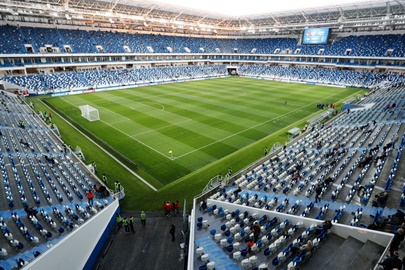
One of the most interesting aspects of Russia's REC campaign this year will be them playing their first match in Kaliningrad against Portugal. The city superbly hosted last year's Rugby Europe U18 Championship and if successful could be a superior winter base for them with far better support than one man and a dog in Sochi (which is now hosting a game at the 47,659 Fisht Olympic Stadium).

---

Under new leadership this year are Romania with Andy Robinson. He has a mixed head coaching record and comes into this job after three years out of the game following dismal failure at Bristol. However he has a reputation as a good technical coach (but poor selector or recruiter), and one of the best successes of his career was repairing a bare bones Edinburgh squad in 2007 to 2009. If committed it is possible he could be a good fit for this Romania job where "upskilling" players is more the challenge than selection.

Several of the 1986 generation is still going (and Andrei Radoi comes out of international retirement), but the Oaks seem to have abandoned betting on residency players, and selected more young players than they have for some time (although now they are coming out of Romania's worst ever U20s).
Image result for Andy Robinson romania rugby
New Romania coach Andy Robinson

For years the great rival for the REC with Georgia, their hopes of winning the Antim Cup away in their opening game in Tbilisi have never been slimmer, instead the focus for Romania this year is on redeveloping a squad and finding new players ready to play key roles in their RWC qualifying campaign starting next year.

---

Below the top four are Belgium who come into this tournament on poor form. Their away form has been a total joke for a while, but even at home they have failed to match some of their past success. Losing badly at home to Romania last year, and more recently to a very average Hong Kong team.

Their strategy will as last year be to focus mainly on just one game against their most likely relegation rival Portugal. This will be first up, and unfortunately for Belgium also away from home, so to stay up they will have to do something they've never done before and win an REC game outside Brussels.

---

Rejoining the REC for the first time in four years are the 2003 Grand Slam winners Portugal who after winning the RET with ease finally beat Germany in the playoff.

Os Lobos have played few higher ranked opponents over the past couple of years so this will be an interesting challenge for a team that almost resembles a University side in its youth (although has now added experienced Top 14 players Samuel Marques and Geoffrey Moise after long absences).

Beating Belgium to avoid bottom place is the priority, and although somewhat unlikely to finish in the top half, they do have some talent and carry an unknown quantity element that could surprise and give a hard test to at least one of the more experienced and higher ranked sides.

---

Below the REC the RET also continues but the winner at this point seems very likely to be the Netherlands having already resoundingly beaten a very weak Germany team 37-7. The Dutch, barring a giant choke, will face probably the loser of Portugal vs Belgium in a summer playoff where they could return to the REC for the first time since they were relegated way back in 2002.

---

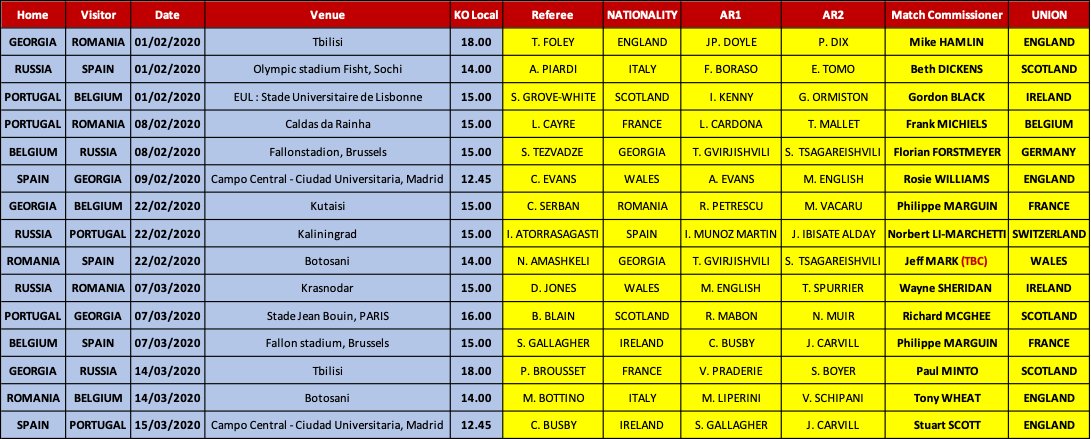
Rugby Europe Championship schedule 2020:


Image

Sunday, 15 September 2019

The best players from Tier 2 nations not at RWC 2019

A look at some of the top players who could have represented Tier 2 nations at RWC 2019 but for a variety of different reasons were not named in the final 31 man squads.

Image result for zurab zhvania georgia1. Zurab Zhvania (Georgia)


Reason? Seemed a likely selection as a second/third choice loosehead who could also cover as third choice hooker, but had a fall out with coach Milton Haig who uncharacteristically visibly annoyed at a press conference stated "he just wasn't fit enough" and being in a position of such huge depth in Georgia meant he was deemed dispensable.

Another chance? A late injury withdrawal in 2015, now out for 2019, Zhvania risks being remembered as one of the best players never to play in a RWC. Only 27 so certainly not too old, but Georgia are producing so many prospects at prop it will be tough to make it in 2023.

Other notable absentees:
Loni Uhila (Tonga) a 30 year old uncapped player reported to be a target for Tonga having left Super Rugby but appears to have chosen to remain at his club instead.
Karlen Asieshvili (Georgia) an unlucky late cut who would walk into any other Tier 2 side but missed out following an injury limited season and the rapid rise of Guram Gogichashvili.
Alex Hodgman (Fiji) could have been a possible starter for Fiji at this RWC but neither he or another loosehead target George Bower were available due to NZ Super Rugby contract restrictions.

Image result for elia elia samoa2. Elia Elia (Samoa)


Reason? A young player (who would have been the youngest in Samoa's squad in fact) set for his first RWC, he picked up a hamstring injury in the PNC which ruled him out the tournament.

Another chance? With just two caps over the past two years (neither of them starts), his senior international career cannot be said to have taken off yet as may have been hoped, but still has plenty of time left in his career and could reach at least two more RWCs.

Other notable absentees:
Samisoni Taukei'aho (Tonga) a homegrown Tongan player but again was unavailable (even as the Ikale Tahi had a reported crisis at hooker) in order to keep New Zealand eligibility in Super Rugby.
Badri Alkhazashvili (Georgia) a former U20 captain who led them to the promotion in 2015 and was one Georgia's best young prospects but his senior career hampered by persistent injuries.

Image result for lasha tabidze 3. Lasha Tabidze (Georgia)


Reason? Another former U20 captain long regarded as one of Georgia's best prospects, but in a competitive position Beqa Gigashvili came from nowhere last year to become a certain selection who could cover all of the front row, and his former U20 teammate Giorgi Melikidze got the nod over him for the third tighthead spot.

Another chance? The competition on both sides of the scrum in Georgia is fierce, and all the 2019 squad tightheads should still be around in 2023, plus new prospects like Kharaishvili. So it will not be easy, but Tabidze will be closer to his peak in four years and still has plenty of time to make a RWC.

Other notable absentees:
Mario Sagario (Uruguay) the veteran first choice tighthead for Los Teros retired in May due to off field business commitments which was a big loss for the Uruguayans.
Davit Kubriashvili (Georgia) an old fashioned scrummaging specialist tighthead he missed out to younger, more mobile options and announced his retirement after missing the squad.
Dave Ryan (USA) has no longer been on eligibility dependant contracts for four years now but still never been recalled to a USA squad despite having a lot more experience at a top level than Paul Mullen.

Image result for Grant Hattingh4. Grant Hattingh (Japan)


Reason? Qualified on residency and would have been sure starter Japan at this RWC adding significant height to the second row as their first ever 2 metre plus tall player. However a groin injury suffered in May and a faltering rehabilitation process ruled him out.

Another chance? At 28 Hattingh can certainly still make another RWC, from his quotes it seems he has the desire to do so, and could be a very valuable addition in a weak position for Japan in the 4 year cycle after this tournament.

Other notable absentees:
Samu Manoa (USA) had a very unhappy injury hit time in Cardiff which saw him depart early, returned 6 months later in MLR clearly lacking match fitness, and soon retired from international rugby.
Anton Bresler (Namibia) no longer a Scottish project player since joining Worcester, but still not representing country of his birth who he could have played for at three RWCs at this point.
Brian Alainu'uese (Samoa) the colossal 2.02m 135kg lock still has never got a call up at senior international level but is currently out with a back injury in any case.
Image result for rodrigo capo ortega

5. Rodrigo Capó Ortega (Uruguay)


Reason? He has been an incredibly durable player but 2018/19 turned out to be the most injury hit of his near 400 match 17 season pro career and he was ruled out for 9 months with surgery on a herniated disc last December. He might have possibly made it just back in time for the RWC, but unable to take part in Uruguay's preparation he decided to withdraw.

Another chance? At 38 this was planned to be the farewell in Uruguayan colours for Capó, who will finish his career as a Uruguay great but also one with a mixed relationship with the national team.

Other notable absentees:
Joe Tekori (Samoa) a veteran coming off a successful season with Toulouse, but since the last RWC played sparingly at international level and retired from international rugby before the tournament.
Michael Fatialofa (Samoa) no longer in New Zealand, but like his second row colleague Bresler, has still seemingly not become available since joining Worcester.
Sergei Sergueev (Russia) one of Russia's only three professional players in Western Europe he quite simply has never wanted an international career with all his 5 only caps coming back in 2010.

Image result for jordan taufua 6. Jordan Taufua (Samoa)


Reason? A player who has been on cusp of the All Blacks but who remains uncapped, it seemed when that cap didn't come and a move to Leicester was announced it might open up his availability for Samoa, unfortunately for them though this was not the case.

Another chance? It still is possible Taufua could have a good 5-6 year career for Samoa if he wants, although if he does want that then it's not clear why he would not start by appearing at this RWC.

Other notable absentees:
Renaldo Bothma (Namibia) retired from international rugby on the eve of the final squad being announced, but coach Phil Davies revealed he was simply dropped, with rumours of some falling out.

Image result for giorgi tsutskiridze rugby7. Giorgi Tsutskiridze (Georgia)


Reason? A revelation of these past 12 months for Georgia, but unfortunately suffered a broken ankle in the first few minutes of the first warm up match vs Southern Kings and now is out long term. Even with Gorgodze rejoining the team, this is still a big blow for Georgia and it is very disappointing not to see Tsutskiridze make his mark as part of the 2016 U20 back row trio on the world stage at this RWC.

Another chance? At only 22 he can certainly come again more than once. This is another position Georgia has quite a few young players coming through, so there will be competition, but if he recovers from injury with his pace intact Tsutskiridze adds an extra dimension to some of the others.

Other notable absentees:
Vito Kolelishvili (Georgia) a mainstay of the Lelos who would have reached a third RWC but after suffering repeated heavy concussions not played since October and now taken a sabbatical to recover.
Colby Fainga'a (Tonga) players' player of the season in his first year at Connacht and with 100 Super Rugby caps may have been a good addition for Tonga but possibly now a "project player" in Ireland.

Image result for rahboni warren-vosayaco8. Rahboni Warren-Vosayaco (Japan)


Reason? One of the most dynamic players for the Sunwolves this year, he looked like he could have added to an already impressive list of back rowers for Japan. He was named in the RWC training squad, but then it turned out he fell just short of residency qualifying criteria.

Another chance? If he stays in Japan he could certainly become an international and will be close to his prime in 2023. However there is significant back row competition with other young players like Shota Fukui, Tevita Tatafu, Ben Gunter and the current squad members in contention. Also eligible for Fiji if both parties were interested.

Other notable absentees:
Tevita Tatafu (Japan) starred for Junior Japan with some big performances in the Pacific Challenge, but Jamie Joseph was not considering University players so simply never got a chance ahead of his RWC.
So'oatala Fa'aso'o (Samoa) had a big season for Brive helping them to promotion to the Top 14 but still was ignored by the selectors and yet to make his senior international debut.
Sione Vailanu (Tonga) was overlooked despite a big ball carrying performance in the final game of the PNC against Canada.
Anton Rudoy (Russia) one of the top players for the Bears this RWC cycle and scored a hat trick in a big win vs Canada in his last test in June 2018 but then suddenly disappeared from the international scene.

Image result for folau fakatava9. Folau Fakatava (Tonga)


Reason? A homegrown Tongan prospect, who even represented them in touch rugby as a 15 year old at the 2015 Pacific Games, however he is not available for his home country at least not at this stage of his career so not to lose eligibility for New Zealand. Unfortunately his absence didn't come as any surprise whatsoever.

Another chance? He is just 19 so will certainly get another chance, with the All Blacks obviously getting the first pick, and possibly Tonga if he falls short of that and moves to a pro club Europe.

Other notable absentees:
Will Percillier (Canada) scored some brilliant tries at U20 who made his debut in the ARC earlier this year but somewhat surprisingly never got an opportunity in the PNC.
Image result for Takuya Yamazawa

10. Takuya Yamasawa (Japan)


Reason? A hugely exciting playmaking fly half, well suited to Japan's style of play, who is a star in the Top League offering a lot more threat with ball in hand than Yu Tamura. He was noted by Eddie Jones on departure as the young player who could breakthrough for RWC 2019, however strangely simply never been given a chance by Jamie Joseph who has cited his lack of experience as a reason (although this hasn't stopped him selecting a pair of converted 8s as props despite only playing in the position for a couple of years).

Another chance? Certainly at just 24 he can come again for two more RWCs and still the most likely eventual successor for Tamura. However it feels a wasted past year where he could have gained some experience with the Sunwolves and as part of Japan squads even if not ready to be first choice at a RWC.

Other notable absentees:
Peceli Nacebe (Fiji) was emerging on the selection radar, but had an ill fated year in France where he was moved to wing, whilst Alivereti Veitokani took his Fijian Drua place and thrived to surpass him.

Image result for nemani nadolo montpellier11. Nemani Nadolo (Fiji)


Reason? Announced his international retirement following an injury disrupted season saying he was feeling the wear and tear on his body. He is currently out injured again after requiring knee surgery.

Another chance? This would have been a last RWC for Nadolo, it's a shame as last time his only RWC had the regret of missing a key match whilst on great form as WR at the time went super strict on "neck rolls". Although Fiji have depth to cope with absences at wing more than any other position losing a player with such a strong strike rate is still a blow.

Other notable absentees:
Hosea Saumaki (Tonga) no secret of interest from Japan, but he is not eligible due to 7s caps, and doesn't seem to be going through Olympics loophole, but still not featured in the Tongan squad.
Monty Ioane (Samoa) players' player of the season nominee in the Pro14 for his form with Benetton but not called up by either Samoa or Fiji (who he is both eligible for) and a possible project player for Italy.
Tevita Li (Tonga) the record try scorer in the U20 Championship for New Zealand, but at senior level never entered All Black plans, but still not available for Tonga even though he has now moved to Japan.

Image result for michael little rugby12. Michael Little (Fiji)


Reason? Had an impressive first season of Super Rugby in 2018 with the Sunwolves, which apparently led to some discussions with John McKee, however his 2019 season got cut short to just 5 games due to concussion leaving him with no opportunity to make the squad.

Another chance? He could possibly have one more opportunity to play a RWC in 2023, but there is plenty of competition from both current players and upcoming youngsters like Vilimoni Botitu, and might be helped if he were to move to a club in Europe where most of the Fijian squad is based, or at least a better Japanese club.

Other notable absentees:
Harumichi Tatekawa (Japan) one of the best players of the Eddie Jones era he was a leader for Japan in the first couple years under Jamie Joseph but got axed in 2018.
Willis Halaholo (Tonga) a former Tonga U20 but now waiting as a "project player" to be eligible for Wales who he qualifies for on residency soon after the RWC.
Image result for Yusuke Kajimura

13. Yusuke Kajimura (Japan)


Reason? Another prospect in Japan who had his early career delayed by University rugby. He finally got into the Top League and had an excellent first season where displaced current Japan incumbent Ryoto Nakamura as first choice at Suntory Sungoliath, but a lack of versatility and experience likely cost him a RWC spot.

Another chance? Similar to Yamasawa, he should be a player who could arrive as an important player for the Japan team over the next 4 year cycle and for RWC 2023.

Other notable absentees:
Tumua Manu (Samoa) one of the few homegrown Samoan players currently in Super Rugby he became first choice starter at the Chiefs but again remaining New Zealand eligible took him out of contention.
Joaquín Prada (Uruguay) offered valuable experience and started every game of the successful ARC campaign earlier this year but withdrew as could not get time off from his doctor studies.

14. Sevu Reece (Fiji)

Image result for Sevu Reece
Reason? In May John McKee said Reece "would love to play for Fiji" but for NZ Super Rugby contract restrictions preventing him. However afterwards his form (14 tries in 11 games for Waikato in Mitre10 Cup, 15 tries in 14 games in Super Rugby for Crusaders) continued to be so spectacular he ended up being an All Blacks call up.

Another chance? An exception the title of this article, he is at the RWC just for the All Blacks not Fiji.

Other notable absentees:
Toni Pulu (Tonga or USA) eligible for two Tier 2 nations at this RWC, however spent his entire career in Super Rugby remaining uncapped to keep eligibility for the two Tier 1 nations he is also eligible for.
Akihito Yamada (Japan) still at 33 has a super try scoring rate in the Top League but omitted as Jamie Joseph said he wanted a bigger wingers to deal with aerial bombardments from Ireland and Scotland.
Eroni Sau (Fiji) part of the squad over this past year but got pushed out by Filipo Nakosi, at 29 and with Fiji producing tonnes of talented wingers this was likely his only chance at a RWC.

Image result for Melani Nanai rugby15. Melani Nanai (Samoa)


Reason? Much the same situation as with Taufua. Having left Super Rugby for a European club it seemed this could now possibly free Nanai to play for Samoa but this was not to be. He is a third uncapped player at Worcester eligible for a Tier 2 nation (fourth if you also add Callum Black who withdrew from a USA squad shortly after signing for them last year) who could have made this tournament but hasn't.

Another chance? Only just turned 26 so could play the entire next 4 year cycle for Samoa if he wants, but then if he did want to why wouldn't he start at a RWC?

Other notable absentees:
Seta Tuicuvu (Fiji) an ill timed injury last November robbed of a chance to make a strong case as a starter and got little opportunity in the PNC with Kini Murimurivalu the preferred 15.
Divan Rossouw (Namibia) the only homegrown Namibian player currently in Super Rugby and former U20 player for them but never been named in a senior squad (most likely to eligibility restrictions ...).
Chrysander Botha (Namibia) a regular for Namibia for years and on his way to a third RWC, but was another surprise exclusion of a senior player with the rumours of fall out inside the camp.

Tuesday, 29 January 2019

Is there a worthwhile future for the REC clubs in the Challenge Cup?

Prior to 2014 the Challenge Cup featured six clubs outside the three main European leagues. This was a point of frustration for many as there was a feeling they were selected poorly. They included four Italian clubs along with two others, the Bucharest Wolves, along with often a mid table Spanish side as the top side didn't have the money or desire to compete, or for one season a Portuguese selection.

For selection sides like Bucharest Wolves assembling with little preparation for two week blocks to take on much more cohesive club sides was not ideal. The Spanish side wasn't even the best in Spain. Whilst Georgian and Russian representation was being omitted despite usually beating Iberian opponents internationally and the latter clearly having some stronger clubs than those that were competing.

Meanwhile the Italian clubs were remarkably poor. Calvisano were the Italian league champions in 2013/14, yet still lost home and away to the Bucharest Wolves. Even Bizkaia Gernika in 2012/13, despite qualifying on the back of a sixth place domestic league finish still beat Rovigo home and away.
Image result for Енисей-СТМ
Enisey-STM players celebrate their
win 19-12 over Worcester in 2016

The change in 2014 which introduced the Continental Shield and opened up the Challenge Cup to a meritocratic qualifying basis was much welcomed. However it hasn't quite turned out as has hoped.

Initially the Russian clubs which were full of internationals and strengthened by experienced players from across Eastern Europe backed up what many had thought. In their first European campaign in 2015/16 Enisey-STM took two scalps from major leagues in Brive (10-7) and Newcastle (24-7). Away trips were trickier, their worst loss was 55-7 in Newcastle, but in light of this season you would take that as a worst result.

The following season they also beat Worcester (19-12) and the Dragons (38-18), whilst only had one loss over 40 pts in their last match away to Worcester (57-14). Their average scoreline over the first two seasons was 14-32. They were winning more often than they conceding over 50+ points.

This was in the context of being new and inexperienced in the competition and with the disadvantage of playing matches in what is their off season and some of the "home" matches being played miles away in Sochi. It was hoped this could be a platform to potentially continue to achieve more credibility and experience on the European stage over the following years.

That has not happened though and their fortunes in the 2018/19 season took a dramatic nosedive. Instead of conceding 50+ pts just once a season, they conceded over that in every match bar one, with even Zebre thrashing them. Whilst they took some scalps in the matches hosted in Russia initially, this season they lost 82-21 to La Rochelle and 65-9 to Bristol. Finally their campaign finished atrociously conceding 17 tries in a 107-19 slaughter in Bristol after an early red card.
Image result for timisoara rovigo rugby
Timisoara beat Italian clubs with ease
to qualify for the Challenge Cup in 2016
but their time actually in the competition
has ended up being utterly forgettable

Meanwhile Timisoara who also at the time had several experienced internationals looked in the qualifying competition like they could possibly perform similarly to Enisey-STM. They were beating Italian clubs in the Continental Shield by clearer margins than the Bucharest Wolves did. Rovigo and Calvisano were the top two teams in the Italian league in 2015/16 and the Romanians beat the former 45-13, and the latter twice home and away over two legs 64-40.

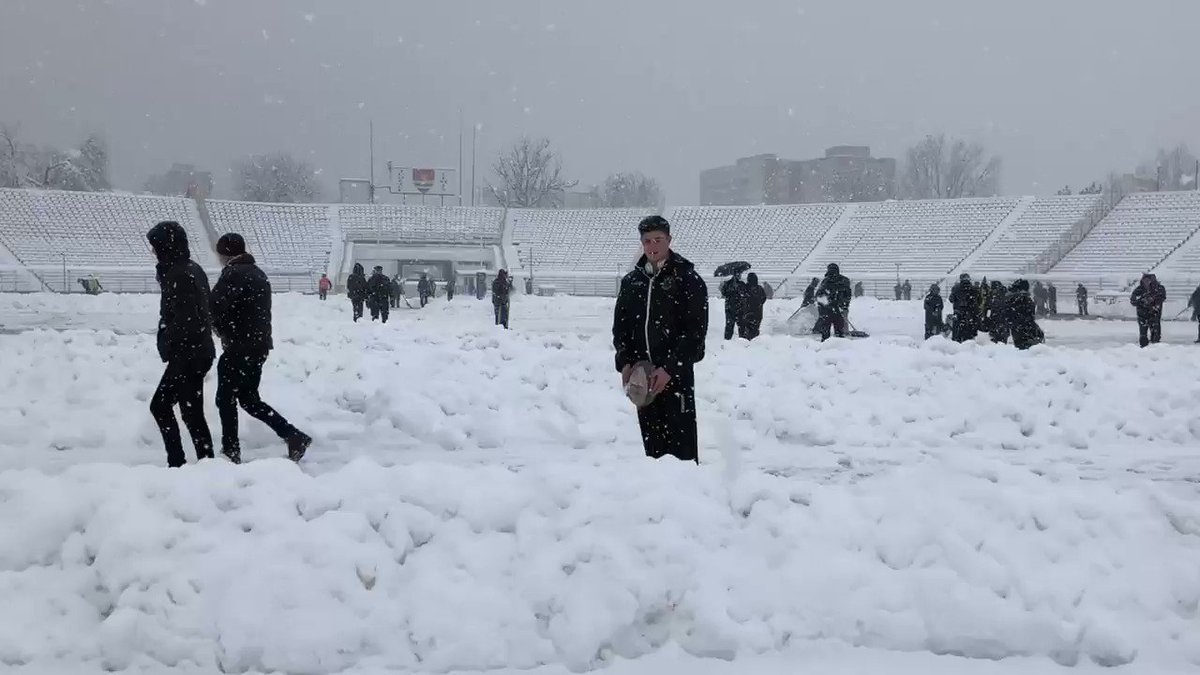
Unfortunately once they reached the Challenge Cup in 2016/17 Timisoara did not at all fare well. Not only were results bad, but they ended up with a sizeable fine for a cancelled match due to snow. There has only been bad news for the club ever since then, with talk of unpaid players and low morale, their main backer reducing investment, and players have been leaving.
Image result for timisoara snow rugby
The snowy pitch that cost Timisoara
yet another €30,000 fine from EPCR

They couldn't qualify for the 2018/19 Challenge Cup on merit getting knocked out by Heidelberger RK, but got through after the Germans were kicked out for ownership conflicts. It was widely expected that they would struggle badly, but in getting hit by yet another fine for a snowy pitch, and then taking 59-3 and 111-3 humiliating hammerings against the Dragons and Bristol it still managed to be a total horror campaign even despite the incredibly low expectations.

The Italians incidentally in the Continental Shield have also done much to alter the view of how having four of them in the old format was certainly not selecting the best possible teams. In the 2016/17 tournament Enisey-STM beat Mogliano 97-7 over two legs, whilst Krasny Yar beat Mogliano 48-24, and Rovigo 42-11. Even German champions Heidelberger RK could beat the Italians and in the 2017/18 season scored wins over the both the top two clubs (Petrarca Padova and Calvisano).

Whilst the Continental Shield also initially seemed a good concept, it has been underwhelming. If you look at the EPCR site you could be forgiven for not realising it existed given the little attention it gets. It has been cut down in size with clubs from Spain, Portugal and Germany all withdrawing due to (likely) financial reasons and possible lack of desire to really compete at Challenge Cup level.

This year there were only two competitors outside of Italy in the Continental Shield, and one of those (a selection side from Belgium the "Belgian Barbarians XV") was hardly prepared at all and was a bit of joke getting annihilated 68-12 and 89-7 home and away to Rovigo.
Image result for enisey stm bristol
The reported crowd at Enisey-STM
vs Bristol at Sochi was a mere 100

These recent results call into question whether there is worthwhile future for the Continental Shield and teams outside the main three European leagues competing in the Challenge Cup right now.

If there was more money to be made either from TV, sponsorship, and a growing fanbase from competing then this would be a non-question. However there does not appear to be much evidence this is the case given the amount of teams who have withdrawn from the Continental Shield. Enisey-STM playing in Sochi drew an attendance reported as small as 100 and was not televised. The probability that Challenge Cup participation right now is a loss maker for these clubs is pretty high.

Image result for Timisoara Northampton
Timisoara's 111-3 annihilation against
Northampton may be the last we see of
them competing in the Challenge Cup
For now it is hard to see any real point from the Romanian perspective at least to continue putting resources towards a series of thumpings and fines for snowy pitches. This is particularly relevant for a club like Timisoara who have reportedly been struggling to pay players and seem in little position to either produce or recruit the amount of talent to compete.

Some have suggested a return to the selection squads like Bucharest Wolves. They were not great (average scoreline in their 2014/15 campaign was 44-13), but at least did not suffer to the degree Timisoara have and get fines for snowy pitches. But again given the state they are in frankly Challenge Cup should not be the priority for Romanian rugby right now. There is also a reasonably strong chance such a side would be much worse in 2020 than they may have been 5 years ago.

As for the Russian clubs their downfall has been slightly more puzzling given a lot of their team getting thumped this season are the same players who were a lot more competitive only a couple years back. However one possibility is fact they are mostly the same team could be part of the problem.

They are not lacking experience, but the core of their squad looks very old and could just be over the hill now at this level. They went into each match this season with a starting XV with an average age of 30 or 31. Half of the XV against Zebre is aged over 32 with a handful veterans over 35.
Image result for enisey stm zebre
Enisey-STM have an ageing squad with
an average of 31 that has barely changed
from their debut Challenge Cup season

At that age a couple years difference can be noticeable and several of those players are probably nearing retirement. This is a side 3 or 4 years older than the average professional team, the rotational Bristol team that pasted them had an average age over 5 years younger.

This brings us onto a similar theme. It has escaped so much attention as Romania as it has not to the same degree or been as badly exposed, but Russia too over the past few years have also had a relatively poor time of late at junior level and been struggling to find the quantity of new young talent from those sides to come through and been relying on a core of older players.

Hence why at national team level they were giving a debut to a 34 year old scrum half (who was the 17th member of their U21 side of 2004 of which remarkably 8 players were still active in 2018). Also possibly hence why we see Enisey-STM enter the Challenge Cup this year with what is an ageing squad that has still barely changed since they first entered the competition back in 2015.

Again to reiterate the situation for Russia is not as dismal as it is for Romania but the general theme remains the same. They have neither been able to produce the level of talent to feed into their domestic teams, nor have they been able to recruit it from overseas either.

So what about the teams that have been considerably more successful in producing talent?

Georgia are notably the clear standouts in this regard, but it's also clear their domestic setup is not producing teams to the level to be competitive at the Challenge Cup. The Didi 10 champions from last season Lokomotivi Tbilsi have recently been playing in the Continental Shield against Italian opposition. Three of four matches those were close contests. If they were going to be competitive at the higher level that opposition would pose no problems.

Obviously the Georgian the domestic level is likely to be weakened with a considerable number of their players abroad, but that doesn't tell the whole story though due to the large percentage of those being props. There still actually remains some decent young talent which is feeding into the Didi 10. We saw this with the U20s and in the upset from the young fully Georgian based Georgia XV team vs Argentina XV in the summer (which didn't even include many domestic based international squad members).
roarse
Unlike some other leagues, there has not
been a really dominant team in Georgia
with the top talent spread across clubs and
5 different regular season winners in 5 years

But there has not been a really strong club side in Georgia owing to how dispersed across the Didi 10 that talent is. There are no one or two teams who stockpile the best talent and dominate unlike some other leagues. In November there were 8 domestic based players in the squad across 6 of the teams. Over the past five seasons five different teams have topped the regular season table.

That is in complete contrast to Romania and Russia in recent times. The SuperLiga final has been Timisoara vs Baia Mara in five of the past six seasons. In Russia it has been Enisey-STM vs Krasny Yar for eight consecutive seasons. Also been similar in Japan, up until this year Panasonic and Suntory shared all the past 8 Top League titles between them. That has made their league much more boring, but also meant a side like Enisey (previously at least), or Panasonic and Suntory (on paper clearly the strongest clubs from a Tier 2 nation) can be able to compete with low end clubs in elite leagues.
Image result for Georgia XV rugby
Georgia XV showed there is some talent
in the Didi 10 with their upset win over
Argentina XV in the Tbilisi Cup last year

Also of course need to remember the Georgians have only been having top tier level youth teams for four years. It will take time for that to feed into the depth of the league which has virtually zero overseas recruitment to boost it. Although clearly the fact they continue to produce a good level of talent, puts them in a better position to potentially field a reasonable side in the competition in future if not yet.

The other REC teams to consider are the Iberians, who both remain largely amateur, and in some cases lack ambition, and have been reluctant to compete in Continental Shield with the costs involved.

A bit of talk has happened in Spain about forming a more professional league. However for now mentions of professionalism is just talk, and they are still miles away from being talked about as possible competitors at Challenge Cup level and the impression you get is don't even want to be either.

So unfortunately being realistic it is hard to see really anybody representative from the REC nations be competitive in the Challenge Cup in the immediate term. The window where the Russian clubs could pick up wins appears to have passed, the Romanians too will unlikely get any better and those have been countries where the strongest REC clubs have come from in recent years. The Georgians maybe have potential upside, but not yet, especially with no club hording all the top players.

Hopefully there will still be a future for REC clubs to be more competitive in the Challenge Cup at some point. It's just right now that seems even more of a long term goal. In the meantime it may be of better use to focus more resources elsewhere with a possible view of coming back when in a stronger position. This season with Timisoara getting fined for snow and embarrassed by Northampton, or Enisey-STM in their off season travelling over 5,000km to Sochi to get thrashed by Bristol in front of 100 people. It simply seems now there is little value in the Challenge Cup for these clubs in just repeating that.

Thursday, 10 January 2019

Rugby in Eastern Europe in a terrible state

The emergence and continued rise of Georgian rugby has been one of the best stories in the sport over the past 15 years. However not only are they somewhat of an anomaly as a nation who went from absolutely nowhere to quickly reach RWC level, but they also buck another unfortunate trend as rugby in Eastern Europe currently seems to be otherwise in poor health right now.

Romania's severe struggles at junior level for the past several years and horrible 2018 have been well documented on this site. But the Oaks may be the most high profile team but are far from alone as several other lower ranked nearby nations have been going through tough times themselves.

Around 5 years ago Moldova looked to be a team on the up with some of the characteristics of a very early Georgia. They started the European Nations Cup in 2000 in the very lowest division playing the likes of Israel and Bulgaria, and rose up the levels and got very near promotion to the REC ahead of Germany in 2013/14, and did so with a big pack which notably included their first two players Vadim Cobilas and Dmitri Arhip to have gone onto have successful careers in major professional leagues.
Moldova have spectacularly crashed
from a World Ranking high of 25th to
now 56th in space of just four years 

To say their fortunes have dipped since then is an understatement as they have turned out to be the Kazakhstan of this current RWC cycle. As a Union they have totally crashed. In 2018 they continued to an ongoing 11 match losing streak, were relegated from the RET, and now in the fourth tier of European rugby they recently lost 80-6 to Sweden (a team they beat 57-8 back in 2014), and their World Ranking has plummeted from a high of 25th in 2014 to currently 56th.

At junior level their results are horrendous as well. Their U20s have not competed in a Rugby Europe tournament since 2015, whilst their U18s last year lost to Hungary (41-5), Israel (31-7), & Croatia (46-0) to rank 27th out of 27 European nations who competed at U18 level (in 2017 they also ranked 29th out 30 European nations who competed at U18 level beating Bulgaria in a last place playoff).

The only positive for Moldovan rugby this past year is an impressive new tighthead prop in Cristian Ojovan achieving a 4 year professional contract at Aurillac. He should hopefully have a good long career for another decade, but you can't expect many more players are likely to emerge into the professional game with the current state the Union is in and some of the continent's worst youth teams.

Meanwhile Ukraine were in the REC as recently as 2012 but have also fallen badly. They went from winning all their games RET in 2015, to losing them all and getting relegated to the fourth tier in 2016.

The most well known Czech player Jan
Macháček with Montferrand in 2001
Another team who used to be in the REC is the Czech Republic who spent six seasons in the competition between 2003 to 2008 with a few players with Top 14 experience such as Jan Macháček, Miroslav Němeček, Lukáš Rapant, and Martin Jágr.

The last of those players retired a couple years ago and saw little coming through to succeed them. After lock Martin Wognitsch left Angoulême in the summer it meant there were no Czechs left in professional rugby in either of the top two divisions in France for the first time this Millennium. Also since dropping out the REC they then were relegated from the RET in 2014, and despite having gotten their place back in 2017 look well set to be relegated again this year.

Elsewhere Poland have still not produced another player to feature in a major professional league since Gregori Kacała in the 1990s and do not appear to be a contender for promotion to the REC any time soon. They recently got trounced 49-0 at home by the Netherlands in November.
Image result for Jonas Mikalčius
Lithuania wing Jonas Mikalčius had his
career ended by a serious knee injury

In the Baltic states, Lithuania have just seen their star prospect Jonas Mikalčius' career ended at 23 by a serious knee injury soon after he had just earned a move to the English Premiership with Harlequins, whilst Latvia's only pro players Uldis Saulite and Jurijs Baranovs at Enisey-STM are both likely near retirement.

Although there has been some more positive news for rugby in Hungary who had their first ever player to reach pro level this year in Bence Róth with Bourg-en-Bresse in Pro D2.

Whilst Russia for the last few years have not exactly made huge progress or produced a bunch new young players to come through either. Although the mood of course has been changed there since receiving a surprise RWC qualification, which has boosted the Bears as they achieved two of their best results for years against Canada and Japan off the back of it. They will hope to build off an appearance on the sport's biggest stage more successfully than they did post 2011 and improve their production line of talent at youth level (which has not been great but also not as bad as Romania).
Image result for gonzalo lópez bontempo espana rugby
Spain U20 thrashed Romania 70-6
in a friendly match last month

Overall though East of Germany the picture does not really look particularly positive for rugby in Europe right now aside from Georgia. Most of the other European sides who appear to be making the most progress, certainly in terms of youth development, are all in the West.

Since Georgia U20 have had a place in the WR U20 Championship, it has been the Iberians Portugal and Spain who have been the ones usually playing it out for a spot in the U20 Trophy and look the best at U18. The latter in particular look to be in a better position to potentially see more homegrown talent of the level to play professionally in France in future compared to others. Along with that Belgium and the Netherlands also have improved in recent years into REC or potential REC level teams.

At junior level all those Eastern European RET teams have shown nothing. Romania had an awful year U20 wise yet still beat Ukraine 76-13, who had in turn beaten Poland 42-13 the match before that. Not results offering much encouragement for new players coming through.

It would be great to see a side from Eastern Europe become the "new Georgia" in terms of a 100% homegrown side rising out of nowhere and very meagre resources. However at this point not only is little progress towards that happening, but rugby in some of these nations seems to be in a dire state going backwards. Hopefully entering into a new decade this pattern can somehow reverse itself.

Tuesday, 4 December 2018

A look at the RWC 2019 schedules for Tier 2 sides

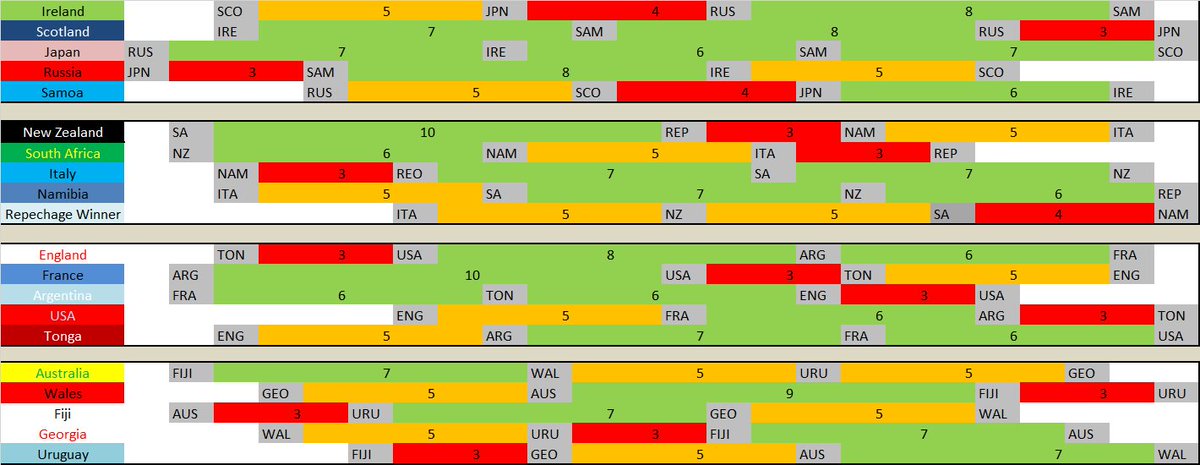
According to WR CEO Brett Gosper the "goal is to have most competitive RWC ever (T1vT2)" and the "2019 schedule is most balanced RWC ever for Tier 2 countries". He also noted it was "the longest ever T2 rest periods are ahead of games vs T1s".
Japan taking on Scotland in 2015 just
three days after playing South Africa

And it is true at the 2019 RWC fewer of the short turnarounds that Tier 2 sides will have to face seem to involve Tier 1 sides which must have come from feedback from coaches after the last RWC.

In 2015 several Tier 2 sides had to back up against two Tier 1 sides on a very short turnaround (Japan vs South Africa then Scotland, Fiji vs England then Australia, Tonga vs Argentina then New Zealand, Romania vs France then Ireland). That would be tough even for bigger teams with more depth to get optimal results against sides like Australia, Ireland, or Scotland only a few days after playing England, France, or South Africa (the short turnarounds for Tier 1 by contrast all mostly involve one of the lowest seeds in the pool usually after rather than before a big game).

This time there are none of those tight turnarounds against top ranked sides in the tournament, but what this means however is more of the matches with short rest for Tier 2 sides are ones that are the two most winnable in the pool. Notably for Uruguay (Fiji then Georgia on three days rest), Georgia (Uruguay then Fiji on three days rest), Russia (Japan then Samoa on three days rest), or USA (Argentina then Tonga on three days rest) are left with squad management dilemmas.

Within the constraints of five team pools that guarantee some short rest periods, and TV demands that mean matches between the big teams are not midweek games, WR do seem to have been genuine in at least attempting at something a bit better relative to past tournaments. Obviously some teams still have got tough schedules (Canada perhaps the worst), and the only real way to be able to remove the worst of the short turnarounds in scheduling is with 4 team pools in an expanded 24 team RWC.

At RWC 2019 one team in each pool (Japan, Namibia, Tonga, Australia) have got lucky with no really short three or four day turnarounds at all and three of those are Tier 2. By comparison in 2015 five teams had no three or four day turnarounds and only one of those (Samoa, who qualified as second pool seed) were not Tier 1. Also no side in 2019 has to play not just one but two of their matches on three or four day turnarounds, whereas in 2015 five teams had to and all of them were Tier 2.

Here we take a quick look at exactly what each Tier 2 team will have to prepare for next year.

Pool A


 Japan | Russia [7 days] Ireland [6 days] Samoa [7 days] Scotland

As hosts of the tournament the Cherry Blossoms get the best schedule of a 6-7 days rest between each match. What's more is that two of their opponents in Samoa and Scotland play them on a short turnaround (although the latter the match before is Russia so may not have that much impact), whilst Russia also play their most winnable match on a short turnaround after playing them.

This is marked change to some of their previous tournaments for Japan. In 2003 they got rest periods of five, four, and three days and notably faded after a decent start to the tournament against Scotland and for part of the match against France. In 2015 the schedule made reaching the quarter finals very difficult even despite the win against South Africa (especially as the Boks got a double losing bonus point in that match). This time if Japan do not perform it will not be to do with their schedule.

 Samoa | Russia [5 days] Scotland [4 days] Japan [6 days] Ireland

Samoa get the advantage of playing Russia on a short three day rest, but then themselves face the hosts Japan on just four days rest from playing Scotland. Even though recent form would have them firm underdogs, they have risen to big occasions in the past and will be targeting that Scotland match, the result of which would likely determine their approach to the Japan match on short rest afterwards.

 Russia | Japan [3 days] Samoa [8 days] Ireland [5 days] Scotland

In the opening match of the tournament with 50,000 fans and a big TV audience, there is no question that Russia will want to kickoff the tournament with nothing less than their best and after this November will believe they could even cause an upset. The Bears don't have enormous squad depth and the next match is their most winnable but on 3 days rest against a fresh Samoa side which will be hard does reduce their chances of getting an upset and first RWC win in this tournament.

Pool B


 Namibia | Italy [5 days] South Africa [7 days] New Zealand [6 days] Canada

If there was ever a tournament Namibia were going to break their RWC duck it is this one as both pool draw and scheduling has been favourable. Unlike the past two RWCs where the Namibians were simply shot by the end (see Wales 2011 or Argentina 2015) after fielding more or less a full team throughout on some really tight turnarounds, this time they get a much better schedule. Not only do they play the big teams on more reasonable rest, but they have also drawn an off form Canadian side and will have full rest for that too, whilst the Canucks will come into that four days from playing South Africa.

 Canada | Italy [5 days] New Zealand [5 days] South Africa [4 days] Namibia

Unluckily for Canada they are the only team in the tournament who do not get a full week rest once. They cannot play the same team throughout and are the team who the schedule makes possibly most likely to field a weakened side against a major team (probably South Africa) in order to keep something left for the most winnable match against Namibia at the end. This is a bad schedule for Kingsley Jones' team, only consolation is two of the Tier 1 opponents Italy (coming off Namibia) and South Africa (coming off Italy) also play them on short rest as well.

Pool C


 USA | England [5 days] France [6 days] Argentina [3 days] Tonga

Some over the course of this year have started to believe the USA have become overwhelming favourites against Tonga at the RWC. A look at their record against them (and Pacific Island opposition in general) would suggest that is not the case, even less so when you consider they play that match on 3 days rest.

The matches against Australia and South Africa in the past two RWCs with weakened teams were horrible matches for Eagles fans and may have even had the effect to sap morale from the camp and supporters as much as it did to rest players. You get the sense Gary Gold may not repeat that this time around and will aim for strong performances both against Argentina and Tonga. It is a tough challenge to deliver and will test the depth and conditioning done for the tournament next year.

 Tonga | England [5 days] Argentina [7 days] France [6 days] USA

Along with Japan and Namibia, Tonga are one of the three lucky Tier 2 sides who have got a schedule with no really short turnarounds. They also play both their final two fixtures against France and USA against sides on three days rest. The Ikale Tahi could not have got a much better schedule and can really target a good result at every match.

Pool D


 Fiji | Australia [3 days] Uruguay [7 days] Georgia [5 days] Wales

This is somewhat better than the nightmare pool draw and schedule Fiji had in 2015. Their match on short rest this time is Uruguay, a team they have recently obliterated and can likely back the depth of their squad to get a good result whilst resting top players. They also get an advantage of coming from that fresh for their next match with Georgia who will be coming off 3 days rest.

 Georgia | Wales [5 days] Uruguay [3 days] Fiji [7 days] Australia

The pool draw for RWC 2019 was not great for Georgia. The fourth pool seeds have a wide range in quality from Fiji at World Ranking 8 to Namibia at 22, and the Lelos not only got the toughest possible fourth seed but a schedule where they face them only on 3 days rest. This is a tricky test for Milton Haig as whilst Georgia will be favourites against Uruguay beforehand, they are not as strong favourites as Fiji are and have a habit of not looking great against weaker teams (see Namibia 2015 one of many examples) so cannot really afford to take Los Teros lightly either.

However Georgia does have a bit more depth than in previous years, so rotating some frontline starters to get past Uruguay may not carry quite the same risk as before. Certainly Haig has two front rows, back rows, and scrum halves he could swap without losing too much. Georgia will need to produce one of their best ever results to beat a fully prepared incredibly talented Fiji team on this schedule.

 Uruguay | Fiji [3 days] Georgia [5 days] Australia [7 days] Wales

The Uruguayans achieved one of their best ever results beating Canada away to qualify as Americas 2 for this tournament and avoid going through the Repechage for the first time. However this has meant they actually got a much more difficult pool to win a game, along with another hard schedule.

Uruguay have their most winnable game against Georgia on 3 days rest from their second most winnable game against Fiji. Only thing in their favour is that Georgia will have to also deal with a tight schedule playing on three days rest themselves after that match. Los Teros need to be at their very best to get good results from this pool, even against the Tier 2 sides, and they do not have great depth in many positions which makes managing the squad much harder for Esteban Meneses.

Full RWC 2019 schedule of rest periods (chart by @rpetty80)