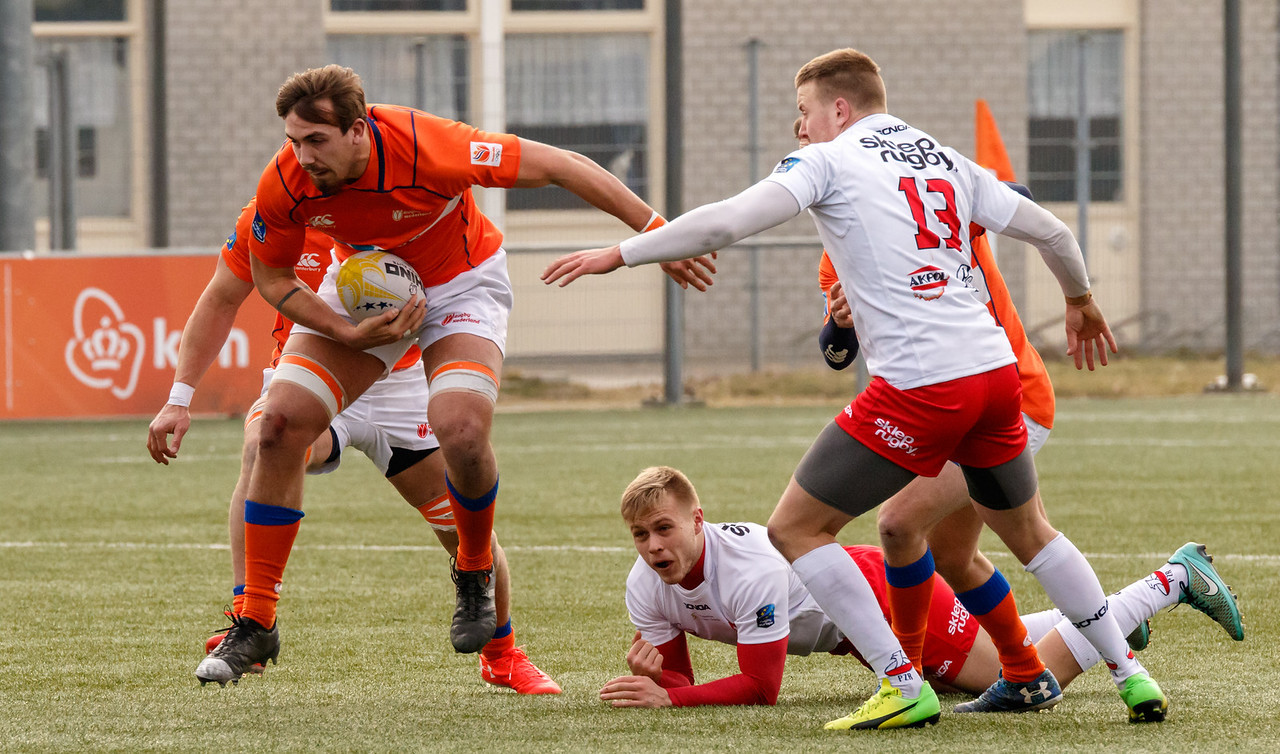
Showing posts with label Netherlands. Show all posts

Thursday, 22 August 2024

Can Netherlands unlock their rugby potential?

Netherlands are generally pretty good all rounders at sport. According to an algorithm that is "is a measure of how likely a country's medal tally is if all people and countries had the same medal-winning capabilities" they were the fourth most successful nation at the Olympics (behind Australia, France, and Great Britain). They won 15 Gold medals (a Dutch record) in 7 different sports which varied from track & field athletics, 3x3 basketball, cycling, hockey, rowing, sailing, and swimming.

This success reminded of the great potential they have to be strong at rugby as the country and its people tick many boxes to make rapid progress possible.


Size: There rarely ever goes a mention of Dutch rugby without somebody commenting on their famous height with the average male over 6 foot.

Someone once mentioned maybe they could become exporters of locks to clubs in France like Georgia is for props. True to stereotype, they don't struggle to find 2m locks, among their homegrown pros currently abroad are Koen Bloemen (Aurillac, 2.03m), Skip Jongejan (Aurillac, 2.01m), Renger van Eerten (Brive, 2.03m), Fabian Holland (Highlanders/Otago, 2.04m), Stan van den Hoven (Miami/Manawatu, 2.03m). These are all just players who emerged from an improved Dutch age grade system to win pro contracts in last 6 years. Spain and Portugal barely have more than two homegrown 2m locks between them in their history.

2.04m tall Fabian Holland is tipped to be a potential All Blacks
lock in the future once he qualifies via residency in 2025 (his
brother Quinten, also a lock, has also now joined him in Otago) 

Athleticism: size is generally an asset in rugby but it would useless if not paired with athleticism and mobility round the field. You can see in Dutch athletes like Femke Bol height is combined with speed and endurance. The best known Dutch rugby player to date, Tim Visser, who was the URC top try scorer four seasons in a row between 2009 to 2013, and later played Tier 1 international level for Scotland was also fast at 1.95m tall.

World famous 400m hurdler Femke Bol (who incidentally is the same height &
weight as the greatest female rugby athlete of all time Maddison Levi) powered
Netherlands to mixed 4x400m relay Gold recently at the Olympics

In addition to the native Dutch, they also have some immigrant diversity in the population, with links to other athletic populations. The football team has over the years featured numerous famous players born or with parents from Suriname like Edgar Davids, Clarence Seedorf, Patrick Kluivert, Nigel de Jong etc. In athletics Churandy Martina from Curaçao reached five Olympic finals in 100 and 200m in the Usain Bolt era (he initially won 200m silver in 2008 but got disqualified for lane infringement). Although this demographic has yet to appear in Dutch rugby, if they could reach it, there is clear athletic potential.

Famous Dutch footballers born or parents were from Suriname include
Clarence Seedorf, Patrick Kluivert, and Edgar Davids. Could Dutch rugby
find any future star talent from this sporting demographic?

Developed world: To achieve great success across a range of sports at the Olympics, or in team sports that is a collection of players, it requires good competent non-corrupt developed world organisation, training, and funding. Netherlands is generally listed in the top 10 of world governance efficiency rankings.

They have shown this highly organised strategic development success in other team sports, most famously in football with the Ajax Academy, and in their success in hockey with male and female Olympic golds recently. But also to some very minor early stage extent in rugby in the speed of which Rugby Nederland was able to build an U20 program that used to be miles off, losing 42-5 to Portugal in 2017, to one that has now beaten them two years in a row and qualified for the World Rugby U20 Trophy this year. In a sport where hierarchies can be very static and development tends to happen only at a slow pace such improvement is notable.

The all star graduate XI of the famous Ajax football Academy

Geography: Some countries are so big (Russia, Brazil, North America) it can cause considerable logistic challenge and expense to national team sport training. Others may have difficulty with small playing populations spread over rural farming areas (Namibia). Or just relatively small populations to support many minor sports (Uruguay). Netherlands strikes a good balance in having a reasonable sized population (17.7 million) in not too large a country that is easy to travel around and train with teammates or play domestic opponents.

Some nations (especially in East Africa) also suffer from distance and isolation from any major Tier 1 rugby power with pro rugby. Netherlands though are located close to both France and the UK. This means it is far easier for them to make frequent in person connections and exchange of ideas with those with knowledge and experience in the professional game. And in particular the proximity to France means it is easier for young players to get scouted for Espoirs contracts to try and become top level professionals without having to move so far away from visiting family and other support back at home.

Netherlands dense 17.7m population and proximity to Tier 1
rugby powers especially France is a notable advantage

Open sporting niche: As in most of Europe, football is king in Netherlands and will always likely be so, but there is room in a sporting culture for multiple sports. Rugby occupies a particular niche of full contact team sport that appeals to those who maybe like the idea of combat battle sports like wrestling, but with also the teamwork and passing and kicking skill of basketball and football mixed in, and also has an international game that their national team can compete in. One of the main reasons that Europe has so much growth potential for rugby is that niche is quite open in several notable countries including the Netherlands.

All this outlines the Dutch potential in rugby should they be able to grow the sport in national popularity. But there is one strange thing about Dutch rugby. Their fanbase hasn't yet got much behind their improving national team.

It was a surprise to read that according to World Rugby the Netherlands was among their best markets for tickets at the recent World Cup in France. The reason it was a surprise is you would not have guessed there was much of an audience for rugby based on following their national team.

Despite being one of the most improved international teams of the past decade, the crowds for national team games are still pretty small, and compared to other REC nations like Georgia or Spain, their rugby community has a relatively quiet presence online as well. None of their social media accounts get that many followers or engagement.

Yet at the same time when the Cheetahs played a Challenge Cup match against Zebre in Amsterdam in January (hardly a clash between two big teams) they quickly sold 4,500 tickets to fill their small stadium (this presumably was a nice boost for the Cheetahs who played their neutral matches the previous season in Parma in front of one man and his dog).

Cheetahs were the biggest ticket selling rugby team wearing Orange in
Amsterdam this year inexplicably at expense of the Dutch national team

So what is going on? It appears from the outside, that there is some small fanbase for rugby in Netherlands, but they became so accustomed to their own national team being so obscure and lowly ranked, seeing their most famous player play for Scotland instead, that they associate the real sport of a serious level is only played by "Tier 1", and have not paid attention to or noticed the huge progress and emerging talent made in their own country.

This is why they are one of the teams for whom 24 team World Cup expansion could be so important. For the first time they have a realistic chance to qualify (their best hope is mostly likely in the Repechage after getting the harder pool in Rugby Europe qualifying). If they could manage to do so, this could be a huge opportunity to announce to the Dutch public and media, that Netherlands now has a team of its own to get behind and support.

What an amazing sight this would be if it was one day at the RWC!

We have seen how debut World Cup appearances achieved a legacy of significant progress down the line in Georgia and Portugal. So the hope is if they can break past that (now lower) barrier of World Cup qualification it will take interest and investment in Dutch rugby to the next level and further unlock some of the great potential they have.

Thursday, 25 August 2022

The Six Nations waste potential to power rugby's growth

[This is a follow up post to a previous one about how the RWC has been the main driver of global growth over the past 20 years]

One may look at Italy and their results over the past 9 years and ask "How has being in the Six Nations helped them? They constantly lose". It is not often you see this point made, but in actual fact Italy has benefited MASSIVELY by being added to the Six Nations.

To understand this properly you need to think of the counterfactual where Italy were ignored by the Six Nations and remained a "Tier 2" side in the REC. In this hypothetical world all the following things would have most likely been different:

  • They would not have the annual budget of all the top five REC sides Georgia, Romania, Spain, Portugal, & Netherlands combined.
  • As a result not had the money for professional teams in the URC.
  • More often played at far smaller stadiums with far smaller crowds.
  • Not had the money to invest so much in improving what was a weak youth system.
  • Nor the regular international competition for that youth to test themselves.
  • Nor would they have the full 3 votes on the World Rugby Council.
  • Selection would have less consistency and involve more negotiation with clubs.
  • Nor would have they been able to select anywhere near the level of foreign imports and heritage players they have managed to get available over the years (over the 2003-2013 period this was a high percentage of their most significant players).
  • And may have very likely got caught fielding ineligible players and like Spain got booted out of a RWC by Russian sleuths if they played in REC too.

It is true Italy's wooden spoon collection has hardly made them the ideal example of how entry to the Six Nations can grow the sport. But that is only if you ignore what the Six Nations prevented them most becoming: a mid-table REC side probably 5 or 6 places lower in the rankings than they are today and without the ability to invest so much in improving youth.

The more you think about this. The more totally obvious it becomes. Of course Italian rugby is much better and richer than it would be otherwise outside the Six Nations. It is for this reason any suggestion they voluntarily put their place at risk in a relegation playoff is a non-starter.

Despite many losses Italy's participation in the Six
Nations has still boosted their level immensely.
Sadly for the sport though few appear to have properly understood this and been able to follow the logical implications of how spreading some of those same benefits of the Six Nations to others would grow the game on the rest of the continent. Instead after every bad result over the last 8 years we have more often heard useless talk of kicking Italy out of the Six Nations (a truly terrible idea that would risk setting them back years).

People now just assume if Georgia or Portugal were added to the Six Nations they would just be another Italy. However much like when the RFU wanted to exclude both those nations from the 2007 World Cup. This is a hopelessly short termist growth killing viewpoint.

Instead what they should be thinking is: "Georgia and Portugal are pushing Italy hard to close and exciting competitive games despite having only a fraction of their budget. Imagine how much more they could grow if the Six Nations opened its doors and they were able to get considerably more funding and experience".

Also: "Spain got a crowd of 40,000 for an exhibition game. There is huge growth potential there. Imagine how much stronger they could be with the budget to maintain a more consistent selection and retain homegrown players like Lucas Paulos and Samu Ezeala. Plus add heritage players the level of Joris Segonds or Rémy Baget like Italy has always been able to do with the likes of Parisse and Castrogiovanni, or in more recently Polledri and Capuozzo".

Lamentably though it is doubtful any thoughts along those lines crossed the mind of a single one of the Six Nations blazers this summer. And that is why the sport struggles to grow.

Georgia and other REC nations compete with a
fraction of the budget of Italy and other "Tier 1". 

Instead of encouraging and inviting growth. The vague alternative idea seems to be that "Tier 1" plays "Tier 2" occasionally in friendlies. And for a team like Georgia to ever join the Six Nations they must follow the same model as Italy and work their way into the tournament through a few wins in those friendlies until they can no longer be ignored (it is sort of the libertarian "pull yourself up by your bootstraps" line of thinking).

This idea basically means Georgia (or any other REC side) is asked to beat Six Nations sides despite having a fraction of the budget, a fraction of the professional player pool, a fraction of the top level experience, and those occasional matches when they happen most often being played away from home.

Unfortunately some clueless people think this is the best and most efficient way to grow the sport. Instead of expanding the Six Nations and enabling them to build a better budget, player pool, and experience to be able to compete. They are asked to perform a miracle only possible with a one off "golden generation" (which would then be wasted as they'd have spent entire careers playing those friendlies and be retired by the time they ever got into the tournament).

When discussing Georgia and the Six Nations. You will commonly hear something along the lines of "yeah, they should get chance of some more "Tier 1" games, but not the Six Nations". Whilst on the surface this may sound supportive, in reality it maintains the vastly uneven playing field and is basically just fobbing them off. Anyone who repeats that line with no plan of Six Nations expansion attached is not genuinely serious about growing the sport.

Expecting teams to repeat Italy's early professional
era wins over Five Nations sides is unrealistic and
ignorant of how international rugby has changed.
(Note: The comparison to Italy c.1997-98 is utterly flawed for another reason. In those barely just turned pro years of the sport. Scotland (at home) could lose 68-10, France (at home) could lose 52-10, and Wales could lose 96-13 versus South Africa. Ireland (at home) could lose 63-15, England could lose 64-22, and Argentina could lose 93-8 versus New Zealand. Never in the history of the sport was the gap between 5N and SANZAR bigger. Nowadays the international landscape is totally different. It is simply not a fair comparison for example to compare Georgia playing Ireland in 2022 to Italy playing Ireland in 1997).

Expansion can be in the interests of "Tier 1" too

Obviously expansion to the Six Nations should be in the interests of every REC nation and anyone who genuinely cares about growing the sport (a lot of fans may say they do but when it comes to applying the necessary changes needed very clearly don't).

But there is another reason why expansion and involvement of "Tier 2" in big events ought to be in the interests of "Tier 1" instead of just playing "Tier 2" in friendlies.

Anyone who has followed rugby long enough should know vaguely supportive promises of "more games for Tier 2 between World Cups" are far from reliable. In 2017 World Rugby pledged to increase "Tier 1 vs Tier 2" matches by 39% over 2020-32. However pretty much the status quo remains (four SANZAAR sides play four of the Six Nations sides on a July/November weekend with the two left over Six Nations playing a "Tier 2" nation).

Reason for little change is obvious. Those friendlies are on some level fundraisers. The biggest draws are the biggest brands (ie All Blacks). When it comes down to it, no "Tier 1" side is volunteering to play two rather one "Tier 2" side in November. For matches involving less established teams to attain high commercial value it requires attachment to a big brand event.

A perfect example of this is the last three matches between Fiji and Uruguay. Despite being one of the lower profile games shifted to midweek, in 2015 and 2019 the fixture sold out stadiums in both Milton Keynes and Kamaishi which were broadcast to global audiences on TV. By contrast in 2018 they played a November friendly at Hartpury College and the crowd was in three figures and only streamed on YouTube. Many of those fans did not come for Fiji vs Uruguay specifically. They came to see the RWC.

Ireland vs Romania sold out Wembley to set
the record crowd of 89,267 for a RWC match.
Similarly in 2015 when we saw Ireland vs Romania sell out Wembley to set the RWC attendance record of 89,267. It was not Romania that were a huge draw per se. Again it was the RWC as an event that sold.

The Six Nations as an event has a similar effect in selling the matches involving a somewhat lower profile team in Italy. We can see this by comparing the fixtures involving Italy in the Six Nations and the exact same fixtures when played as friendlies in RWC warm ups.

2003 RWC warm ups:
25,000 vs Scotland in Edinburgh (20,000 fewer than previous fixture in the Six Nations)
14,000 vs Ireland in Limerick (35,000 fewer than previous fixture in the Six Nations)

2007 RWC warm ups:
14,000 vs Ireland in Belfast (35,000 fewer than previous fixture in the Six Nations)

2011 RWC warm ups:
20,000 vs Scotland in Edinburgh (22,000 fewer than previous fixture in the Six Nations)

2015 RWC warm ups:
10,000 vs Scotland in Torino (56,000 fewer than previous fixture in the Six Nations)
43,000 vs Scotland in Edinburgh (19,000 fewer than previous fixture in the Six Nations)
52,000 vs Wales in Cardiff (14,000 fewer than previous fixture in the Six Nations)

2019 RWC warm ups:
30,000 vs Ireland in Dublin (21,000 fewer than previous fixture in the Six Nations)  
25,000 vs France in Paris (25,000 fewer than previous fixture in the Six Nations)
50,000 vs England in Newcastle (32,000 fewer than previous fixture in the Six Nations)

Some of those crowds are good (50,000 in Newcastle or Cardiff). But still on average across those 10 friendlies Italy games sold 28,000 fewer tickets per match at presumably lower prices and lower TV rights than they did in the corresponding Six Nations fixture. The largest effect is seen in Italy itself, who attract far better numbers for the Six Nations than friendlies.

To be fair "Tier 1" Six Nations sides (besides Italy) get quite healthy crowds these days hosting their annual "Tier 2" fixture in November, but those matches are still obviously of much higher commercial value as part of big events than friendlies.

If the Six Nations would be willing to think long term there is also the larger potential future pay off in creating more competitive teams with bigger fanbases, and having a tournament with more matches to sell, which allows for more possible exposure for sponsors and larger TV deals. The modern day RWC has grown more lucrative as an event for these reasons and Six Nations could too. "Tier 2" growth should not have to come at expense of "Tier 1".

Conclusion: Six Nations has huge potential power to grow the sport in Europe that it is wasting. As seen at the RWC, most growth comes from expanding major tournaments, not from friendlies.

"Tier 1" blazers take the view that the big mid-RWC events must ultra exclusive to themselves, and they will "grow the game" with the odd friendly. This gets it totally back to front. It is the big events that make the biggest impact in growing the sport and should aim to be inclusive. Then you can leave sides to organise friendlies and three match test series mostly as they please.

For rugby to grow, and one day fully shed its "Tier" tags, it is crucial that its administrators open their minds to the idea of expansion of the major mid-RWC event. There are huge potential gains to be made throughout the continent from an expanded European Championship event (maybe once every four years similar to football). Especially for all those labelled "Tier 2" of course, but long term also "Tier 1" as well.

It is incredibly frustrating the Six Nations with their total lack of vision and desire for growth fail to see this. European expansion should be seen as a great opportunity for the sport, where unlike the USA there is a more open niche available for full contact team sport, but it gets ignored and wasted as "Tier 2" sides remain asked to compete at enormous financial and competitive disadvantages in perpetuity. Rugby has to look at where successful examples of growth have come at RWCs and apply those lessons to their other major events.

Video: Everything Georgia captain Merab Sharikadze says here is spot on. "Rugby must be more open".

Thursday, 26 July 2018

The impressive ambition of a young generation of Dutch players

As a rugby nation the Netherlands has not had much success over the course of the professional era. Their only ever test against a Tier 1 nation finished 110-0 vs England in 1998. They were also briefly in the second tier of European rugby the Rugby Europe Championship in the early 2000s, but were soon relegated in 2002 finishing with a points difference of -273 and average losing margin of 55 points.

After that for the next decade the Dutch became the yo-yo team between the third tier and fourth tier of European rugby. Between 2004 to 2015, they lost 20 from 21 games in the Rugby Europe Trophy and were twice relegated, whilst won 14 from 16 in the fourth tier to always go straight back up.

However after such a weak record over the first 20 years of professionalism, and nearly going bankrupt in December 2014, in the past couple of years things have begun to look brighter for the Oranje. In fact they could be said to be arguably one of the most improved sides in international rugby.

As recently as 2012 the Netherlands were losing 58-3 to their neighbours Belgium, were relegated to play the likes of Malta, Croatia, or Israel in Europe's fourth tier, and had a World Ranking of 47.

Now over the last couple of years or so in the Rugby Europe Trophy, the Dutch have won 7 of their last 9 home games having previously won 1 in their last 10, and snapped a 14 match losing run away from home to win 4 of their last 6 on the road. In 2017/18 they won four out of five games in the competition for the first time in their history, the only loss coming away to Portugal. In March this year the Netherlands reached an all time World Ranking high of 26th, 21 places higher than they were in 2012.

Perhaps the most interesting development in Dutch rugby over the past couple of years though, has been the very recent emergence of a group of young talent who have travelled abroad to try and make it at a higher level as professional rugby players.
Image result for tim visser nederland rugby
The two most successful Dutch
players Tim Visser and Zeno Kieft

In the professional era the Dutch have only had three players to have played professionally. Most notably of course Tim Visser (251 appearances over 12 seasons for Newcastle, Northampton, Edinburgh, & Harlequins, plus 33 caps for Scotland), who was followed to the UK briefly by his brother Sep Visser (8 appearances for Edinburgh), and also Zeno Kieft (68 appearances for La Rochelle). Now in just the past two years twice as many young Dutch players have joined professional clubs as did so in the previous 20.

Firstly in 2016 lock Koen Bloemen and number 8 Kevin Krieger were among a group of Dutch players given trials at Montpellier which led to them successfully winning contracts, both of which have been subsequently extended. Krieger who is described by his national team coach as "a beast" for who "the sky is the limit" has been gradually growing into a similar build to that of his clubmate Louis Picamoles, and already at just 19 years old become a starting player for the Dutch senior team.
LunaPic Edit 20987520_299636960445130_8708018335482118144_n
Stan van den Hoven received superb
reports in NZ with Bay of Plenty U19

Then in 2017 another lock Stan van den Hoven, a 2.03m 113kg giant at 18 and who was part of that group but did not get a contract at Montpellier, moved to New Zealand. He clearly impressed mightily, as he not only made the provincial squad but was named U19 player of the year at Bay of Plenty (in a team that had four New Zealand U20 squad members), plus was also selected to train with the New Zealand U20 squad, and part of the Chiefs Development squad. He got a superb review from one of his coaches who noted whilst on arrival he was "very raw in terms of subtleties of the game", he made incredible progress as his "commitment to improve" was "something that I have never seen before in a player" and that "no doubt Stan van den Hoven is a name we will hear a lot more about in the future".

Also soon to be joining him in New Zealand is dynamic back rower Dave Koelman, who last season was awarded a scholarship deal to play in England and was part of the Leicester U18 Academy side that were English champions. He apparently had an offer to stay at Leicester, but instead opted to further his rugby education and take up an opportunity to play at North Harbour instead.

Video: Dave Koelman's ball carrying playing for Netherlands U18 a year young in 2017

Whilst most recently after the Rugby Europe U20 Championship two more Dutch players signed contracts with Aurillac, one of the top 8 Espoirs teams in France. First announced was another back rower Jesse de Vries, and then fly half Jasey van Kampen, who had just spent a year at Le Havre in the lower Fédérale leagues who he joined specifically to work with ex Gloucester fly half Ludovic Mercier as coach.

Video: Jasey van Kampen's sensational match winning fly half performance vs Romania

Others who may join them in the future include Siem Noorman, the youngest member of the senior national team having made his debut at 18 last year and scored 3 tries in 5 matches in the Rugby Europe Trophy this season, another who was part of that first trial at Montpellier and who has talked of his desire to play professionally. Or also the talented prospect at scrum half Lorenzo Groos, who like Koelman still has years left to play at U20 level.

For that many players from one single U20 side from a Tier 2 nation to move to professional clubs abroad is highly unusual. The fact it they are from the Netherlands of all places, and that one of those players is a fly half which is a position of such rarity for any player outside Tier 1 to reach a high level, just makes it even more so.
Koen Bloemen and Kevin Krieger
after their first match with Montpellier

To put it in context, the only other Tier 2 nations this year with more U20 players signed to professional clubs is Georgia, and they had an U20 team beating 6 Nations sides and competing with some of the best U20s in the world, plus have a well established link to France with around 60 players currently contracted to Top 14 or Pro D2 clubs. Netherlands U20 this year came 4th in the Rugby Europe U20 Championship (although they looked a more talented group of players than that placing, which was nevertheless still their highest ever, would suggest) and only had one player in Kieft back in 2010 ever sign for a French team in the professional tier.

So what are the possible reasons behind this?

First of all obviously some of these Dutch players have shown a lot of potential and displayed some impressive individual performances. However the step towards the professional level is not that simple, and a lot more than that is needed to make it. Many other talented players from European nations have not taken that step. Indeed the Rugby Europe U20 Championship winners and World Rugby U20 Trophy runners up Portugal, who have the best age grade setup of any European side outside the main U20 Championship, have seen zero of their leading talents this year or last, such as hooker Nuno Mascarenhas or full back Manuel Cardoso Pinto, recruited by professional teams.

One of the things you also need is ambition to move in the first place and to form connections. That ambition as part of Rugby Nederland's "route naar de top" (route to the top) strategy is pretty clear. Summed up in an article in de Volkskrant the Union's philosophy is for young players to "gain experience in strong English and French competitions is the best way to get better quickly" and to work towards their goal of promotion to the REC and ultimately becoming a contender to qualify for the RWC.
The group of U18 players to trial at Montpellier in 2016

This has been backed by their coach Gareth Gilbert, a big South African who was also a former international player and coach for Botswana. He alongside his colleague Istvan Gyori even travelled with the group of players that trialled at Montpellier two years ago that led to Bloemen and Krieger winning contracts.

Another group were invited to trials at Montpellier last year as well although none on that occasion got contracts. The articles on the Dutch players at Montpellier say they were scouted at the Rugby Europe U18 Championship in 2016. However scouts do not typically tend to have a keen eye on those tournaments, and no other team involved has had groups of 6-8 players getting trials in France. What seems more likely is Rugby Nederland made some sort of connection with Montpellier to arrange those trials as part of this strategy.

It was also Rugby Nederland who part organised a scholarship for two players to travel to England to play at Stamford College, which led to Dave Koelman getting an opportunity with Leicester (the other part the players used crowd funding in order to take the opportunity). Whilst Stan van den Hoven received a full international scholarship to train at the "Inside Running Academy" in New Zealand, presumably something also at least part organised by Rugby Nederland as there were also a couple other Dutch players there as well, which led to him impressing enough to get selected to Bay of Plenty U19 and later the New Zealand U20 training squad.

One of the Dutch regional Academies also has a formal partnership with a school in South Africa that has seen some players, one being Jasey van Kampen, spend a year there on a full scholarship after being selected by former Springbok full back and now Sharks scout Brent Russell.

This group of players seems to have the desire, support from family, and backing from the Union to make the sacrifices needed travel overseas away from friends and family at a young age to pursue their dream of making it as professional rugby players. For some other European Tier 2 nations, especially Portugal, neither that ambition or support seem to be there at all to anything like the same degree.

Neither of the most succesful Dutch players to play professionally have contributed much to the national team. Tim Visser played for Scotland and Zeno Kieft hasn't played international rugby for years (although he said in an interview this year "the door is always open" for a return at some point).
Image result for Kevin Krieger rugby
Kevin Krieger playing against Poland in March during a win
that took the Netherlands to their World Ranking high of 26th

When Visser made his debut for Scotland back in June 2012 that was a totally different time though, the Netherlands were ranked 47th, lost 10 of their last 11 games, and were down in the fourth tier of European rugby, plus unlike these players he did not progress through the national Dutch academies and age grade system (which incidentally has tied nearly all of them to the Netherlands as they had U20s as their designated second team last year), nor had the assistance in moving abroad.

These young players are much more connected to the national Dutch development program, and seem committed to the overall national team project and the goals it is working towards.

It will be interesting to follow the progress of these players over the coming years and see whether they will be able to fulfil their ambition to successful careers at professional clubs playing at a high level, and whether Rugby Nederland's strategy will further the upward trend the team has been taking lately.