Showing posts with label Uruguay. Show all posts

Wednesday, 24 August 2022

Six examples of how RWC has powered rugby's global growth

Major changes to the hierarchy of international rugby generally occur at a glacial speed. However it is worth looking at some of the biggest success stories of where increases in growth and popularity have happened outside the "foundation Unions" (made up of the old Five Nations and Tri Nations) from over the past 20 or so years.

A common theme in each of these examples is that every single one illustrates the pivotal role the World Cup has had in driving of the sport's growth and expansion in new areas.   

Argentina (1999 & 2007)

Argentina, just like most of the Five Nations, suffered their record heaviest defeat in the early professional era period (where SANZAR professionalised earlier) when in 1997 an amateur side got thrashed 93-8 by New Zealand. It was obvious mostly amateur players would no longer compete with these teams.

Fortunately though a special generation of Argentines born 1973-77 would all emerge at roughly the same time and form the core of the team for the next three World Cups. (Agustín Pichot, Mario Ledesma, Felipe Contepomi, Rodrigo Roncero, Martín Scelzo, Ignacio Fernández Lobbe, Gonzalo Longo, Diego Albanese, Ignacio Corleto, Manuel Contepomi).

Prior to 1999, Los Pumas had disappointingly only won 1 out 9 of their previous RWC games (vs Italy in 1987). This generation changed that. Upsetting Ireland to reach the quarter finals for the first time and firmly putting Argentine rugby on the world map. In the 18 months or so afterwards, the squad was transformed from only having two or three professional players to nearly an entire team playing at a high level in France or England.
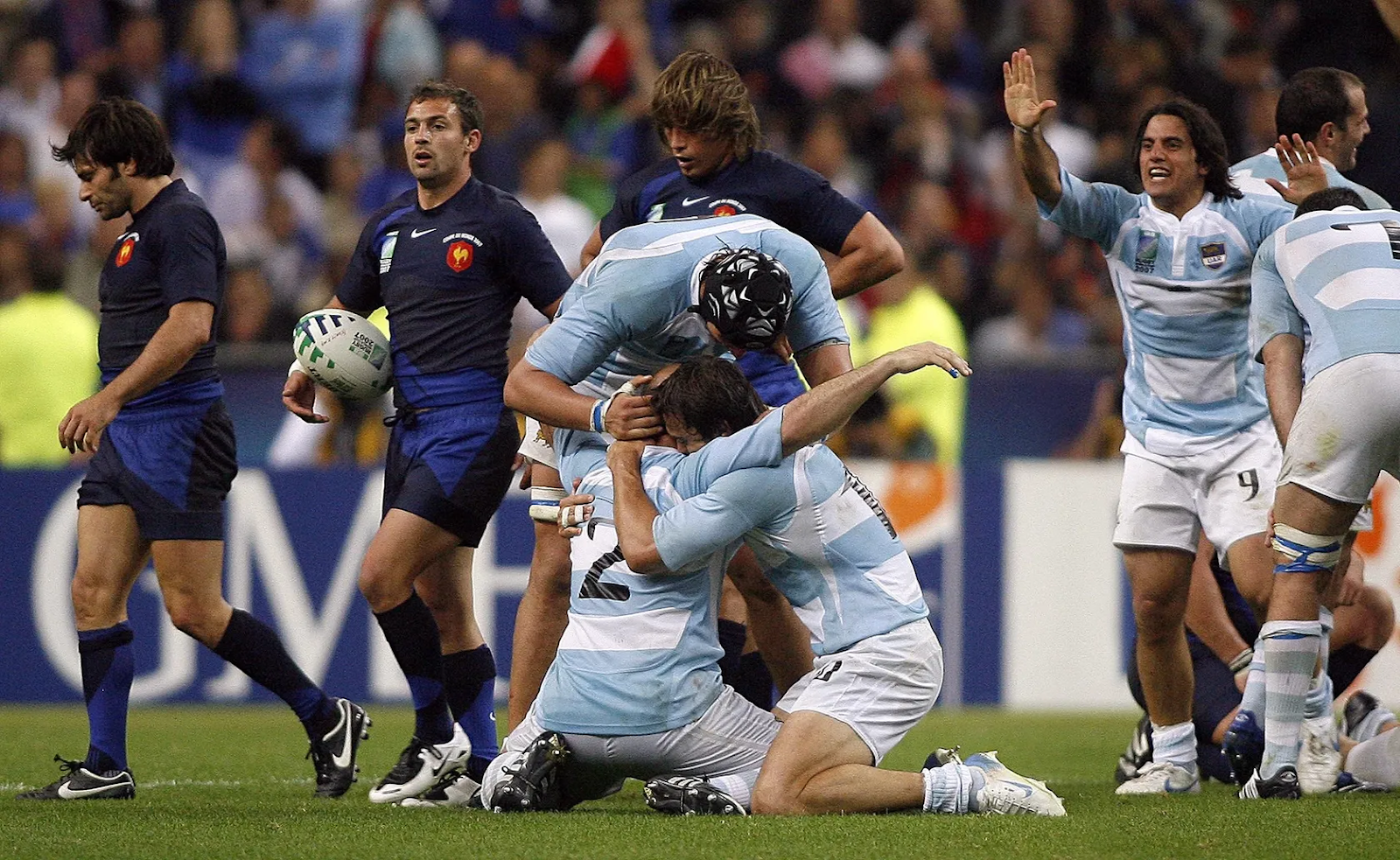
Argentina shock France in the opening game of RWC 2007
That first stage of growth led to the second stage when a more experienced team showed up at RWC 2007 and did even better. In a "pool of death" with #1 and #2 of that year's Six Nations, Los Pumas shocked France in the opening game of their home World Cup, then swept aside Ireland to top the pool, and went onto reach the semi finals and win the bronze medal.

Argentina had achieved some big results before (they had beaten all the Six Nations over that four cycle including an away win at Twickenham). However it was this World Cup that captured the public imagination of the country like never before. It was in this tournament this generation confirmed a legacy for future growth.

This is shown today by how the sport has spread across the country. In 2007, 26 of the 30 man squad were from Buenos Aires. Now 13 of the 23 that beat the All Blacks, and all 7 try scorers in their recent record win over the Wallabies, were from other parts of the country. Both those matches were in the Rugby Championship, where the overdue Argentine inclusion was another legacy from that generation's achievement.

Georgia (2007)

To understand how much Georgian rugby has evolved. It always worth going back to this description from The Guardian of their team at the 2003 World Cup.

There was a buzz of excitement in the Georgia camp last week as they rounded off their final training runs at La Grande Motte on the shores of the Mediterranean in southern France.

At last, the 30 members of Georgia's World Cup squad were to receive their first official piece of equipment: tracksuits, paid for by their coach, the Frenchman Claude Saurel, and the other team officials, who had all chipped in to ensure that the players would have at least one piece of equipment in common before they arrived in Australia.

The former Béziers coach and Languedoc winegrower has also forked out for a video camera, computer and tape machine in an attempt to replicate the sophisticated analysis systems now used by major international teams.

"We are light years behind teams like England or France but we realise there is nothing much we can do about it," confided Gregoire Yachvili, the Georgian flanker whose brother, Dimitri, is the scrum-half for France.

"There is no point in our getting obsessed by the logistical and financial difficulties; we just have to get on and do our best. We might not have any tackle-bags, we have no body armour and we have to borrow a scrum machine, but we've got a ball, we've got a pitch to play on, and two teams of players... What else do you need to train for a game of rugby?"

Even more disastrous for the Georgians has been the ad hoc nature of their build-up. A training camp in the mountains of Georgia and a two-match tour of Canada were reluctantly cancelled in July for financial reasons.

At this point Georgian rugby had almost nothing but got by just from natural talent and predisposition for the rough and tumble of the sport along with the helpful generosity of coach Claude Saurel (who used his contacts to first open the doors for Georgian players to play in France - initially in lower leagues but gradually more in higher teams).
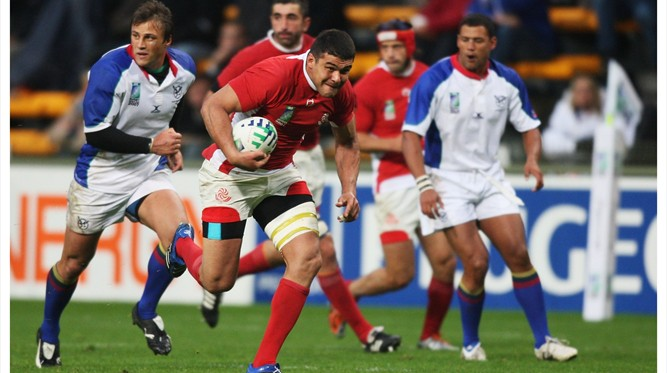
Georgia powering to their first RWC win in 2007
Still going in to RWC 2007 there were reports of only eight pitches in the country. But this tournament was a turning point where they most famously came ever so close beating Ireland (indeed they really should won that match). They were also only 6-3 behind vs Argentina at 45 minutes, and resoundingly recorded their first RWC win 30-0 vs Namibia.

It was after this the Georgian government and politicians took notice and started to support the side. In particular from 2008 the Cartu Foundation started investing heavily in improving infrastructure. This enabled the new generation of young kids inspired by Gorgodze to play the sport to enjoy facilities a world apart from what the earlier players in the 2000s had.

The result is Georgia is now one of the leading producers of young talent outside "Tier 1", and have established themselves as the top side of the REC, with a far stronger, more skilled, and professional group of players many of which now star in Top 14 or Pro D2.

Portugal (2007)

Heading into their first World Cup back in 2007. Portugal were supposed to be the exemplar of a team World Rugby wanted to boot out as they planned to cut the tournament back to 16 teams for 2011.

BBC Sport's tournament preview listed their weaknesses as "pretty much everything" and that "hopefully the mismatches they face will not end in serious injury". In The Guardian veteran BBC radio commentator Iain Robertson argued passionately against their presence at the event stating "there is a serious risk to the physical welfare of the Portuguese players" and "it will be an embarrassment for rugby". This was a commonly repeated sentiment at the time among journalists.

Portugal's passionate anthem singing at RWC 2007
In the end whilst they did suffer the largest defeat of that tournament (108-13 against a ruthless all time great All Blacks team), the team won over many spectators with the passion and heart they showed despite their limitations, and their fans in the stands never stopped cheering for them throughout the match. Every single Portuguese player and staff still reflects back on the match as an amazing experience.

Also despite being given least rest time of any team in the tournament they competed above expectation in other matches. They were only 16-5 down to Italy after 65 minutes before fading and conceding two late tries, and led Romania for 71 minutes before losing 14-10 to another late try.

They defied those predictions of how their matches could be "an embarrassment for rugby" and many fans enjoyed watching them play and now argued in favour of keeping sides like them in the tournament. More importantly, their efforts also led to an immediate surge of interest in the sport at home, with large numbers of more kids turning up to play.

Although in the following years they dropped down the rankings, reaching a low in 2016 with relegation from the REC, the legacy of that 2007 World Cup team lived on. As around 10 years later many of those kids who were inspired to take up the sport around that time became part of the growth of Portuguese youth rugby which started performing well above its senior ranking and nearly reaching promotion to the U20 Championship.

A number of those U20 players from 2017-19 were quickly promoted to the senior team, and along with some added French experience, now form the basis of one of the most exciting young teams on the "Tier 2" scene, and who in the past year have nearly upset Japan, Georgia, Italy, and were within 10 seconds of qualifying directly for the RWC ("nearly" is a word they will be so desperate not to hear again this November in the Repechage). 

Japan (2015)

The interest in Japanese rugby had long dwindled in the modern era. When in 2009 they were awarded hosting rights to the 2019 World Cup, there was some concern about whether they could fill the grounds for all the smaller matches. Unless a "Tier 1" team came to visit (which was rare - Japan did not host them a single "Tier 1" test between 2005 and 2013), crowds were usually very modest for their usual Pacific Nations Cup matches.

The moment that changed Japanese rugby forever
Then everything changed in September 2015 when Japan shocked the world with the biggest upset in World Cup history against the Springboks. After many years of humiliation against the leading teams on the big stage, Japanese rugby became an overnight sensation and interest instantly boomed with the Brave Blossoms matches attracting some huge TV viewing figures.

A hypothetical win over South Africa in a friendly outside the World Cup would have been equally shocking, but the magnitude of the enormous effect it had on the Japanese public was so much more for the result coming at the sport's showpiece event when the entire world's attention on that match.

If you ever play the match of your life and stage a monumental upset. It is always best to do it on the world stage with every rugby fan watching. One huge match at a World Cup can change everything and leave a legacy.

Not everything has necessarily been perfect in capitalising on that success. but regardless the level of interest remains miles above what it was before 2015 and that momentous match in Brighton, and in the end nobody needed to have worried about the World Cup as the Japanese crowd enthusiastically packed every stadium for every match.

The impact of this match (followed by the repeated heroics at their home RWC four years later) could still be felt more further down the road if the increase in young kids inspired to start rugby as a result of it later brings its benefits to senior level.   

Uruguay (2015)

Uruguay's win over Russia in 2014 has ended up
being significant for all of South American rugby
Uruguay reached the World Cup in 1999 and 2003, but it was their return to the tournament after defeating Russia in 2014 that led to major growth and change to the sport in the country. Indeed that match in Montevideo may be one of the most significantly important matches in South American rugby history.

Heading into RWC 2015 they proudly talking of their amateur status. Afterwards, with the unlocked funding and ambition they gained from the tournament, they launched a new era under coach Esteban Meneses.

This involved leading players signing up to a more professional High Performance system and better schedule of matches. Although it was not all plain sailing (they had miserable November tours in 2016 and 2018), they arrived at the 2019 World Cup a far better prepared outfit having qualified without needing to go through the Repechage and beaten all the four national teams in the now defunct Americas Rugby Championship that year.

Los Teros played three of the same opponents (Wales, Australia, Fiji) in 2019 as they did in 2015. In every match they were more competitive than they had been four years earlier. Improving from an 166-27 aggregate score against them to an 107-53 aggregate score. This of course included their all time best ever result with the upset vs Fiji.

That improved level Uruguay showed in 2019 would never have been possible if they hadn't qualified beating Russia in 2014 first. Their success then added to the entire South American rugby ecosystem and with that came another bonus bit of growth as well.

If Uruguay didn't reach RWC 2015 it is far less likely the new South American domestic league SLAR would have launched in 2020, and if that league had not launched it is likely Chile would never have been able to obtain a more professional High Performance system of their own, and without that their defeat of the USA to become the biggest surprise qualifier in recent World Cup history would not have likely been possible. 

USA (1999-2019)

This case is a bit different to all the others mentioned here. USA Rugby is far from at its highest point, and cannot be said to have made the level of progress some may have hoped. There is a good chance they may even not qualify for the World Cup next year.

Would USA's historic win over Scotland have
happened if they had missed RWCs for over 20 years?
However they are still a success story of the World Cup in that it has prevented decline as much as helped growth. To understand this you need to ask yourself a counterfactual. What would the state of USA Rugby look like today if the tournament had never expanded and remained at 16 teams and Canada kept the Eagles out of the event for over 20 years? (2019 was the first time USA beat Canada to take the Americas qualifying spot).

My guess is that they would probably be about several years behind where they are now. The Major League Rugby project would be not yet be in existence. Nor would have they got that historic win over Scotland in 2018. And probably can forget about the plan for them to host the World Cup in 2031. Rugby League may have even seen an opportunity to attempt targeting them as a region where Union was weaker.

(Similarly when looking at Italy in the Six Nations. They may not have been great, but in the counterfactual world where they were ignored by the Five Nations like Romania in the 1980s, they would have likely fallen to the level of a mid-table REC side and had none of the money to invest in improving their youth which now so looks to promising for a brighter future).

Some have hypothesised World Rugby expanded to 20 teams in 1999 to keep the USA involved after were left out for the first time in 1995. There are no direct quotes saying this was the reason, and there were plans in the 2000s to reduce the format to leave them out again, but if it was the reason it was a sensible one. Now there is a speculation among fans if them missing out again in 2023 will lead WR to hurry up and increase to 24 teams for 2027 not 2031.

Conclusion: RWC is the key driver of the sport's growth and must be understood as investment for the FUTURE not the just the present


Nothing else over the past 20 years has been as consistently proven to significantly grow the sport outside the old Five Nations and Tri Nations sides as the World Cup.

The most important lesson to learn though is the Rugby World Cup is about the future as much as the present. This is relevant to today's discussions over potential expansion to a 24 team tournament.

For much of the 2000s there were frequent discussions over mismatches at the tournament. In 2002 the RFU bid for the 2007 World Cup with a plan to cut it down to 16 teams. That failed as France won the bid and kept the 20 team format, but World Rugby again initially planned to reduce the tournament to 16 for 2011.

Portugal vs Georgia this year would have likely been
of a much lower standard if the short termist RFU had
gotten their way and cut them both out of RWC 2007
We can now see just how disastrously short termist those plans were. If the RFU had won that bid and enacted their plan neither Georgia or Portugal would have been at the 2007 World Cup. The investment since 2008 in Georgian rugby simply would not have happened. Some of those kids who took up rugby in Portugal and now are playing such good rugby for the national team may have never picked up the sport.

RWCs also serve as a good arena for talent to get noticed. For example USA vs South Africa match in 2007 launched two successful pro careers. Chris Wyles, who was unattached and on the verge of quitting rugby, got noticed by Eddie Jones and signed by Saracens. Whilst Takudzwa Ngwenya famously scorched Bryan Habana for one of the best tries in RWC history which led to a move to Biarritz. Both players went on to strengthen the Eagles across three World Cups. If RFU had their way none of that would have happened.


Similarly if they reduced to 16 teams Uruguay would have never qualified in 2015. Much of their progress over the next four year cycle would not have been possible, nor the improvements that spilled over to Chile over this four year cycle.

Even some of the sides that did still reach World Cups may have been negatively effected as the entire "Tier 2" global rugby ecosystem would have been weakened. A side like Japan would have still qualified, but their preparation for each tournament would have suffered from several of their opponents having made less progress.

Thankfully improved performances from "Tier 2" in 2007 changed minds on this issue. Not many talk of reducing to 16 teams any more, but now World Rugby remain wary of increasing to 24 teams for same reasons they were constantly thinking of cutting back to 16 in the 2000s.

It is true that total wipeouts are not desirable and you don't want to see too many. But fans and administrators also need to understand short term pain for long term gain. Georgia needed to first play 2003 to be the side that recently thrashed Scotland at U20 level. Portugal needed to play 2007 to be the exciting team they are today. Uruguay needed to first play 2015 to be more competitive in 2019 and Chile needed that to qualify for 2023.

Stories of growth like these are why World Rugby should stop being overly cautious about increasing to 24 teams for the 2027 World Cup. The tournament is the vehicle that has produced most of the sport's growth over the professional era and they have to think about expanding for the potential pay off in the future and not solely focus on the present.

Tuesday, 16 August 2022

Uruguay bafflingly push to qualify for the World Sevens Series

In an unfortunate development for "Tier 2" rugby, recently Scotland, Wales, & England merged their 7s setups into a Great Britain side. This opened up a new spot on the World 7s circuit (although the recent Welsh effort was so weak in 7s they were threatening relegation anyway).

7s is basically rugby's equivalent of 5-a-side football. It is useful reduced format for recreational and amateur participation plus fits nicely into events like the recent Commonwealth Games. However the many games over long weekends across different time zones makes it difficult follow closely year round and severely limits its potential to grow popularity as a spectator sport.

A WR employee acknowledged its limits as a product in a recent interview with Rugby World talking about the need for other attractions and a Darts style atmosphere at the events. At 7s most popular port of call in Hong Kong apparently there is a saying "if you ever get bored of the sevens, you can turn around and watch the rugby".

Despite this WR often push 7s as the key to growing game in "Tier 2" countries. This is partly a patronising Tier 1 effort to excuse some historically weak efforts to grow 15s by fobbing off Tier 2 Unions with the version of the game they don't care about. It is partly a delusional idea that 7s is rugby equivalent of T20 cricket which totally misunderstands the format. It is also partly due to the overly hopeful idea Olympic entry is the golden ticket for growing into a hugely popular global sport (unfortunately this idea is not helped of course by the fact the Olympics outside the big few events are mostly a not particularly popular set of niche sports only noticed once every four years).

In reality though, entry to the 6 months 7s circuit has nearly always been a negative drain on the 15s for most low resource "Tier 2" nations (Fiji is a very notable exception for despite being low in money are extremely resource rich for suitable talent and the 7s game being a rich part of their rugby history).

These nations have tended to end up in a muddle. They sort of follow "Tier 1" in that they don't often play 100% with their best possible talent. But take enough talent that it still takes a few players from the 15s player pool which for those "Tier 2" nations is very small comparative to any "Tier 1". As a result they end up in the undesirable situation of achieving 100% of their potential in neither 15s or 7s.

The biggest example of all here is Canada. But also to various different degrees Samoa, Spain, USA, Portugal, Russia have all ended up somewhat muddled. (Japan keep 7s distant enough from 15s but that has just left them with a virtually pointless bottom of the table side full of 5th tier talent).

More 7s focused nations Germany and Hong Kong

There is plenty of evidence of how having a team on the 7s circuit risks for most "Tier 2" nations only negative effects for 15s with little upside. So well informed Unions on the recent "Challenger 7s" who have not drunken the Kool-Aid the Tier 1 WR were selling to them ought to have known this. The question is what Unions really wanted to take that extra Sevens Series spot the most?

The answer was probably Germany, who are led by a credulous CEO who is one of the very few who believes the comically ludicrous fan statistics that Nielsen Sports produce for WR and uses that as the basis for the nonsensical view 7s is the future of the sport. Since the collapse of Capri Sun sponsored 15s team DRV have targeted 7s. Not the a recommend decision (and now a problem for the expanded REC), but to be fair to the Germans, their policy is at least coherent and not confused in same way as others. They have been clear in going 100% for 7s. Avoiding the trap achieving sub-par potential in both codes.

Hong Kong also target 7s more, even resting some players for their RWC qualifier vs Tonga for this event, and have relatively small 15s schedule. Whilst it also makes more sense for Uganda to push for 7s circuit spot considering African sides also play relatively few matches a year. It would have been better if any of these three had qualified considering none appear to progressing anywhere in 15s anyway so can at least devote 100% effort towards 7s (however if rugby is to ever grow in the Asia and Africa regions though to find a decent 24th RWC team it will take a fully focused 15s effort to do so).

However there is a problem. Germany, Hong Kong, Uganda are all nations of not huge strength in rugby. The RWC sides involved Tonga, Uruguay, Chile, Georgia are all stronger rugby nations with better talent pools. If they really cared enough to pick their best talent to beat them at 7s they all could.

As it happens. Tonga did not care enough. Chile even at home did not care to add many top tier 15s talent either. But Georgia and Uruguay whilst hardly loading their teams with big names to be as strong as possible both decided to field stronger sides with more 15s talent than they usually ever would (neither has cared much for 7s in the past). This talent overcame early adjustments needed for the format enough to beat more focused 7s specialist setups Germany or Hong Kong and reach the final.

Uruguay the winner ... but also the loser
So this final ended up being one where the losing side would win by being spared the confusion and hassle of interrupting 15s resources. In the end Uruguay were the winner .... but also the loser.

You could hardly find a nation more ill advised to start a World 7s Series adventure than Uruguay. They are small nation, with a tiny player pool with few genetic freaks, who have to fully maximise their talent to overachieve and punch well above their weight to compete with bigger nations in 15s.

This makes the Uruguayans drafting in half a dozen young players from their 15s setup (Baltazar Amaya, Felipe Etcheverry, Bautista Basso, Tomas Inciarte, Carlos Deus, Tomas Etcheverry) to achieve qualification an utterly bafflingly daft decision from the Union. If they intend to field this team on the full time 7s circuit then they will have reduced strength in depth from a 15s player pool that has precious little. They would also fall into the 7s trap of not achieving full potential in either code.

If on the otherhand they don't interrupt their 15s player pool, then they just qualified with a stronger team than they actually intended to field on the actual 7s circuit, and will likely be totally uncompetitive with all but the lowest of low effort sides on the circuit which would be utterly pointless.

Either way using 15s players to qualify for World 7s Series was an incredibly unwise move from the URU who had been doing such good work to improve over last five years. You might have thought they could have seen other examples of "Tier 2" nations on the circuit and been warned off. But instead appear to have followed the false 7s cliched myths sold by the sports ignorant "Tier 1" leaders.

Sunday, 15 September 2019

The best players from Tier 2 nations not at RWC 2019

A look at some of the top players who could have represented Tier 2 nations at RWC 2019 but for a variety of different reasons were not named in the final 31 man squads.

Image result for zurab zhvania georgia1. Zurab Zhvania (Georgia)


Reason? Seemed a likely selection as a second/third choice loosehead who could also cover as third choice hooker, but had a fall out with coach Milton Haig who uncharacteristically visibly annoyed at a press conference stated "he just wasn't fit enough" and being in a position of such huge depth in Georgia meant he was deemed dispensable.

Another chance? A late injury withdrawal in 2015, now out for 2019, Zhvania risks being remembered as one of the best players never to play in a RWC. Only 27 so certainly not too old, but Georgia are producing so many prospects at prop it will be tough to make it in 2023.

Other notable absentees:
Loni Uhila (Tonga) a 30 year old uncapped player reported to be a target for Tonga having left Super Rugby but appears to have chosen to remain at his club instead.
Karlen Asieshvili (Georgia) an unlucky late cut who would walk into any other Tier 2 side but missed out following an injury limited season and the rapid rise of Guram Gogichashvili.
Alex Hodgman (Fiji) could have been a possible starter for Fiji at this RWC but neither he or another loosehead target George Bower were available due to NZ Super Rugby contract restrictions.

Image result for elia elia samoa2. Elia Elia (Samoa)


Reason? A young player (who would have been the youngest in Samoa's squad in fact) set for his first RWC, he picked up a hamstring injury in the PNC which ruled him out the tournament.

Another chance? With just two caps over the past two years (neither of them starts), his senior international career cannot be said to have taken off yet as may have been hoped, but still has plenty of time left in his career and could reach at least two more RWCs.

Other notable absentees:
Samisoni Taukei'aho (Tonga) a homegrown Tongan player but again was unavailable (even as the Ikale Tahi had a reported crisis at hooker) in order to keep New Zealand eligibility in Super Rugby.
Badri Alkhazashvili (Georgia) a former U20 captain who led them to the promotion in 2015 and was one Georgia's best young prospects but his senior career hampered by persistent injuries.

Image result for lasha tabidze 3. Lasha Tabidze (Georgia)


Reason? Another former U20 captain long regarded as one of Georgia's best prospects, but in a competitive position Beqa Gigashvili came from nowhere last year to become a certain selection who could cover all of the front row, and his former U20 teammate Giorgi Melikidze got the nod over him for the third tighthead spot.

Another chance? The competition on both sides of the scrum in Georgia is fierce, and all the 2019 squad tightheads should still be around in 2023, plus new prospects like Kharaishvili. So it will not be easy, but Tabidze will be closer to his peak in four years and still has plenty of time to make a RWC.

Other notable absentees:
Mario Sagario (Uruguay) the veteran first choice tighthead for Los Teros retired in May due to off field business commitments which was a big loss for the Uruguayans.
Davit Kubriashvili (Georgia) an old fashioned scrummaging specialist tighthead he missed out to younger, more mobile options and announced his retirement after missing the squad.
Dave Ryan (USA) has no longer been on eligibility dependant contracts for four years now but still never been recalled to a USA squad despite having a lot more experience at a top level than Paul Mullen.

Image result for Grant Hattingh4. Grant Hattingh (Japan)


Reason? Qualified on residency and would have been sure starter Japan at this RWC adding significant height to the second row as their first ever 2 metre plus tall player. However a groin injury suffered in May and a faltering rehabilitation process ruled him out.

Another chance? At 28 Hattingh can certainly still make another RWC, from his quotes it seems he has the desire to do so, and could be a very valuable addition in a weak position for Japan in the 4 year cycle after this tournament.

Other notable absentees:
Samu Manoa (USA) had a very unhappy injury hit time in Cardiff which saw him depart early, returned 6 months later in MLR clearly lacking match fitness, and soon retired from international rugby.
Anton Bresler (Namibia) no longer a Scottish project player since joining Worcester, but still not representing country of his birth who he could have played for at three RWCs at this point.
Brian Alainu'uese (Samoa) the colossal 2.02m 135kg lock still has never got a call up at senior international level but is currently out with a back injury in any case.
Image result for rodrigo capo ortega

5. Rodrigo Capó Ortega (Uruguay)


Reason? He has been an incredibly durable player but 2018/19 turned out to be the most injury hit of his near 400 match 17 season pro career and he was ruled out for 9 months with surgery on a herniated disc last December. He might have possibly made it just back in time for the RWC, but unable to take part in Uruguay's preparation he decided to withdraw.

Another chance? At 38 this was planned to be the farewell in Uruguayan colours for Capó, who will finish his career as a Uruguay great but also one with a mixed relationship with the national team.

Other notable absentees:
Joe Tekori (Samoa) a veteran coming off a successful season with Toulouse, but since the last RWC played sparingly at international level and retired from international rugby before the tournament.
Michael Fatialofa (Samoa) no longer in New Zealand, but like his second row colleague Bresler, has still seemingly not become available since joining Worcester.
Sergei Sergueev (Russia) one of Russia's only three professional players in Western Europe he quite simply has never wanted an international career with all his 5 only caps coming back in 2010.

Image result for jordan taufua 6. Jordan Taufua (Samoa)


Reason? A player who has been on cusp of the All Blacks but who remains uncapped, it seemed when that cap didn't come and a move to Leicester was announced it might open up his availability for Samoa, unfortunately for them though this was not the case.

Another chance? It still is possible Taufua could have a good 5-6 year career for Samoa if he wants, although if he does want that then it's not clear why he would not start by appearing at this RWC.

Other notable absentees:
Renaldo Bothma (Namibia) retired from international rugby on the eve of the final squad being announced, but coach Phil Davies revealed he was simply dropped, with rumours of some falling out.

Image result for giorgi tsutskiridze rugby7. Giorgi Tsutskiridze (Georgia)


Reason? A revelation of these past 12 months for Georgia, but unfortunately suffered a broken ankle in the first few minutes of the first warm up match vs Southern Kings and now is out long term. Even with Gorgodze rejoining the team, this is still a big blow for Georgia and it is very disappointing not to see Tsutskiridze make his mark as part of the 2016 U20 back row trio on the world stage at this RWC.

Another chance? At only 22 he can certainly come again more than once. This is another position Georgia has quite a few young players coming through, so there will be competition, but if he recovers from injury with his pace intact Tsutskiridze adds an extra dimension to some of the others.

Other notable absentees:
Vito Kolelishvili (Georgia) a mainstay of the Lelos who would have reached a third RWC but after suffering repeated heavy concussions not played since October and now taken a sabbatical to recover.
Colby Fainga'a (Tonga) players' player of the season in his first year at Connacht and with 100 Super Rugby caps may have been a good addition for Tonga but possibly now a "project player" in Ireland.

Image result for rahboni warren-vosayaco8. Rahboni Warren-Vosayaco (Japan)


Reason? One of the most dynamic players for the Sunwolves this year, he looked like he could have added to an already impressive list of back rowers for Japan. He was named in the RWC training squad, but then it turned out he fell just short of residency qualifying criteria.

Another chance? If he stays in Japan he could certainly become an international and will be close to his prime in 2023. However there is significant back row competition with other young players like Shota Fukui, Tevita Tatafu, Ben Gunter and the current squad members in contention. Also eligible for Fiji if both parties were interested.

Other notable absentees:
Tevita Tatafu (Japan) starred for Junior Japan with some big performances in the Pacific Challenge, but Jamie Joseph was not considering University players so simply never got a chance ahead of his RWC.
So'oatala Fa'aso'o (Samoa) had a big season for Brive helping them to promotion to the Top 14 but still was ignored by the selectors and yet to make his senior international debut.
Sione Vailanu (Tonga) was overlooked despite a big ball carrying performance in the final game of the PNC against Canada.
Anton Rudoy (Russia) one of the top players for the Bears this RWC cycle and scored a hat trick in a big win vs Canada in his last test in June 2018 but then suddenly disappeared from the international scene.

Image result for folau fakatava9. Folau Fakatava (Tonga)


Reason? A homegrown Tongan prospect, who even represented them in touch rugby as a 15 year old at the 2015 Pacific Games, however he is not available for his home country at least not at this stage of his career so not to lose eligibility for New Zealand. Unfortunately his absence didn't come as any surprise whatsoever.

Another chance? He is just 19 so will certainly get another chance, with the All Blacks obviously getting the first pick, and possibly Tonga if he falls short of that and moves to a pro club Europe.

Other notable absentees:
Will Percillier (Canada) scored some brilliant tries at U20 who made his debut in the ARC earlier this year but somewhat surprisingly never got an opportunity in the PNC.
Image result for Takuya Yamazawa

10. Takuya Yamasawa (Japan)


Reason? A hugely exciting playmaking fly half, well suited to Japan's style of play, who is a star in the Top League offering a lot more threat with ball in hand than Yu Tamura. He was noted by Eddie Jones on departure as the young player who could breakthrough for RWC 2019, however strangely simply never been given a chance by Jamie Joseph who has cited his lack of experience as a reason (although this hasn't stopped him selecting a pair of converted 8s as props despite only playing in the position for a couple of years).

Another chance? Certainly at just 24 he can come again for two more RWCs and still the most likely eventual successor for Tamura. However it feels a wasted past year where he could have gained some experience with the Sunwolves and as part of Japan squads even if not ready to be first choice at a RWC.

Other notable absentees:
Peceli Nacebe (Fiji) was emerging on the selection radar, but had an ill fated year in France where he was moved to wing, whilst Alivereti Veitokani took his Fijian Drua place and thrived to surpass him.

Image result for nemani nadolo montpellier11. Nemani Nadolo (Fiji)


Reason? Announced his international retirement following an injury disrupted season saying he was feeling the wear and tear on his body. He is currently out injured again after requiring knee surgery.

Another chance? This would have been a last RWC for Nadolo, it's a shame as last time his only RWC had the regret of missing a key match whilst on great form as WR at the time went super strict on "neck rolls". Although Fiji have depth to cope with absences at wing more than any other position losing a player with such a strong strike rate is still a blow.

Other notable absentees:
Hosea Saumaki (Tonga) no secret of interest from Japan, but he is not eligible due to 7s caps, and doesn't seem to be going through Olympics loophole, but still not featured in the Tongan squad.
Monty Ioane (Samoa) players' player of the season nominee in the Pro14 for his form with Benetton but not called up by either Samoa or Fiji (who he is both eligible for) and a possible project player for Italy.
Tevita Li (Tonga) the record try scorer in the U20 Championship for New Zealand, but at senior level never entered All Black plans, but still not available for Tonga even though he has now moved to Japan.

Image result for michael little rugby12. Michael Little (Fiji)


Reason? Had an impressive first season of Super Rugby in 2018 with the Sunwolves, which apparently led to some discussions with John McKee, however his 2019 season got cut short to just 5 games due to concussion leaving him with no opportunity to make the squad.

Another chance? He could possibly have one more opportunity to play a RWC in 2023, but there is plenty of competition from both current players and upcoming youngsters like Vilimoni Botitu, and might be helped if he were to move to a club in Europe where most of the Fijian squad is based, or at least a better Japanese club.

Other notable absentees:
Harumichi Tatekawa (Japan) one of the best players of the Eddie Jones era he was a leader for Japan in the first couple years under Jamie Joseph but got axed in 2018.
Willis Halaholo (Tonga) a former Tonga U20 but now waiting as a "project player" to be eligible for Wales who he qualifies for on residency soon after the RWC.
Image result for Yusuke Kajimura

13. Yusuke Kajimura (Japan)


Reason? Another prospect in Japan who had his early career delayed by University rugby. He finally got into the Top League and had an excellent first season where displaced current Japan incumbent Ryoto Nakamura as first choice at Suntory Sungoliath, but a lack of versatility and experience likely cost him a RWC spot.

Another chance? Similar to Yamasawa, he should be a player who could arrive as an important player for the Japan team over the next 4 year cycle and for RWC 2023.

Other notable absentees:
Tumua Manu (Samoa) one of the few homegrown Samoan players currently in Super Rugby he became first choice starter at the Chiefs but again remaining New Zealand eligible took him out of contention.
Joaquín Prada (Uruguay) offered valuable experience and started every game of the successful ARC campaign earlier this year but withdrew as could not get time off from his doctor studies.

14. Sevu Reece (Fiji)

Image result for Sevu Reece
Reason? In May John McKee said Reece "would love to play for Fiji" but for NZ Super Rugby contract restrictions preventing him. However afterwards his form (14 tries in 11 games for Waikato in Mitre10 Cup, 15 tries in 14 games in Super Rugby for Crusaders) continued to be so spectacular he ended up being an All Blacks call up.

Another chance? An exception the title of this article, he is at the RWC just for the All Blacks not Fiji.

Other notable absentees:
Toni Pulu (Tonga or USA) eligible for two Tier 2 nations at this RWC, however spent his entire career in Super Rugby remaining uncapped to keep eligibility for the two Tier 1 nations he is also eligible for.
Akihito Yamada (Japan) still at 33 has a super try scoring rate in the Top League but omitted as Jamie Joseph said he wanted a bigger wingers to deal with aerial bombardments from Ireland and Scotland.
Eroni Sau (Fiji) part of the squad over this past year but got pushed out by Filipo Nakosi, at 29 and with Fiji producing tonnes of talented wingers this was likely his only chance at a RWC.

Image result for Melani Nanai rugby15. Melani Nanai (Samoa)


Reason? Much the same situation as with Taufua. Having left Super Rugby for a European club it seemed this could now possibly free Nanai to play for Samoa but this was not to be. He is a third uncapped player at Worcester eligible for a Tier 2 nation (fourth if you also add Callum Black who withdrew from a USA squad shortly after signing for them last year) who could have made this tournament but hasn't.

Another chance? Only just turned 26 so could play the entire next 4 year cycle for Samoa if he wants, but then if he did want to why wouldn't he start at a RWC?

Other notable absentees:
Seta Tuicuvu (Fiji) an ill timed injury last November robbed of a chance to make a strong case as a starter and got little opportunity in the PNC with Kini Murimurivalu the preferred 15.
Divan Rossouw (Namibia) the only homegrown Namibian player currently in Super Rugby and former U20 player for them but never been named in a senior squad (most likely to eligibility restrictions ...).
Chrysander Botha (Namibia) a regular for Namibia for years and on his way to a third RWC, but was another surprise exclusion of a senior player with the rumours of fall out inside the camp.

Tuesday, 4 December 2018

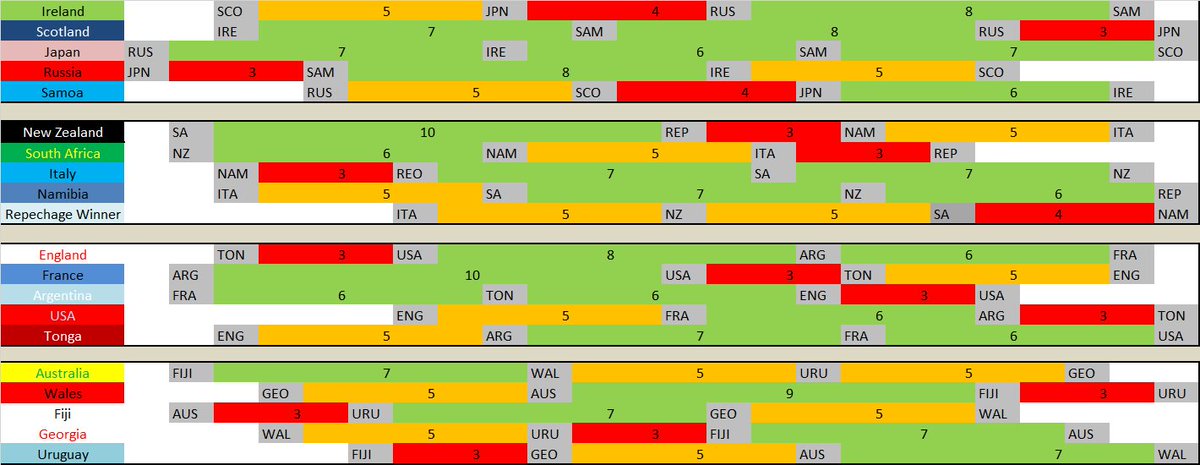
A look at the RWC 2019 schedules for Tier 2 sides

According to WR CEO Brett Gosper the "goal is to have most competitive RWC ever (T1vT2)" and the "2019 schedule is most balanced RWC ever for Tier 2 countries". He also noted it was "the longest ever T2 rest periods are ahead of games vs T1s".
Japan taking on Scotland in 2015 just
three days after playing South Africa

And it is true at the 2019 RWC fewer of the short turnarounds that Tier 2 sides will have to face seem to involve Tier 1 sides which must have come from feedback from coaches after the last RWC.

In 2015 several Tier 2 sides had to back up against two Tier 1 sides on a very short turnaround (Japan vs South Africa then Scotland, Fiji vs England then Australia, Tonga vs Argentina then New Zealand, Romania vs France then Ireland). That would be tough even for bigger teams with more depth to get optimal results against sides like Australia, Ireland, or Scotland only a few days after playing England, France, or South Africa (the short turnarounds for Tier 1 by contrast all mostly involve one of the lowest seeds in the pool usually after rather than before a big game).

This time there are none of those tight turnarounds against top ranked sides in the tournament, but what this means however is more of the matches with short rest for Tier 2 sides are ones that are the two most winnable in the pool. Notably for Uruguay (Fiji then Georgia on three days rest), Georgia (Uruguay then Fiji on three days rest), Russia (Japan then Samoa on three days rest), or USA (Argentina then Tonga on three days rest) are left with squad management dilemmas.

Within the constraints of five team pools that guarantee some short rest periods, and TV demands that mean matches between the big teams are not midweek games, WR do seem to have been genuine in at least attempting at something a bit better relative to past tournaments. Obviously some teams still have got tough schedules (Canada perhaps the worst), and the only real way to be able to remove the worst of the short turnarounds in scheduling is with 4 team pools in an expanded 24 team RWC.

At RWC 2019 one team in each pool (Japan, Namibia, Tonga, Australia) have got lucky with no really short three or four day turnarounds at all and three of those are Tier 2. By comparison in 2015 five teams had no three or four day turnarounds and only one of those (Samoa, who qualified as second pool seed) were not Tier 1. Also no side in 2019 has to play not just one but two of their matches on three or four day turnarounds, whereas in 2015 five teams had to and all of them were Tier 2.

Here we take a quick look at exactly what each Tier 2 team will have to prepare for next year.

Pool A


 Japan | Russia [7 days] Ireland [6 days] Samoa [7 days] Scotland

As hosts of the tournament the Cherry Blossoms get the best schedule of a 6-7 days rest between each match. What's more is that two of their opponents in Samoa and Scotland play them on a short turnaround (although the latter the match before is Russia so may not have that much impact), whilst Russia also play their most winnable match on a short turnaround after playing them.

This is marked change to some of their previous tournaments for Japan. In 2003 they got rest periods of five, four, and three days and notably faded after a decent start to the tournament against Scotland and for part of the match against France. In 2015 the schedule made reaching the quarter finals very difficult even despite the win against South Africa (especially as the Boks got a double losing bonus point in that match). This time if Japan do not perform it will not be to do with their schedule.

 Samoa | Russia [5 days] Scotland [4 days] Japan [6 days] Ireland

Samoa get the advantage of playing Russia on a short three day rest, but then themselves face the hosts Japan on just four days rest from playing Scotland. Even though recent form would have them firm underdogs, they have risen to big occasions in the past and will be targeting that Scotland match, the result of which would likely determine their approach to the Japan match on short rest afterwards.

 Russia | Japan [3 days] Samoa [8 days] Ireland [5 days] Scotland

In the opening match of the tournament with 50,000 fans and a big TV audience, there is no question that Russia will want to kickoff the tournament with nothing less than their best and after this November will believe they could even cause an upset. The Bears don't have enormous squad depth and the next match is their most winnable but on 3 days rest against a fresh Samoa side which will be hard does reduce their chances of getting an upset and first RWC win in this tournament.

Pool B


 Namibia | Italy [5 days] South Africa [7 days] New Zealand [6 days] Canada

If there was ever a tournament Namibia were going to break their RWC duck it is this one as both pool draw and scheduling has been favourable. Unlike the past two RWCs where the Namibians were simply shot by the end (see Wales 2011 or Argentina 2015) after fielding more or less a full team throughout on some really tight turnarounds, this time they get a much better schedule. Not only do they play the big teams on more reasonable rest, but they have also drawn an off form Canadian side and will have full rest for that too, whilst the Canucks will come into that four days from playing South Africa.

 Canada | Italy [5 days] New Zealand [5 days] South Africa [4 days] Namibia

Unluckily for Canada they are the only team in the tournament who do not get a full week rest once. They cannot play the same team throughout and are the team who the schedule makes possibly most likely to field a weakened side against a major team (probably South Africa) in order to keep something left for the most winnable match against Namibia at the end. This is a bad schedule for Kingsley Jones' team, only consolation is two of the Tier 1 opponents Italy (coming off Namibia) and South Africa (coming off Italy) also play them on short rest as well.

Pool C


 USA | England [5 days] France [6 days] Argentina [3 days] Tonga

Some over the course of this year have started to believe the USA have become overwhelming favourites against Tonga at the RWC. A look at their record against them (and Pacific Island opposition in general) would suggest that is not the case, even less so when you consider they play that match on 3 days rest.

The matches against Australia and South Africa in the past two RWCs with weakened teams were horrible matches for Eagles fans and may have even had the effect to sap morale from the camp and supporters as much as it did to rest players. You get the sense Gary Gold may not repeat that this time around and will aim for strong performances both against Argentina and Tonga. It is a tough challenge to deliver and will test the depth and conditioning done for the tournament next year.

 Tonga | England [5 days] Argentina [7 days] France [6 days] USA

Along with Japan and Namibia, Tonga are one of the three lucky Tier 2 sides who have got a schedule with no really short turnarounds. They also play both their final two fixtures against France and USA against sides on three days rest. The Ikale Tahi could not have got a much better schedule and can really target a good result at every match.

Pool D


 Fiji | Australia [3 days] Uruguay [7 days] Georgia [5 days] Wales

This is somewhat better than the nightmare pool draw and schedule Fiji had in 2015. Their match on short rest this time is Uruguay, a team they have recently obliterated and can likely back the depth of their squad to get a good result whilst resting top players. They also get an advantage of coming from that fresh for their next match with Georgia who will be coming off 3 days rest.

 Georgia | Wales [5 days] Uruguay [3 days] Fiji [7 days] Australia

The pool draw for RWC 2019 was not great for Georgia. The fourth pool seeds have a wide range in quality from Fiji at World Ranking 8 to Namibia at 22, and the Lelos not only got the toughest possible fourth seed but a schedule where they face them only on 3 days rest. This is a tricky test for Milton Haig as whilst Georgia will be favourites against Uruguay beforehand, they are not as strong favourites as Fiji are and have a habit of not looking great against weaker teams (see Namibia 2015 one of many examples) so cannot really afford to take Los Teros lightly either.

However Georgia does have a bit more depth than in previous years, so rotating some frontline starters to get past Uruguay may not carry quite the same risk as before. Certainly Haig has two front rows, back rows, and scrum halves he could swap without losing too much. Georgia will need to produce one of their best ever results to beat a fully prepared incredibly talented Fiji team on this schedule.

 Uruguay | Fiji [3 days] Georgia [5 days] Australia [7 days] Wales

The Uruguayans achieved one of their best ever results beating Canada away to qualify as Americas 2 for this tournament and avoid going through the Repechage for the first time. However this has meant they actually got a much more difficult pool to win a game, along with another hard schedule.

Uruguay have their most winnable game against Georgia on 3 days rest from their second most winnable game against Fiji. Only thing in their favour is that Georgia will have to also deal with a tight schedule playing on three days rest themselves after that match. Los Teros need to be at their very best to get good results from this pool, even against the Tier 2 sides, and they do not have great depth in many positions which makes managing the squad much harder for Esteban Meneses.

Full RWC 2019 schedule of rest periods (chart by @rpetty80)

Thursday, 18 February 2016

The benefits of the Americas Rugby Championship

A few thoughts arguing why the concept of the Americas Rugby Championship, despite its lack of star names, will still be of use to those sides involved.

Thursday, 20 August 2015

A brief look at Uruguayan rugby

As Uruguay enter the toughest pool in RWC history, with four top 10 ranked opponents. All they tell the media is how they are amateur, so here is an attempt at a slightly different look at the team.


Wednesday, 1 July 2015

Uruguay and their fixation with amateurism

Uruguay are fixated on telling the world about how amateur they are, often evenexaggerating. But the Teros clinging to that amateurism as a badge of pride is what will prevent any significant progression in the future.

Thursday, 26 June 2014

Friday, 13 June 2014

Tuesday, 1 April 2014

IRB Nations Cup schedule for 2014 confirmed

image

The IRB have confirmed the schedule for the 9th edition IRB Nations Cup, which again will take place at the Arcul de Triumf in Bucharest.

Sunday, 30 March 2014

Roundup: USA vs Uruguay RWC Americas Qualifier Second Leg

image

Report of the second leg of the World Cup qualifying playoff between USA and Uruguay in Atlanta as the Eagles became the 16th team to confirm their place at next year's tournament.

Sunday, 23 March 2014

Roundup: Uruguay vs USA RWC Americas Qualifier

image

Report on the World Cup qualifying playoff from Montevideo where Uruguay nearly pulled off a gigantic upset in front of their home fans.

Friday, 21 March 2014

Team News: RWC Americas Qualifier

image

Team news ahead of the first leg of the World Cup qualifying playoff between Uruguay and USA to decide the Americas 2 spot.