Showing posts with label Rugby World Cup. Show all posts

Wednesday, 21 August 2024

How come World Rugby keep getting the RWC right?


World Rugby finally confirmed this month the Rugby World Cup will expand for the first time since 1999 and increase from 20 to 24 teams in a move that should be welcomed by all who care about growth of the sport.

Now once the tournament comes around you can inevitably expect to hear quite a few complaints from "Tier 1" fans at the presence of a few more less impressive teams and a format where the pool stage poses very little challenge to get through.

Even as a big supporter of expansion, you have to concede these complaints to some extent do have merit. The 24 team format is indeed far from perfectly ideal.

Hopefully there can still remain some excitement in pool stage. Even if there is little jeopardy for any of the top 10 or 12 in advancing, it ought to still be worth coming 1st in a pool rather than 2nd for a more favourable knockout pathway (if Wales for example as 2nd pool seed could upset Ireland to 1st it could get them say Samoa rather than France in the next round).

Meanwhile for sides ranked 13-19 the scramble for the final spots to the last 16 would reliably go to the final day with for them at least with every point being vital for points difference and no dead rubbers. It might not be meaningful for "Tier 1" fans, but for those teams supporters the challenge of getting that one extra match the format may be quite engaging (for instance the idea of Portugal beating Fiji for the prize of reaching the knockout stage, just sounds more of a positive sell than the same game with the prize of just not finishing last in their pool).

However there is a no getting around the fact a cross pool ranking can't possibly avoid being slightly unsatisfactory and unfair due to vagaries of the draw (facing Romania instead of Portugal on their respective 2023 form would be a big advantage for your points difference).

Portugal's win over Fiji in 2023 would probably see them advance to the last 16
knockout stage in a 24 team format rather than merely avoid last in their pool

Also true that in theory top seed (say NZ or SA) could draw the 12th seed (Japan) as next best in their pool, then draw 16th seed in the last 16, so reach the quarter final without any challenge. Not ideal, but should only apply to the very top, for others the format essentially switches what were 2nd place pool deciders in 2023 like SA vs Scotland, Argentina vs Japan, Fiji vs Australia into the last 16 knockout stage instead. So the trade off may be duller start to the tournament for those mostly likely to win it, slightly more exciting for those not.

But the main point to remind those complaining is whilst it is true the format is imperfect, the pros still clearly outweigh the cons next to the alternative status quo 20 team 5 team pool format, which has its own even bigger flaws.

From 1999 to 2019 the RWC involved short turnarounds, which for "Tier 2" sides (who tended to get the bulk of them) meant either fatiguing a full strength team to the detriment of performance, or sacrificing an unwinnable game vs "Tier 1" by fielding a reserve team and getting thrashed by an even larger margin than they would normally in order to rest players for the more winnable game (although this carried its own risk of a damaging morale).

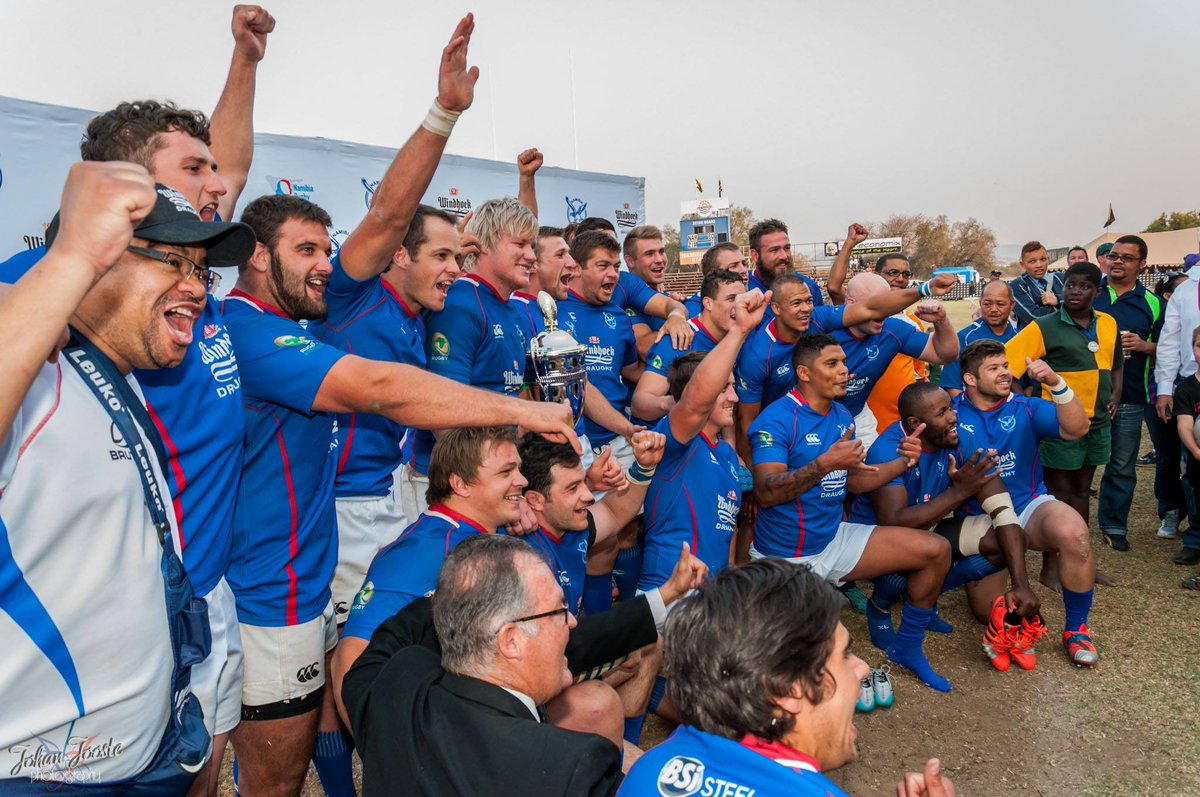
In 2023 WR added a week to avoid short turnarounds (although inexplicably still gave Namibia short turnarounds which resulted in them opting to field a reserve team against France and playing their final match two days before New Zealand even played their third game). Yet this just caused different equally bad problems. A 5 week pool stage becomes far too long and tediously spaced out, with some teams resting two weeks between games, and the tournament loses momentum and festival feel of a steady flow of matches nearly every day throughout the week and becomes more like a regular international weekend schedule.

Some fans can enjoy the minnows, and some of the stories behind them, giving it their all against the top sides, even if it may be restricted to celebrating and cheering on "mini-wins" in moments or passages of games as opposed to actually winning (think Brian Lima's crunching hit on Derick Hougaard in 2003, or Takudzwa Ngwenya's classic try outpacing prime Bryan Habana in 2007, as the most memorable often replayed moments in what were otherwise resounding Springbok wins). 

Although there is no denying a lopsided mismatch is obviously a generally less intriguing game, and when the minnow, like for instance Romania last year or Canada this year vs Scotland, is really underperforming they can turn into quite grim watches for any fan. This is all the more reason to get the very worst performing teams out quicker in just 3 weeks though.
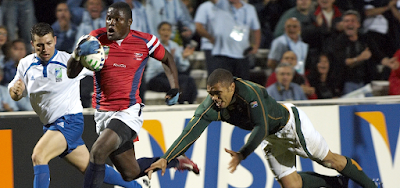
Takudzwa Ngwenya outpaces prime Bryan Habana for the most
memorable moment of an otherwise wide 64-19 Springbok win

So here is what should be said in response to those "Tier 1" fans who will really hate on the 24 team format and the presence of some weaker teams like the African and Asian qualifiers or Repechage winner.

"Okay, you are right the format is not perfect, but just think at least it now can be over and done in just 3 weeks rather than 5 before the big business stage of the tournament can begin. The more condensed pool stage, also means even if there is an unenjoyable mismatch, instead of it being one of your main rugby offerings for the weekend, it will be among 36 pool matches packed in and played nearly every day over those 3 weeks, so can easily be skipped if you choose, or at least easily moved on from as you won't have days to wait for next match".

Of course the "Tier 1" fan might respond that a 16 team format solves 5 team pool issue and with fewer mismatches. This is correct, but the harm to global development (especially with no big continental tournaments between World Cups like football), plus harm to World Rugby revenues from cutting back from a 52 to 32 match format is so significant (that could be maybe 500,000 ticket sales down the drain) the proposal should not be taken seriously.

Cutting the pool stage from 5 to 3 weeks really is a win-win both for "Tier 1" fans who dislike the weaker teams being at the event and also those fans who support and enjoy watching "Tier 2" teams play as well (fortunately latter category includes plenty with the "Tier 2" vs "Tier 2" games in 2023 getting average crowds of 37,454, whilst France vs Uruguay on a Thursday on TF1 had a peak of over 13m viewers more even than any Six Nations game and equal to France's opening Euro 2024 football match vs Austria).

France vs Uruguay at RWC 2023 drew over 13m viewers on a
Thursday evening, more even than any Six Nations game 

It should be more affordable for fans of "Tier 2" teams to travel for all their games. Also for players of "Tier 2" teams as well, it reduces the financial hit on market value to clubs and thus should give a bit of help around availability issues. And whilst the four bottom teams of the 20 team format now play a game less, this really is no loss, often that fourth game for the worst sides with fatigue ends up one too many anyway, and it gets more than offset by opportunity to promote growth in four extra countries who gain three games they never had.

There remain some major disagreements on other points in WR's announcement. For instance playing all qualifiers in 2024-2025, closer in time to the previous World Cup than the next one is too far out (there ought to be a different major mid-RWC cycle event like in football). There is some debate over whether gifting Hong Kong an Asia spot instead of making them qualify as one of the top 24 teams is the best idea (both sides of argument make reasonable points). Also WR has allowed the sport to wither post-pandemic below the top 30 in the rankings so the number of sides involved in qualifiers has nosedived.

All this needs to be addressed later, but considering how often they make terrible decisions around "Tier 2" rugby, it is a relief at least the most important thing in expansion is now done.


This leads to another question; how come World Rugby for the past 25 years keeps getting the Rugby World Cup event (mostly) right?


The expansion of the event is in total contrast to WR blazers attitude and proposals for international rugby in between World Cups which tends to be entirely "Tier 1" establishment focused and generally anti-expansionist (indeed they now risk undermining and watering down the prestige and status of their own biggest success story by essentially staging three World Cup finals in four years thanks to their Tier 1 owned "Nations Championship" plan).

It still actually remains a surprise how the RWC ever got expanded to 20 teams in the first place back in 1999. As it went totally against the anti-expansionist instincts of certain influential "Tier 1" Unions, as displayed by the RFU who spent the following decade pushing hard for it to go back to 16 (only France winning hosting rights stopped that in 2007).

Former RFU CEO Francis Baron spent years pushing for the RWC
to be reduced back down to 16 teams in 2007 in a move that would
have been more characteristic of anti-expansionist idea held by
many of the "Tier 1" blazers who control World Rugby 

Now WR despite initially being reported to only be considering expansion in 2031, which would have been a needless delay and forced us to suffer another 5 week pool stage, wisely brought it forward to 2027. This is a move that again bucks the trend of how "Tier 1" runs just about every other part of the international game in an anti-expansionist way.


More broadly, since expanding to 20 teams in 1999 the RWC as a commercial event has grown bigger just about every tournament (with the exception of the one hosted by smaller New Zealand in 2011). Last year it was the RWC which brought ITV their highest viewing figure of the year with a peak of 8.7m watching the England vs SA semi final. In France TF1 also got their highest viewing figure of the year with a peak of 18.4m watching the quarter final vs SA (the second most watched rugby match ever in France behind only the 2007 RWC semi final vs England). Irish TV also got their highest viewing figure (1.5m) of the year for their quarter final vs NZ. Whilst Japanese TV got 13.8m to watch them play Chile in the middle of the night in their timezone. Overall it was the most viewed rugby event in history with numbers that defy the more gloomy prognostications about the health of the sport and illustrate how the Six Nations anti-expansionist views wastes huge potential for growth of a major Euros event between World Cups.

RWC branding and aesthetics have consistently looked superb
in giving the entire event a special and important feel and vibe 

On the branding and aesthetics front the RWC certainly from 2007 onwards has really looked the part as well. Tidy logos, theme music, travelling fans mixing cultures, packed stadiums for neutral matches, embrace of a now near 40 year history, and an iconic magical looking trophy all combine to make the entire event look and feel special and important even to the less informed casual. Again, this is not something rugby otherwise reliably gets right, compare and contrast with the hyper generic brand and aesthetics of "The Rugby Championship", or the bizarre Anglophone centric "SVNS" rebrand of Rugby Sevens.

Unfortunately though the horrible new slime green coloured clip art looking logo (this is not just speaking from personal taste, you can see the reaction on forums like Reddit, the vast majority of fans consider that logo awful) is a rare aesthetic misstep for the RWC brand that has up until then been so strong. One can only hope that it is very short lived.

Who the heck approved this horrible new RWC logo?!

There is a lot in rugby between World Cups that is poorly run, with a "Tier 1" stranglehold on power offering a lack of vision and ambition, with too many too happy with a very static idea of the sport forever being dominated only by the same handful of nations, which hinders even more growth potential to make the RWC more exciting, competitive, and bigger still.

However it is undeniable that the RWC's growth over the last 25 years is the one thing in modern rugby that has unambiguously been a huge success story. Those who helped the sport get to the right decisions over this period to achieve that success deserve applause.

Some of the good calls on expansion may have been down to a string of luck arriving at the right moments. They were only saved by France winning hosting rights from a terrible decision to go back to 16 teams in 2007. Then narrowly avoided going back to 16 again for 2011 thanks to "Tier 2" performances in 2007 (like Georgia nearly beating Ireland) changing enough minds. It was also by chance Australia hosted a successful women's football World Cup in 2023 which apparently convinced not to delay expansion to 2031. Also, whilst never seen this backed up by insider reports, some have guessed it is no coincidence USA failing to qualify in 1995 and 2023 was followed by expansions to 20 and 24 at subsequent events, which if true Chile's and Portugal's qualification in 2022 was another dose of luck.

Do we have Chile to thank for expansion to 24 teams after they
shockingly came from 19-0 behind to stop USA reaching the RWC? 

Anyway, whatever or whoever deserves credit for the RWC's success, hopefully good luck and fortune continues to shine on this event (especially as it takes its biggest risk yet going to the USA in 2031) and the latest expansion will over time be as vindicated by future growth as the previous one was, and then also maybe one day some of the sport's other tournaments will learn some lessons from it.

Wednesday, 24 August 2022

Six examples of how RWC has powered rugby's global growth

Major changes to the hierarchy of international rugby generally occur at a glacial speed. However it is worth looking at some of the biggest success stories of where increases in growth and popularity have happened outside the "foundation Unions" (made up of the old Five Nations and Tri Nations) from over the past 20 or so years.

A common theme in each of these examples is that every single one illustrates the pivotal role the World Cup has had in driving of the sport's growth and expansion in new areas.   

Argentina (1999 & 2007)

Argentina, just like most of the Five Nations, suffered their record heaviest defeat in the early professional era period (where SANZAR professionalised earlier) when in 1997 an amateur side got thrashed 93-8 by New Zealand. It was obvious mostly amateur players would no longer compete with these teams.

Fortunately though a special generation of Argentines born 1973-77 would all emerge at roughly the same time and form the core of the team for the next three World Cups. (Agustín Pichot, Mario Ledesma, Felipe Contepomi, Rodrigo Roncero, Martín Scelzo, Ignacio Fernández Lobbe, Gonzalo Longo, Diego Albanese, Ignacio Corleto, Manuel Contepomi).

Prior to 1999, Los Pumas had disappointingly only won 1 out 9 of their previous RWC games (vs Italy in 1987). This generation changed that. Upsetting Ireland to reach the quarter finals for the first time and firmly putting Argentine rugby on the world map. In the 18 months or so afterwards, the squad was transformed from only having two or three professional players to nearly an entire team playing at a high level in France or England.

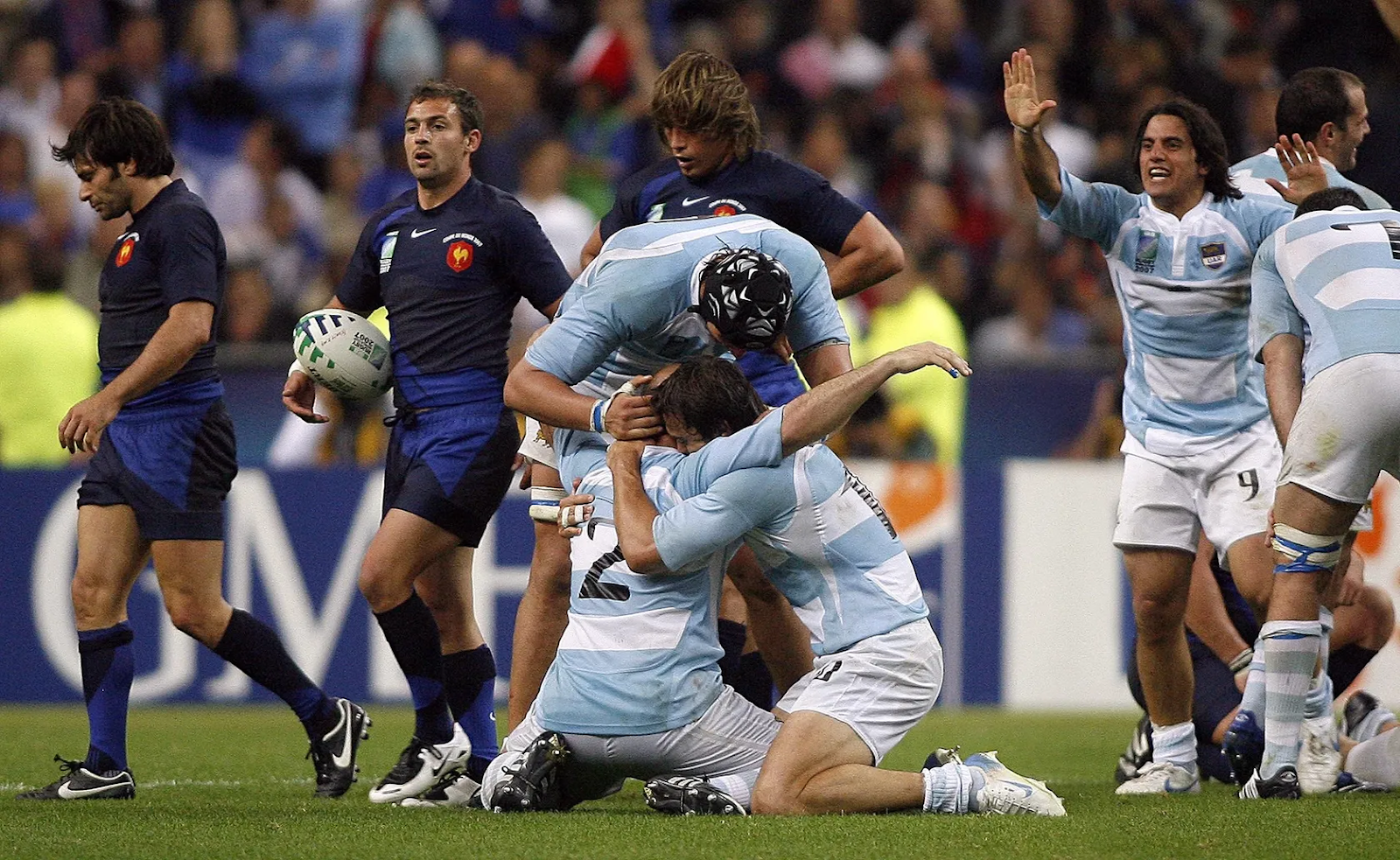
Argentina shock France in the opening game of RWC 2007
That first stage of growth led to the second stage when a more experienced team showed up at RWC 2007 and did even better. In a "pool of death" with #1 and #2 of that year's Six Nations, Los Pumas shocked France in the opening game of their home World Cup, then swept aside Ireland to top the pool, and went onto reach the semi finals and win the bronze medal.

Argentina had achieved some big results before (they had beaten all the Six Nations over that four cycle including an away win at Twickenham). However it was this World Cup that captured the public imagination of the country like never before. It was in this tournament this generation confirmed a legacy for future growth.

This is shown today by how the sport has spread across the country. In 2007, 26 of the 30 man squad were from Buenos Aires. Now 13 of the 23 that beat the All Blacks, and all 7 try scorers in their recent record win over the Wallabies, were from other parts of the country. Both those matches were in the Rugby Championship, where the overdue Argentine inclusion was another legacy from that generation's achievement.

Georgia (2007)

To understand how much Georgian rugby has evolved. It always worth going back to this description from The Guardian of their team at the 2003 World Cup.

There was a buzz of excitement in the Georgia camp last week as they rounded off their final training runs at La Grande Motte on the shores of the Mediterranean in southern France.

At last, the 30 members of Georgia's World Cup squad were to receive their first official piece of equipment: tracksuits, paid for by their coach, the Frenchman Claude Saurel, and the other team officials, who had all chipped in to ensure that the players would have at least one piece of equipment in common before they arrived in Australia.

The former Béziers coach and Languedoc winegrower has also forked out for a video camera, computer and tape machine in an attempt to replicate the sophisticated analysis systems now used by major international teams.

"We are light years behind teams like England or France but we realise there is nothing much we can do about it," confided Gregoire Yachvili, the Georgian flanker whose brother, Dimitri, is the scrum-half for France.

"There is no point in our getting obsessed by the logistical and financial difficulties; we just have to get on and do our best. We might not have any tackle-bags, we have no body armour and we have to borrow a scrum machine, but we've got a ball, we've got a pitch to play on, and two teams of players... What else do you need to train for a game of rugby?"

Even more disastrous for the Georgians has been the ad hoc nature of their build-up. A training camp in the mountains of Georgia and a two-match tour of Canada were reluctantly cancelled in July for financial reasons.

At this point Georgian rugby had almost nothing but got by just from natural talent and predisposition for the rough and tumble of the sport along with the helpful generosity of coach Claude Saurel (who used his contacts to first open the doors for Georgian players to play in France - initially in lower leagues but gradually more in higher teams).

Georgia powering to their first RWC win in 2007
Still going in to RWC 2007 there were reports of only eight pitches in the country. But this tournament was a turning point where they most famously came ever so close beating Ireland (indeed they really should won that match). They were also only 6-3 behind vs Argentina at 45 minutes, and resoundingly recorded their first RWC win 30-0 vs Namibia.

It was after this the Georgian government and politicians took notice and started to support the side. In particular from 2008 the Cartu Foundation started investing heavily in improving infrastructure. This enabled the new generation of young kids inspired by Gorgodze to play the sport to enjoy facilities a world apart from what the earlier players in the 2000s had.

The result is Georgia is now one of the leading producers of young talent outside "Tier 1", and have established themselves as the top side of the REC, with a far stronger, more skilled, and professional group of players many of which now star in Top 14 or Pro D2.

Portugal (2007)

Heading into their first World Cup back in 2007. Portugal were supposed to be the exemplar of a team World Rugby wanted to boot out as they planned to cut the tournament back to 16 teams for 2011.

BBC Sport's tournament preview listed their weaknesses as "pretty much everything" and that "hopefully the mismatches they face will not end in serious injury". In The Guardian veteran BBC radio commentator Iain Robertson argued passionately against their presence at the event stating "there is a serious risk to the physical welfare of the Portuguese players" and "it will be an embarrassment for rugby". This was a commonly repeated sentiment at the time among journalists.

Portugal's passionate anthem singing at RWC 2007
In the end whilst they did suffer the largest defeat of that tournament (108-13 against a ruthless all time great All Blacks team), the team won over many spectators with the passion and heart they showed despite their limitations, and their fans in the stands never stopped cheering for them throughout the match. Every single Portuguese player and staff still reflects back on the match as an amazing experience.

Also despite being given least rest time of any team in the tournament they competed above expectation in other matches. They were only 16-5 down to Italy after 65 minutes before fading and conceding two late tries, and led Romania for 71 minutes before losing 14-10 to another late try.

They defied those predictions of how their matches could be "an embarrassment for rugby" and many fans enjoyed watching them play and now argued in favour of keeping sides like them in the tournament. More importantly, their efforts also led to an immediate surge of interest in the sport at home, with large numbers of more kids turning up to play.

Although in the following years they dropped down the rankings, reaching a low in 2016 with relegation from the REC, the legacy of that 2007 World Cup team lived on. As around 10 years later many of those kids who were inspired to take up the sport around that time became part of the growth of Portuguese youth rugby which started performing well above its senior ranking and nearly reaching promotion to the U20 Championship.

A number of those U20 players from 2017-19 were quickly promoted to the senior team, and along with some added French experience, now form the basis of one of the most exciting young teams on the "Tier 2" scene, and who in the past year have nearly upset Japan, Georgia, Italy, and were within 10 seconds of qualifying directly for the RWC ("nearly" is a word they will be so desperate not to hear again this November in the Repechage). 

Japan (2015)

The interest in Japanese rugby had long dwindled in the modern era. When in 2009 they were awarded hosting rights to the 2019 World Cup, there was some concern about whether they could fill the grounds for all the smaller matches. Unless a "Tier 1" team came to visit (which was rare - Japan did not host them a single "Tier 1" test between 2005 and 2013), crowds were usually very modest for their usual Pacific Nations Cup matches.

The moment that changed Japanese rugby forever
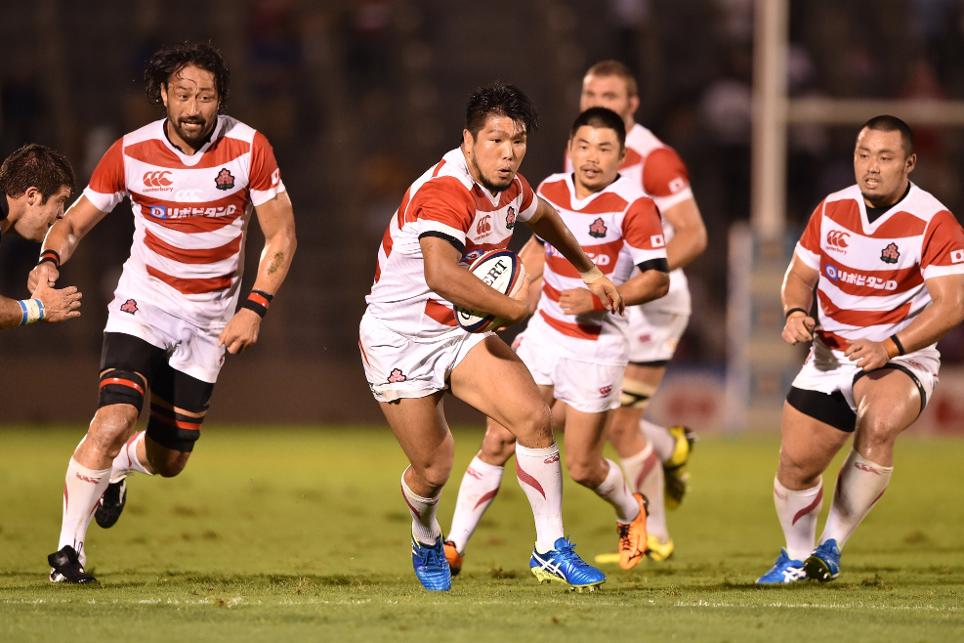
Then everything changed in September 2015 when Japan shocked the world with the biggest upset in World Cup history against the Springboks. After many years of humiliation against the leading teams on the big stage, Japanese rugby became an overnight sensation and interest instantly boomed with the Brave Blossoms matches attracting some huge TV viewing figures.

A hypothetical win over South Africa in a friendly outside the World Cup would have been equally shocking, but the magnitude of the enormous effect it had on the Japanese public was so much more for the result coming at the sport's showpiece event when the entire world's attention on that match.

If you ever play the match of your life and stage a monumental upset. It is always best to do it on the world stage with every rugby fan watching. One huge match at a World Cup can change everything and leave a legacy.

Not everything has necessarily been perfect in capitalising on that success. but regardless the level of interest remains miles above what it was before 2015 and that momentous match in Brighton, and in the end nobody needed to have worried about the World Cup as the Japanese crowd enthusiastically packed every stadium for every match.

The impact of this match (followed by the repeated heroics at their home RWC four years later) could still be felt more further down the road if the increase in young kids inspired to start rugby as a result of it later brings its benefits to senior level.   

Uruguay (2015)

Uruguay's win over Russia in 2014 has ended up
being significant for all of South American rugby
Uruguay reached the World Cup in 1999 and 2003, but it was their return to the tournament after defeating Russia in 2014 that led to major growth and change to the sport in the country. Indeed that match in Montevideo may be one of the most significantly important matches in South American rugby history.

Heading into RWC 2015 they proudly talking of their amateur status. Afterwards, with the unlocked funding and ambition they gained from the tournament, they launched a new era under coach Esteban Meneses.

This involved leading players signing up to a more professional High Performance system and better schedule of matches. Although it was not all plain sailing (they had miserable November tours in 2016 and 2018), they arrived at the 2019 World Cup a far better prepared outfit having qualified without needing to go through the Repechage and beaten all the four national teams in the now defunct Americas Rugby Championship that year.

Los Teros played three of the same opponents (Wales, Australia, Fiji) in 2019 as they did in 2015. In every match they were more competitive than they had been four years earlier. Improving from an 166-27 aggregate score against them to an 107-53 aggregate score. This of course included their all time best ever result with the upset vs Fiji.

That improved level Uruguay showed in 2019 would never have been possible if they hadn't qualified beating Russia in 2014 first. Their success then added to the entire South American rugby ecosystem and with that came another bonus bit of growth as well.

If Uruguay didn't reach RWC 2015 it is far less likely the new South American domestic league SLAR would have launched in 2020, and if that league had not launched it is likely Chile would never have been able to obtain a more professional High Performance system of their own, and without that their defeat of the USA to become the biggest surprise qualifier in recent World Cup history would not have likely been possible. 

USA (1999-2019)

This case is a bit different to all the others mentioned here. USA Rugby is far from at its highest point, and cannot be said to have made the level of progress some may have hoped. There is a good chance they may even not qualify for the World Cup next year.

Would USA's historic win over Scotland have
happened if they had missed RWCs for over 20 years?
However they are still a success story of the World Cup in that it has prevented decline as much as helped growth. To understand this you need to ask yourself a counterfactual. What would the state of USA Rugby look like today if the tournament had never expanded and remained at 16 teams and Canada kept the Eagles out of the event for over 20 years? (2019 was the first time USA beat Canada to take the Americas qualifying spot).

My guess is that they would probably be about several years behind where they are now. The Major League Rugby project would be not yet be in existence. Nor would have they got that historic win over Scotland in 2018. And probably can forget about the plan for them to host the World Cup in 2031. Rugby League may have even seen an opportunity to attempt targeting them as a region where Union was weaker.

(Similarly when looking at Italy in the Six Nations. They may not have been great, but in the counterfactual world where they were ignored by the Five Nations like Romania in the 1980s, they would have likely fallen to the level of a mid-table REC side and had none of the money to invest in improving their youth which now so looks to promising for a brighter future).

Some have hypothesised World Rugby expanded to 20 teams in 1999 to keep the USA involved after were left out for the first time in 1995. There are no direct quotes saying this was the reason, and there were plans in the 2000s to reduce the format to leave them out again, but if it was the reason it was a sensible one. Now there is a speculation among fans if them missing out again in 2023 will lead WR to hurry up and increase to 24 teams for 2027 not 2031.

Conclusion: RWC is the key driver of the sport's growth and must be understood as investment for the FUTURE not the just the present


Nothing else over the past 20 years has been as consistently proven to significantly grow the sport outside the old Five Nations and Tri Nations sides as the World Cup.

The most important lesson to learn though is the Rugby World Cup is about the future as much as the present. This is relevant to today's discussions over potential expansion to a 24 team tournament.

For much of the 2000s there were frequent discussions over mismatches at the tournament. In 2002 the RFU bid for the 2007 World Cup with a plan to cut it down to 16 teams. That failed as France won the bid and kept the 20 team format, but World Rugby again initially planned to reduce the tournament to 16 for 2011.

Portugal vs Georgia this year would have likely been
of a much lower standard if the short termist RFU had
gotten their way and cut them both out of RWC 2007
We can now see just how disastrously short termist those plans were. If the RFU had won that bid and enacted their plan neither Georgia or Portugal would have been at the 2007 World Cup. The investment since 2008 in Georgian rugby simply would not have happened. Some of those kids who took up rugby in Portugal and now are playing such good rugby for the national team may have never picked up the sport.

RWCs also serve as a good arena for talent to get noticed. For example USA vs South Africa match in 2007 launched two successful pro careers. Chris Wyles, who was unattached and on the verge of quitting rugby, got noticed by Eddie Jones and signed by Saracens. Whilst Takudzwa Ngwenya famously scorched Bryan Habana for one of the best tries in RWC history which led to a move to Biarritz. Both players went on to strengthen the Eagles across three World Cups. If RFU had their way none of that would have happened.


Similarly if they reduced to 16 teams Uruguay would have never qualified in 2015. Much of their progress over the next four year cycle would not have been possible, nor the improvements that spilled over to Chile over this four year cycle.

Even some of the sides that did still reach World Cups may have been negatively effected as the entire "Tier 2" global rugby ecosystem would have been weakened. A side like Japan would have still qualified, but their preparation for each tournament would have suffered from several of their opponents having made less progress.

Thankfully improved performances from "Tier 2" in 2007 changed minds on this issue. Not many talk of reducing to 16 teams any more, but now World Rugby remain wary of increasing to 24 teams for same reasons they were constantly thinking of cutting back to 16 in the 2000s.

It is true that total wipeouts are not desirable and you don't want to see too many. But fans and administrators also need to understand short term pain for long term gain. Georgia needed to first play 2003 to be the side that recently thrashed Scotland at U20 level. Portugal needed to play 2007 to be the exciting team they are today. Uruguay needed to first play 2015 to be more competitive in 2019 and Chile needed that to qualify for 2023.

Stories of growth like these are why World Rugby should stop being overly cautious about increasing to 24 teams for the 2027 World Cup. The tournament is the vehicle that has produced most of the sport's growth over the professional era and they have to think about expanding for the potential pay off in the future and not solely focus on the present.

Thursday, 27 September 2018

Thoughts on the possibility of an expanded 24 team Rugby World Cup

Recently World Rugby CEO Brett Gosper mentioned that expanding the RWC to 24 teams is a discussion that is now on the table and could possibly happen by 2023 if progress from lower ranked sides against Tier 1 in 2019 is good enough. Here is a look at what that tournament could look like and why whilst any expansion would add some weaker teams it does have some arguments in its favour.
The RWC trophy on tour in Germany

The possible 24 team RWC format


The current RWC format of 4 pools of 5 teams has been criticised as inherently flawed on the basis that the uneven number of teams in each pool will always mean unequal rest periods.

That has been used as an argument for the 24 team RWC, which could come in either two forms, six pools of four under the 1982 FIFA World Cup format, or the 1986-1994 version which was also used for the recent UEFA Euro 2016.

However both those come with issues as well. The problem with the latter is with 16 teams advancing to the second round it turns the pool stage into somewhat of a non-event. The only intrigue in terms of qualifying would be which of the third pool seeds beat the fourth seeds by enough of a margin to get the requisite points difference to progress. Although other matches perhaps could still maybe carry some importance in the context of securing a better passage to the final.

The 1982 FIFA World Cup format creates a little more tension in the pool stages, and removes the unsatisfactory "lucky points difference winner" element of getting through to the next round, however also comes with problems in its second round phase of matches that act to decide the semi finalists.

A second round format of 12 teams split between 4 pools of 3 would revisit the unequal scheduling issue of an uneven numbers in pool, as well as creating the potential for some dead rubbers at a point when the tournament should be approaching its most important stage.

So really none of these formats in either 20 team or a 24 team RWC are perfectly ideal. The 16 team second round is probably the slightly better of the two 24 team options should expansion happen though.

4 team pool much better for all Tier 2 nations


It has been well documented that some Tier 2 nations despite having the least capable to manage from short 3 or 4 day turnarounds between matches with less depth than the biggest nations have got them the most often. There are numerous cases where this has had a notable effect in different ways.
Image result for Tonga France 2011
The two biggest upsets at the past two
RWCs has seen a Tier 2 side not reach
the quarter final after failing to win a
match off a short 3 day turnaround

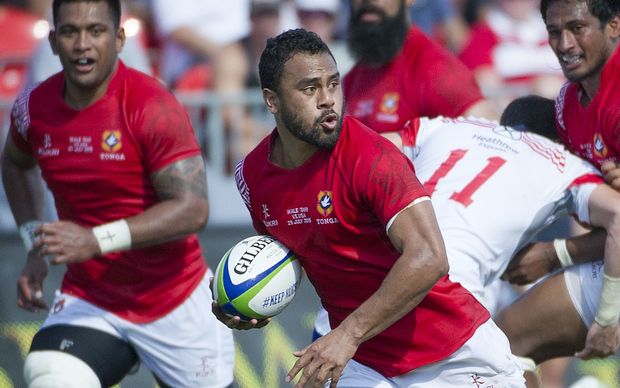
Firstly it has arguably stopped teams reaching the quarter finals. In 2011 Tonga opted to play their strongest team for the tournament opener against New Zealand but then had to play Canada only four days later. They ended up losing that match, so their win later in the tournament against France didn't get them to the quarter finals. It's possible they may have lost that match anyway, but it would have surely helped had they not had to rotate their team for it, whilst the alternative of playing a second string and resting players for the opening match would have kicked the tournament off on a bad note.

Also at that tournament we saw Samoa lose their key match against Wales which they also played off a short turnaround. For that game they had lost two notable starters who took small knocks in their first game against Namibia and may have recovered in a week but not in three days. One of those was particularly crucial in first choice fly half Tusi Pisi, as his replacement Tasesa Lavea had an absolute shocker against Wales. Again it's possible Samoa may not have won anyway, but it would have been different, and they did lead that match past 60 minutes before fading over the last quarter.

Whilst in 2015 we saw Japan's quarter final hopes end against Scotland where they were only 12-10 behind at 45 minutes but faded badly conceding 33 unanswered points over the last 33 minutes. That was especially tough for them as they were not only playing two matches in four days, but two of the top 8 teams within four days, and after such an effort against South Africa it was always going to be tough to have the energy to repeat that again.

We have also seen those turnarounds effect matches in terms of resting players. In previous tournaments Japan had fielded reserves against the big team in their pool in Australia in 2007 and New Zealand in 2011 to rest players for more winnable matches (it's likely most other coaches would have done the same against South Africa in 2015 and we'd have never had that all time classic match).
Image result for Romania England 2011
Some of the most utterly forgettable
RWC matches in recent times such as
Romania vs England in 2011 have been
when Tier 2 teams have fielded second
string sides up against Tier 1 teams

Numerous other teams have done this too. For example Romania fielded reserves against England in 2011, as did the USA against Australia in 2011 and South Africa in 2015 in order to target the next match in three days against a more winnable opponent. In all those cases a match between a Tier 2 nation's second string and a Tier 1 side have been some of the worst and most forgettable of the tournament. Only rarely do you get an exception like Georgia in 2015 who gave a credible effort against New Zealand in spite of resting several players.

Many of those who complain of more blowouts in a 24 team RWC don't understand that whilst there is the potential for that, you would also get the chance to schedule the matches better in a way that reduces some of those sorts of matches as listed above where teams do not put out their best (indeed none of those teams would be likely to still field a second string in any match with points difference playing a role in whether they got to the next round or not).

It also means Tier 2 teams that do achieve an upset a more likely to get to a quarter final from it. In the 24 team format that France vs Tonga result would possibly have come in the last 16 for example.

One less match for the 8 weakest teams also makes sense. It is easier for a team like Namibia for example to put their strongest effort all into three matches. In both the previous RWCs in 2011 and 2015 they have played their best team throughout on a tight schedule and run out of steam by their final match against Wales (especially the second half) or Argentina despite some better earlier efforts. Same also could be said of Uruguay in the second half vs England in 2015, or Georgia vs France in 2007.

Concerns of more blowouts somewhat overblown


As already explained the existing 5 team pool format already lends itself to some larger margins than possible with 4 team pool. Both with matches involving weakened teams like USA vs South Africa 2015 and Romania vs England 2011, or with the weakest team in the tournament Namibia playing their best team on one of the tightest schedules in 2011 and simply having nothing left by the final match.

Any expansion would though obviously be including weaker teams. However the likely four added entrants are not so far off the existing participants that we will necessarily see a return of 12 plus tries conceded in a match. Romania and Spain are the obvious ones who both are ranked in the top 20 teams right now but missing out next year due to eligibility issues.

The next best others are probably one of Brazil, Germany (at least the version not wrecked by political infighting) or Hong Kong who are a step down but with a full two months of preparation should be able to at least match USA's second string effort against South Africa. That admittedly is not particularly great, but the point is that if you account for possibility of reducing those Tier 2 second string matches then there wouldn't be all that many more blowouts in a 24 team competition compared to how many there already are currently in the existing 20 team one as some might expect.
Image result for Fiji rugby 2007
Fiji in 2007 are the only team in the
professional era outside Tier 1 sides to
have reached a RWC quarter final

Really it is the repetitiveness of the quarter final lineup that is more of the problem for the tournament than the bottom end now. In the professional era only Fiji in 2007, who were fortunate enough to run into a Gareth Jenkins coached Wales team, have broken the hold the same 9 Tier 1 sides have had on the last 8 RWC lineup over the professional era. Whilst the list of genuine potential finalists and winners has not exactly increased much over that period either.

Perhaps the strongest argument against a 24 team RWC is that expanding the list of quarter finalists needs to be the focus before expanding the list of qualifiers. Although as also already noted, Samoa and Tonga in 2011, and Japan in 2015 would have had their chances of breaking into that quarter final lineup increased rather than decreased in a evenly pooled 24 team format.

Short term pain for longer term gain


Also we are of course speaking about all this in the present moment. The strongest argument for a 24 team RWC lies in the boost to the sport it would bring to all the new participants over the longer term.
Image result for USA rugby world cup 2007
A classic RWC moment that would have
not happened had the RFU won their bid to
host in 2007 and cut the tournament to 16

For some of the most improved Tier 2 sides in World Rugby that progress is likely to have been significantly slower if they had not benefited from the RWC's last expansion to 20 teams.

If the tournament had always remained at 16 and the USA likely missed out on RWC qualification to Canada for the last 20 years would they have been in a position to finally launch a professional domestic league and take a historic Tier 1 scalp against Scotland this year? It's doubtful. It's also unlikely Georgia would have progressed as fast as they have done without the opportunity to make their initial RWC debut in 2003.

That expansion also cut off the opportunity for Rugby League to get ahead of Union in certain territories. No doubt if the USA had spent the past 20 years outside the RWC then the ground may been riper for League to have had a better chance of trying becoming the more dominant code there. Also potentially in parts of Europe too. That is extremely unlikely to happen now though and it is thanks to the expansion in 1999 to 20 teams. Also if one of Fiji, Samoa, and Tonga always had to miss out every RWC the sport may have faced difficulty than it has in keeping their interest on Union up against League as well.

Whilst it may have added more blowouts especially over the first two or three editions, that move to 20 was clearly a very wise move in the longer term for the global game. Also as a side note rugby history should look back unfavourably on the blazers at the RFU for campaigning for the RWC to be cut back down to 16 teams in 2007.
Image result for uruguay rugby 2015
Uruguay may have lost all their matches
at RWC 2015 by wide margins but from
that appearance have since progressed
significantly both on and off the field

A more recent example of a nation whose progress has been accelerated by a RWC appearance is Uruguay. They were arguably the weakest team at RWC 2015 and got put in the pool of death, but since then rugby in the country has improved both on and off the field and Los Teros will now arrive at RWC 2019 a far more professional outfit and with new a South American professional domestic league on the horizon in the 2020s.

It is not possible to look precisely into the future, but expansion to 24 would potentially bring similar benefits in terms of accelerating the sport's growth in the beneficiaries of that expansion as well even if they were not all impressive on their debut tournament. Those would notably be nations like Germany, Spain, or Brazil who have all beaten regular RWC nations over this 4 year cycle.

What above all brings most improvement to a nation is is more money and participation in the sport's showpiece event would add much more sponsorship, and interest to reach right back down right to the grassroots of the system. Also of course the participation of more countries and growth in audience in those territories would have the potential to bring more money and sponsorship to World Rugby too which is why the move has been mooted in the first place.
Image result for Brasil espana rugby
Brazil and Spain are two potential nations
who would benefit from a 24 team RWC

So should the expanded 24 team RWC happen?


Anyone who cares about the sport's global growth should agree an eventual expansion is desirable at some point, but the debate about when the time is right ultimately comes down to personal judgement. However for what it's worth from my personal point of view the pros of the 24 team RWC (a possibly fairer pool format that allows better performance from Tier 2 sides and a significant boost for the sport's growth in new territories) are hard to ignore and outweighs the cons (a dilution of quality with more teams who have no quarter final hopes and a less exciting pool stage where it is harder to get knocked out than get through) and I lean towards that happening as soon as 2023.

However whilst the sport has perhaps found more teams perhaps becoming more competitive amongst the lower ranked sides at the RWC over this cycle and the qualifying campaign (apart from in Africa) has in general been more competitive than 2013/14. The competitiveness of Tier 2 up against Tier 1 (excluding Italy) and the repetitiveness of quarter final lineups remains something that still needs to be improved upon. That is another topic, but the shut door to all the sport's major tournaments outside of the RWC is a problem and expansion is probably more badly needed there than at the RWC.

Thursday, 17 May 2018

Thoughts on the RWC disqualification of Romania, Spain, & Belgium

Over two months on from the controversial end to the 2018 REC, on Tuesday finally World Rugby confirmed the outcome of their investigation into ineligible players. After the earlier precedent set by Tahiti's disqualification it was one that many had expected as the most likely.

The investigation involved all REC teams involved in RWC qualifying. Although the mostly retaliatory accusation against Russia over former Kazakh international Anton Rudoy was never going to be an issue. He has been in Russia a long time and clearly fulfilled all the necessary criteria to change his allegiance via the Olympic 7s qualifying loophole.

Germany also came under question. It is thought the player involved was former Wales U20 international Jamie Murphy. Whilst the U20s were Wales' second designated team when Murphy played for them in 2009, unlike the case in involving Mathieu Bélie and Bastien Fuster however, in that particular year France's second designated team was "France A", so there were no possible opponents for his eligibility to get locked.
Image result for Victor Paquet
Victor Paquet

The others could not escape though having all clearly fielded ineligible players. Romania with former Tongan 7s player Sione Faka'osilea. Spain with former France U20s Bélie and Fuster. And Belgium with five unnamed players (although at least one is thought to be hooker Victor Paquet) with heritage just from great-grandparents one generation out from what is allowed.

There is a lot of sympathy to be had for the players and fans from Romania and Spain. They have done nothing wrong and seen their goal of reaching the World Cup disappear away from the pitch and all the effort, sacrifice, and work gone into it go to waste. As two teams with squads on the older side for many of their players this was also their last chance to play on the sport's biggest stage.

Unfortunately in both cases the administrators (contrary to the claims made to the investigation) have simply fallen foul of human error and messed up.
Image result for sione faka'osilea
Sione Faka'osilea

The Romanians claimed to have "explained" Regulation 8 to Faka'osilea. The player would surely remembered he played 7s for Tonga so if that were really the case they must have either given a rather shoddy explanation or the player totally misunderstood it.

Romania also claimed to have checked with the Tongan Rugby Union Chairman, and searched ESPN and Wikipedia to find out if Faka'osilea had played for Tonga. This part also seems a bit odd.

Firstly if they needed to check if Faka'osilea had played 7s for Tonga then surely wouldn't the first thing to do be to ask the player himself if he had done so? That would be have provided a better answer than going to two notoriously incomplete and unreliable sources or a Union that is one of the worst in terms of providing information and unable even to run their own website or active social media feed.

Secondly Faka'osilea made his international debut on March 4 last year and his Wikipedia page was only created on March 20. Also ESPN don't have profiles of Romanian SuperLiga players so are unlikely to have had a page on him prior to March either. Thirdly if the FRR had searched Google a bit better they could have found his page on "it's rugby", the article in 2014 from Baia Mare announcing his signing, or an article from 2015 on the blog "Est XV" all of which also noted he was a Tonga 7s international.

In all likelihood it is doubtful Romania actually "explained" Regulation 8 to Faka'osilea at all or went to any lengths to check if he had played 7s for Tonga. All they probably made sure to check was if he had played for Tonga or Tonga A and simply forgot about 7s. Indeed it is not all that surprising they might have forgotten about 7s as the abbreviated form of a game is a complete non entity in Romania.

The report also shows Spain attempted to scramble their way out of disqualification claiming France shouldn't have been able to change their second designated team to France U21 in 2007 to France U20 in 2008 (when World Rugby changed the age of their junior competition) and that the chosen team should have stood for four years.
Image result for mathieu belie bastien fuster
Mathieu Bélie

This was actually quite a clever attempt by the FER to save themselves but this was ultimately rejected by the report. WR had clearly allowed France to change to U20 years ago when U21 got pushed aside. If Spain had indeed studied the rules closely to attempt to find a loophole to field Bélie and Fuster they would have surely checked with World Rugby first.

In reality this was just them desperately looking for anything to try and cover for their oversight. It is not the first they have made eligibility oversights in recent times either. Former France 7s player Fabien Grammatico played for them back in 2015. David Mélé also previously of France 7s very nearly played for them this year as well but for an injury.

World Rugby were obviously correct to judge these were ineligible players. It is hard to see how the appeals that are being launched will have much success in getting more lenient sanctions either.

This is a big shame for both teams, especially Romania who would have certainly been able to qualify without Faka'osilea anyway. Their demise is particularly sad as RWC 2019 was likely to be the last tournament for many of their longest serving players which they have now missed out on through such a needless and unnecessary blunder. Also for the tournament itself it would have been far better to have had the strongest most competitive team possible there.

Whilst Spain would not have got so close to qualifying without their ineligible player Bélie, who was crucial for them at fly half and probably one of their best of all time, they will also probably be genuinely annoyed at how World Rugby has for so long allowed the designated second team to be used so inconsistently in the first place, and at France for designating their U20s.

Next year Los Leones will watch from home a World Cup that will feature dozens of former U20 internationals such as the likes of Nemani Nadolo, Amanaki Mafi, CJ Stander, Chris Vui, Henry Speight, Ross Moriarty, or Brad Shields who now all represent different countries to the ones they did at junior level. In fact over half the teams in the tournament are likely to field such players including even possibly France themselves if they recall Scott Spedding or Noa Nakaitaci.

Spain were just unlucky that the one particular nation which provides them with all their heritage players happened to be one of the few that nominated U20s as their second team.
Image result for Telusa Veainu tonga
Telusa Veainu is one of eight players
in the Tonga squad who would have
been ineligible had New Zealand
designated U20s as a second team

By the way you can be very sure Tonga are incredibly thankful New Zealand never did likewise even though their "Junior All Blacks" team has been inactive even longer than "France A" has been. If New Zealand had nominated their U20s instead then the Ikale Tahi would have lost eight members of their current squad including key players such as Ben Tameifuna and Telusa Veainu.

However whilst many would agree that being able to essentially nominate U20s as your 'A' team to lock eligibility has always been daft and World Rugby were right to belatedly stop that as of this year. The rules nevertheless were still in place and Spain benefited from not following them.

Image result for khatchik vartanov
Russia are unable to call upon
Khatchik Vartanov after his
appearances for France U20
Russia also have heritage players from France tied by U20s as well such as Oyonnax prop Khatchik Vartanov. You would imagine they would have been very keen to select him if he was available especially as he plays in a position where they possess little depth. But the Russians, already stung by their own ineligibility disqualification 15 years ago, followed the rules. Whereas Spain didn't in selecting Bélie, who was one of the most influential players in the tournament and created the match winning try in Krasnodar that all but ended the Bears hopes of reaching the World Cup (or at least had done until this situation arose).

Had there been a more lenient sanction on Spain that didn't involve points deduction it would have been quite unfair on Russia to have missed out thanks to knowing the rules properly. Also especially considering the precedent set in 2003, where the shoe was on the other foot and Russia were disqualified from the RWC for ineligible players and Spain progressed to the next stage of qualifying.

Video: Spain's ineligible player Bélie created the try that all but ended
Russia's chances of reaching the World Cup on the pitch.

Image result for ireland wolfhounds rugby
'A' teams have gradually become
very inactive over this decade
Moving forwards two things should happen as a result of this. Firstly the second designated team concept adds needless confusion and ideally should be scrapped altogether. Nowadays most 'A' teams are highly inactive anyway. Only selection for full national sides not development sides should lock eligibility.

Secondly World Rugby should create an official statistical database of international rugby. Currently most rely upon ESPN Scrum for the records of past matches and players. However their data is riddled with small errors for teams outside Tier 1 and mostly incomplete outside those ranked in the top 20.

Whilst there are hardly any sites to search for historical data on 7s matches and players at all (it is impossible to find out for example the precise number of matches and tries Rupeni Caucaunibuca scored for Fiji at 7s). If WR were to create an official statistical database it would not only help in cases like this for Unions to check a player's eligibility easily and efficiently, but it would also be good for fans looking for accurate information on the records of players outside Tier 1.

This situation has been a regrettable one and it is good to at last have the decision out of the way. Although the fall out from this will still probably keep rumbling on for the next year or so. There are still appeals from Spain and Romania to be heard. Next year's REC may feature a number of match ups that involve a lot more bitterness between the teams than usual. And Russia's appearance at the RWC next year will carry an asterisk alongside it as a fluke that was not earned on the pitch especially if they fail to make the best of it. Hopefully none of this will ever be allowed to happen again.

Thursday, 17 September 2015

RWC Preview: Namibia

Embedded image permalink

A short look at Namibia's preparation and build up and squad for the tournament, as they hope just to limit the heaviness of defeat they suffer.


Wednesday, 16 September 2015

RWC Preview: Georgia

Talismanic Mamuka Gorgodze is 'key to Georgia’s RWC 2019 campaign'A short look at Georgia's preparation and build up and squad for the tournament, as they hope to trump Tonga and qualify automatically for 2019.

RWC Preview: Japan

We want to inject fear into Springboks, says Japan's Hitoshi OnoA short look at Japan's preparation, build up and squad for the tournament, as they hope to improve their damaged reputation, and win a World Cup game for the first time in 24 years.


RWC Preview: Romania


A short look at Romania's preparation, build up and squad for the tournament, as they hope to continue their success against Canada, and finally beat Italy.

RWC Preview: Tonga

All Blacks fan Telusa Veainu embraces his Tongan rootsA short look at Tonga's preparation, build up and squad for the tournament, as they look to repeat another major upset achieved in 2011.

RWC Preview: Fiji

European experience gives Flying Fijians confidence

A short look at Fiji's preparation, build up and squad for the tournament, as they head into a pool of death with three of the world's top 6 sides.

RWC Preview: Samoa

Samoa's Tim Nanai-Williams confident his gamble will pay offA short look at Samoa's preparation and build up and squad for the tournament, as they look to reach the quarter finals for the first time in the professional era.

Friday, 11 September 2015

The issues of the 20 team World Cup format

A question as to whether the scheduling, that has often made it difficult particularly for Tier 2 sides with less depth, detracts from the Rugby World Cup, and whether fans may feel ripped off if they knew that some games had teams not picking their strongest XV.

Saturday, 19 July 2014

Debate: What's the best approach to Japan's RWC dilemma?

image

Japan will be hoping to cause an upset at the next World Cup, but the scheduling of their opening 2 matches leaves them a bit of a dilemma of how best to approach the tournament.

Sunday, 30 March 2014

Roundup: USA vs Uruguay RWC Americas Qualifier Second Leg

image

Report of the second leg of the World Cup qualifying playoff between USA and Uruguay in Atlanta as the Eagles became the 16th team to confirm their place at next year's tournament.

Sunday, 23 March 2014

Roundup: Uruguay vs USA RWC Americas Qualifier

image

Report on the World Cup qualifying playoff from Montevideo where Uruguay nearly pulled off a gigantic upset in front of their home fans.